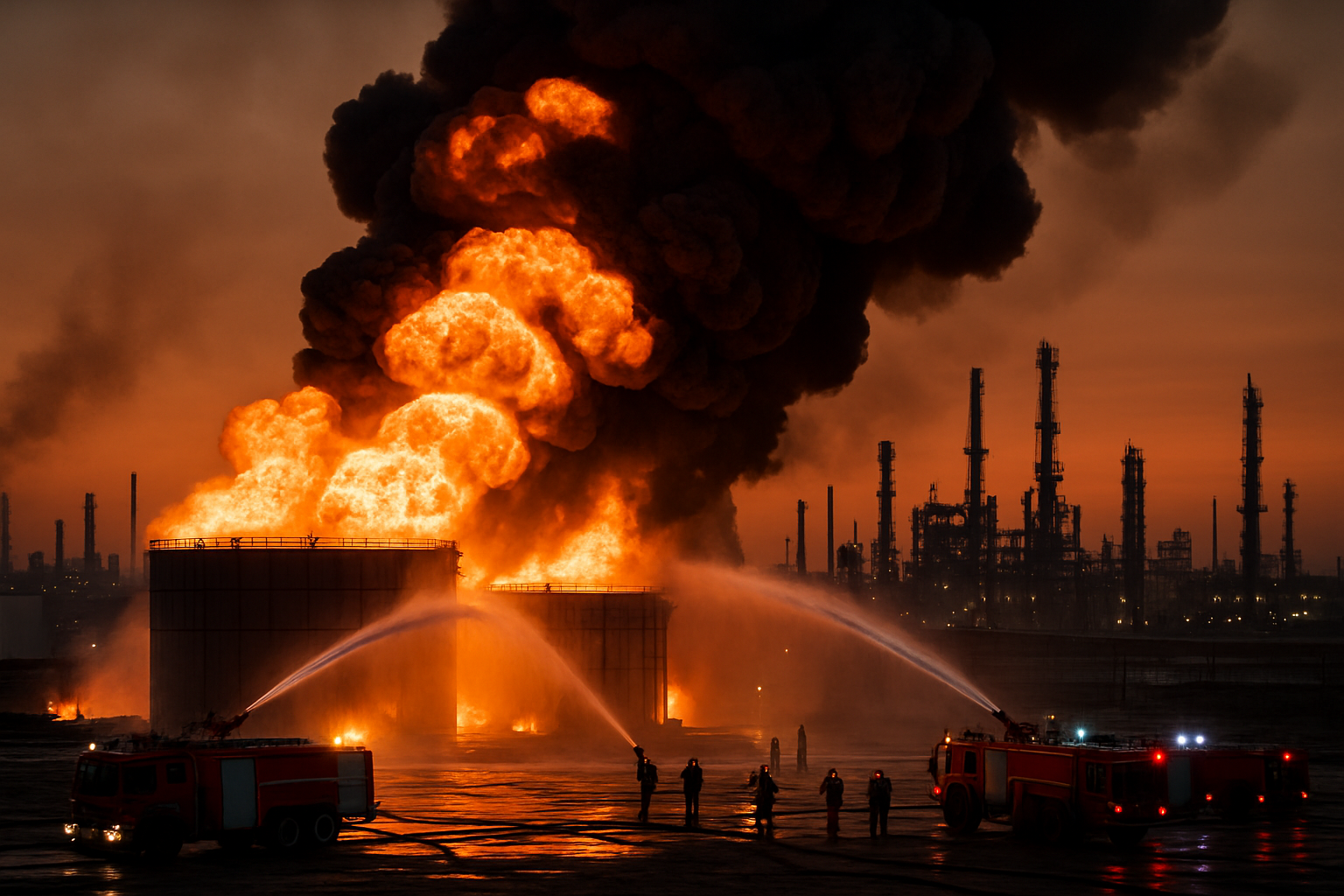
A massive fire erupted at a major oil complex in Kuwait's Shuwaikh industrial area following coordinated drone attacks early Sunday, authorities confirmed, as the Gulf state continues to face systematic targeting amid the ongoing regional crisis.
Kuwait Petroleum Corporation (KPC) announced that a fire broke out at the oil sector complex in Shuwaikh after what officials described as an "assault by drones." The corporation emphasized that no human casualties were recorded during the incident, which prompted an immediate emergency response from multiple agencies.
Emergency Response and Containment
Emergency response teams, including Fire Force units, Army personnel, National Guard forces, and oil sector specialists, immediately mobilized to contain the blaze. KPC confirmed that emergency and firefighting teams began dealing with the fire immediately upon its outbreak.
The rapid deployment of multiple emergency services demonstrates the severity of the incident and Kuwait's preparedness for such attacks, which have become increasingly common as part of Iran's "Operation True Promise 4" campaign targeting regional energy infrastructure.
Regional Context and Escalation
The attack on Kuwait's oil complex represents the latest in a series of systematic strikes targeting Gulf energy infrastructure since the Iran-US conflict began in March 2026. The incident follows a pattern of precision targeting that has characterized Iranian retaliation operations across the region.
"Kuwait Petroleum Corporation confirms that emergency and firefighting teams immediately began dealing with the fire that broke out following the drone assault."
— Kuwait Petroleum Corporation Statement
This attack comes as Kuwait has repeatedly found itself in the crosshairs of Iranian forces. Previous incidents have included strikes on Kuwait International Airport, resulting in 32 injuries, and attacks on the Mina al-Ahmadi refinery facility, which handles significant petroleum processing capacity.
Strategic Targeting Pattern
The Shuwaikh industrial complex represents a significant economic and strategic target. The area houses critical oil infrastructure that supports Kuwait's position as a major petroleum exporter. The precision nature of the drone attack suggests sophisticated intelligence gathering and operational planning.
Military analysts note that Iran's Revolutionary Guard has demonstrated remarkable accuracy in targeting specific industrial facilities while generally avoiding mass civilian casualties – a calculated approach designed to apply economic pressure without triggering broader international intervention.
Regional Coalition Under Pressure
The attack further strains the regional coalition of Saudi Arabia, UAE, Qatar, and Egypt that has attempted to maintain diplomatic solutions to the crisis. Kuwait's targeting represents a direct challenge to Gulf Cooperation Council unity and demonstrates Iran's willingness to expand attacks beyond initial military targets.
Egyptian President Abdel Fattah al-Sisi has repeatedly condemned attacks on what he terms "sisterly Arab countries," warning of "comprehensive chaos" if the targeting continues. The systematic nature of strikes across multiple Gulf states has severely tested regional diplomatic consensus.
Global Energy Security Implications
The Kuwait oil complex fire occurs against the backdrop of the most severe global energy crisis since the 1970s oil shocks. Iran's closure of the Strait of Hormuz has blocked 40% of global seaborne oil transit, with oil prices having surged past $100 per barrel for the first time since 2022.
Kuwait's oil infrastructure represents a crucial component of global energy supply chains. Any sustained damage to processing facilities could exacerbate existing supply shortages that have already triggered the International Energy Agency's largest strategic petroleum reserve release in 50-year history – 400 million barrels from 32 countries.
Aviation and Transportation Impact
The ongoing crisis has created unprecedented disruption to transportation networks. Over 18,000 flights have been cancelled worldwide – the most extensive aviation crisis since COVID-19. Eight countries maintain simultaneous airspace closures, creating what aviation experts describe as an "aviation black hole" severing critical Europe-Asia corridors.
Kuwait has been forced to relocate Jazeera Airways operations to Saudi Arabia due to repeated targeting of aviation infrastructure, demonstrating the far-reaching impact of the attacks on civilian transportation.
Economic and Consumer Impacts
The wider crisis has triggered severe consumer impacts globally. Bangladesh has implemented fuel rationing for 170 million people, while Pakistan has instituted wartime austerity measures including four-day work weeks. In Europe, natural gas prices have surged 24%, reaching the highest levels since February 2025.
Financial markets continue to experience extreme volatility, with major indices posting record declines. The uncertainty surrounding Gulf energy infrastructure has prompted central banks to coordinate emergency liquidity measures to prevent broader economic contagion.
Nuclear Diplomacy Breakdown
The attacks occur amid the complete breakdown of nuclear diplomacy between the United States and Iran. Despite achieving a "broad agreement on guiding principles" in Geneva talks – the most progress since the 2018 JCPOA collapse – fundamental disagreements over Iran's ballistic missile program and regional proxy activities proved insurmountable.
Iran continues uranium enrichment at 60% purity with over 400kg of weapons-grade material, sufficient for multiple nuclear weapons. The crisis has coincided with the expiration of the New START treaty between the US and Russia, creating the first 50+ year period without nuclear arms constraints between the superpowers.
International Response and Evacuations
The escalating crisis has prompted the largest international evacuations since the Arab Spring in 2011. Australia has 115,000 nationals trapped in the region, while Germany is evacuating 30,000 stranded tourists. The European Union activated its ESTIA crisis mechanism for the first time in bloc history following Iranian drone strikes on RAF Akrotiri in Cyprus – the first attack on European territory since World War II.
Looking Ahead
The Kuwait oil complex fire represents another escalation in what UN Secretary-General António Guterres has called "the greatest test of multilateral cooperation in the modern era." The systematic targeting of energy infrastructure across multiple Gulf states suggests Iran's commitment to maintaining pressure through economic warfare rather than direct military confrontation.
Recovery timelines remain uncertain, dependent on military and diplomatic resolution rather than predictable factors like weather disruptions. The crisis has exposed dangerous over-dependence on strategic chokepoints and critical infrastructure that may require fundamental restructuring of global energy security architecture.
As emergency teams continue to monitor the situation in Shuwaikh, the incident serves as another stark reminder of the region's vulnerability to asymmetric warfare tactics and the far-reaching global implications of Middle Eastern instability in an interconnected world economy.