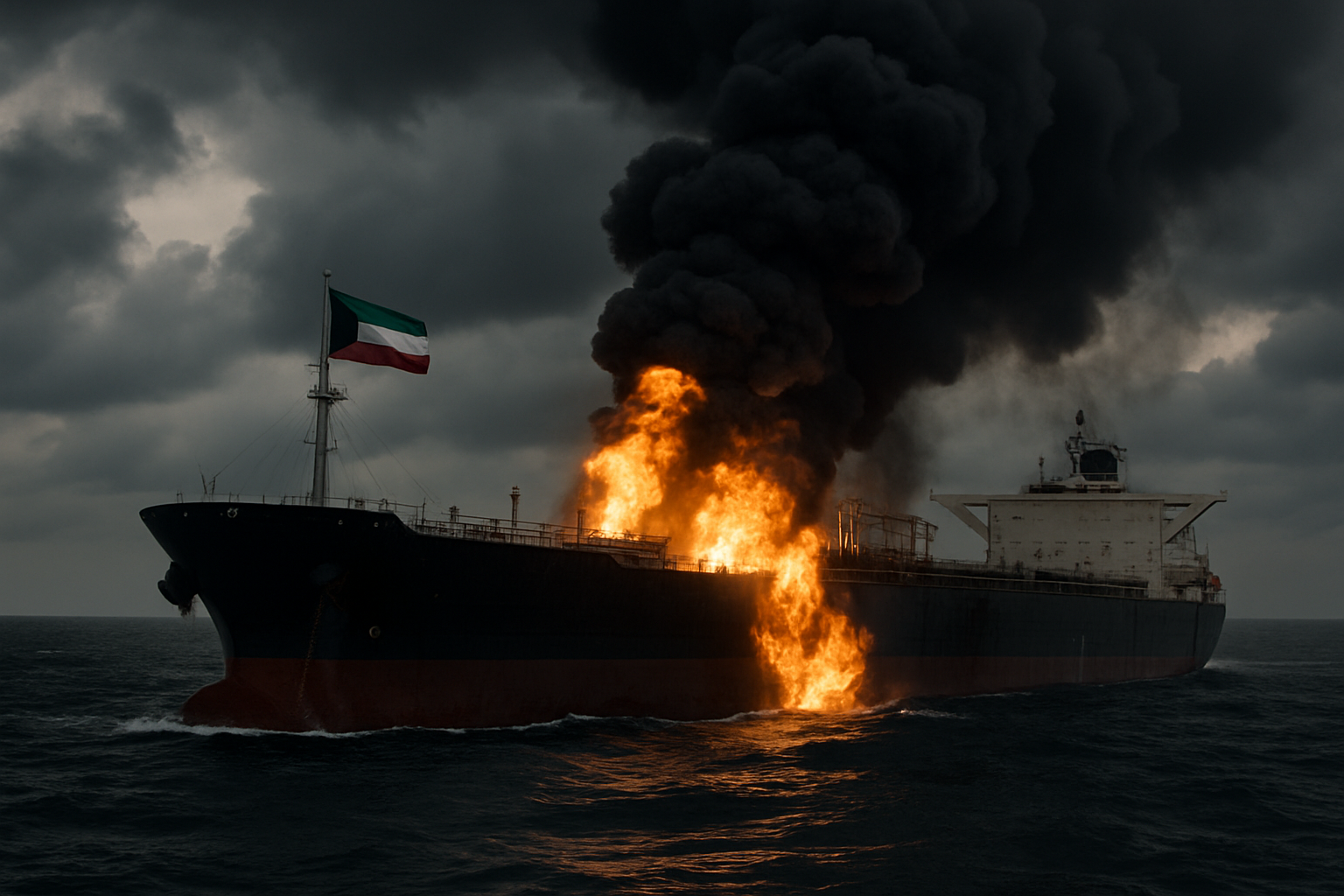
Iranian forces targeted the Kuwait-flagged oil tanker Al-Salmi with drone strikes while the vessel was anchored off Dubai in UAE waters, marking a dangerous escalation of attacks on critical energy infrastructure amid the ongoing Middle East crisis that has already disrupted global oil markets and shipping routes.
The attack on March 31, 2026, occurred at approximately 12:10 AM local time when the fully loaded crude oil tanker was positioned in the Al-Mukhatif area outside Dubai port. According to Kuwait Petroleum Corporation (KPC), the crew successfully extinguished the resulting fire by 4:26 AM Kuwait time, following emergency protocols coordinated with UAE authorities.
Swift Response Prevents Environmental Disaster
All 24 crew members aboard the Al-Salmi emerged unharmed from the incident, with Dubai authorities confirming no oil spillage occurred despite the severity of the attack. The successful containment effort prevented what could have been a major environmental catastrophe in one of the world's busiest shipping corridors.
"The crew dealt immediately with the fire and succeeded in controlling and extinguishing it according to instructions and guidelines from the Corporation's management and crisis management team," KPC stated in an official release to the Kuwait News Agency (KUNA).
UAE officials worked closely with the tanker's crisis management team to assess damages and coordinate the emergency response. Dubai's specialized response teams successfully concluded their operations without recording any casualties or environmental impact, according to the Dubai Government Media Office.
Regional Context: Escalating Maritime Warfare
The attack on the Al-Salmi represents Iran's continued strategy of targeting energy infrastructure as part of "Operation True Promise 4," the Islamic Republic's systematic retaliation campaign following the U.S.-Israeli "Operation Epic Fury" strikes launched in early March.
"Iran attacked and set ablaze a fully loaded crude oil tanker off Dubai early Tuesday. The strike on the Kuwait-flagged Al-Salmi is the latest in a string of assaults on merchant vessels by missiles or explosive air and sea drones in the Gulf and Strait of Hormuz."
— Saudi Gazette Report
Iran's Revolutionary Guard has declared "no red lines remain" in targeting vessels associated with countries supporting U.S. and Israeli operations. The Al-Salmi attack occurred as the tanker was struck 31 nautical miles northwest of Dubai, according to UK maritime authorities tracking the incident.
Global Energy Crisis Context
This latest attack comes as global energy markets face their most severe crisis since the 1970s oil shocks. Iran's Revolutionary Guard has effectively closed the Strait of Hormuz to commercial shipping, blocking 40% of global seaborne oil transit through the critical 21-mile waterway.
The crisis has triggered unprecedented international responses, including the largest strategic petroleum reserve release in history. The International Energy Agency (IEA) coordinated the release of 400 million barrels from 32 member countries, more than double the 182.7 million barrels released during the 2022 Ukraine crisis.
Oil prices have surged past $100 per barrel for the first time since 2022, with Brent crude reaching peaks of $119.50 and West Texas Intermediate jumping 18.98% to $108.15 in record single-day increases. Natural gas prices have exploded by 24% in Europe and 78% in the United States.
Shipping Industry Under Siege
Major shipping companies including Maersk and MSC have suspended all Persian Gulf operations, leaving more than 150 oil and LNG tankers stranded in the region with billions of dollars worth of cargo. The shipping crisis extends beyond energy, affecting global supply chains dependent on Gulf logistics networks for automotive, electronics, and textile manufacturing.
Iran has deployed an estimated 2,000-6,000 naval mines throughout the Strait of Hormuz, forcing U.S. naval forces to destroy 28 Iranian mine-laying vessels in response. The waterway's designation as "unsafe for shipping" has created a single-point failure in modern global logistics with no realistic alternative routes.
Aviation Crisis Compounds Transportation Disruptions
Parallel to the maritime crisis, the aviation industry faces its most extensive disruption since the COVID-19 pandemic. More than 18,000 flights have been cancelled worldwide as eight Middle Eastern countries—Iran, Iraq, Israel, UAE, Qatar, Syria, Kuwait, and Bahrain—maintain simultaneous airspace closures.
Dubai International Airport, the world's busiest with 86 million annual passengers, remains completely shut down after sustaining missile damage during Iranian retaliation strikes. Major carriers including Emirates, Air France-KLM, Wizz Air, and Bulgaria Air have suspended operations indefinitely, affecting hundreds of thousands of passengers globally.
Regional Coalition Under Strain
The attack on the Kuwaiti tanker further strains an unprecedented regional coalition that had emerged to support diplomatic solutions to the crisis. Saudi Arabia, UAE, Qatar, and Egypt had formed an unusual consensus supporting negotiated resolution, but Iranian attacks on member territories are testing these relationships.
The UAE reported one civilian killed in Abu Dhabi from drone debris, while Kuwait suffered 32 injured foreign nationals in airport strikes. Qatar intercepted 65 missiles and 12 drones using Patriot defense systems, with eight people injured by fragments. Egyptian President Abdel Fattah El-Sisi condemned attacks on "sisterly Arab countries" and warned of "comprehensive chaos" spreading across the region.
Economic and Consumer Impacts
The energy crisis has triggered severe consumer impacts worldwide. Bangladesh has implemented fuel rationing for 170 million people, while Pakistan faces its highest fuel costs in South Asia at Rs321.17 per liter, forcing the government to implement wartime austerity measures including four-day work weeks.
European markets show dramatic increases, with Swedish electricity up 10-20 öre and gasoline up 1-2 kronor, particularly affecting the Malmö region due to continental market integration. Ireland faces heating oil approaching €2 per liter, while Austria reports fuel costs up 20% due to "war-driven explosions" in energy markets.
Financial markets have crashed globally, with Pakistan's KSE-100 index falling 8.97% in the largest single-day decline in the exchange's history. South Korea's KOSPI dropped 12%, triggering circuit breakers as the Korean won hit a 17-year low. Central banks including the ECB and Bank of Japan are coordinating emergency liquidity measures to prevent contagion.
Nuclear Diplomacy Breakdown
The maritime attacks occur against the backdrop of completely collapsed nuclear negotiations between the United States and Iran. Despite achieving what negotiators called "broad agreement on guiding principles" in Geneva talks—representing the most progress since the 2018 JCPOA collapse—fundamental scope disagreements proved insurmountable.
Iran insisted on nuclear-only discussions while excluding ballistic missiles and proxy groups as "red lines," while the U.S. demanded comprehensive agreements covering missiles, armed groups, and human rights issues. Iran continues enriching uranium to 60% purity with more than 400kg of weapons-grade material—sufficient for multiple nuclear weapons if weaponized.
The diplomatic breakdown coincided with the expiration of the New START Treaty in February 2026, creating the first 50+ year gap without U.S.-Russia nuclear constraints and raising nuclear governance risks to their "highest level in decades," according to UN Secretary-General António Guterres.
International Response and Evacuations
The crisis has triggered the largest international evacuation operations since the Arab Spring of 2011. Australia has 115,000 nationals trapped in the region, while Germany is evacuating 30,000 tourists. Cyprus activated its ESTIA national evacuation plan for the first time in the nation's history following Iranian drone strikes on RAF Akrotiri—the first attack on European territory since World War II.
Multiple countries have closed embassies and ordered immediate evacuations, with Sweden and Serbia ordering citizens to leave Iran citing "extremely uncertain" security conditions. The U.S. has closed its Kuwait embassy indefinitely and evacuated non-essential personnel from 15 Middle Eastern countries.
Energy Architecture Vulnerabilities Exposed
The crisis has exposed dangerous over-dependence on strategic chokepoints in global energy architecture. The 21-mile Strait of Hormuz represents a single-point failure for modern logistics, with the Persian Gulf serving as a critical trade hub affecting not just energy but consumer goods and industrial materials worldwide.
Qatar Energy Minister Saad Al Kaabi warned that Gulf states may be forced to declare force majeure "within weeks" if the conflict continues, with oil prices potentially reaching $150 per barrel—levels that could "bring down the economies of the world." The crisis highlights the urgent need for supply diversification and accelerated transitions to renewable energy sources, though such transformations require years or decades to implement.
Template-Setting Crisis for 21st Century
Energy security analysts describe the current crisis as "template-setting" for 21st-century conflict resolution approaches. Samuel Ciszuk characterized it as "the most severe energy security crisis in decades, with single-chokepoint vulnerabilities completely exposed," while portfolio strategist Damien Boey noted the "situation is going on longer than initially thought, with financial markets becoming the ultimate constraint on prolonged conflict."
UN Secretary-General Guterres called the crisis "the greatest test of multilateral cooperation and crisis management in the modern era." The rapid transition from diplomatic breakthrough to military escalation demonstrates the fragility of crisis management mechanisms in an increasingly multipolar world.
The success or failure of containing this escalation will provide frameworks for future nuclear crisis resolution. Success could strengthen diplomatic precedents for international dispute resolution, while failure may accelerate military solutions, reshape Middle Eastern geopolitics for decades, encourage nuclear proliferation globally, and undermine diplomatic credibility in addressing territorial and sovereignty disputes.
As the Al-Salmi attack demonstrates, the stakes extend far beyond regional stability to encompass global energy security, nuclear governance credibility, and the fundamental principles of international law enforcement that have underpinned the post-World War II order. The crisis represents the most consequential test of international cooperation mechanisms in the modern era, with implications that will extend decades beyond current events.