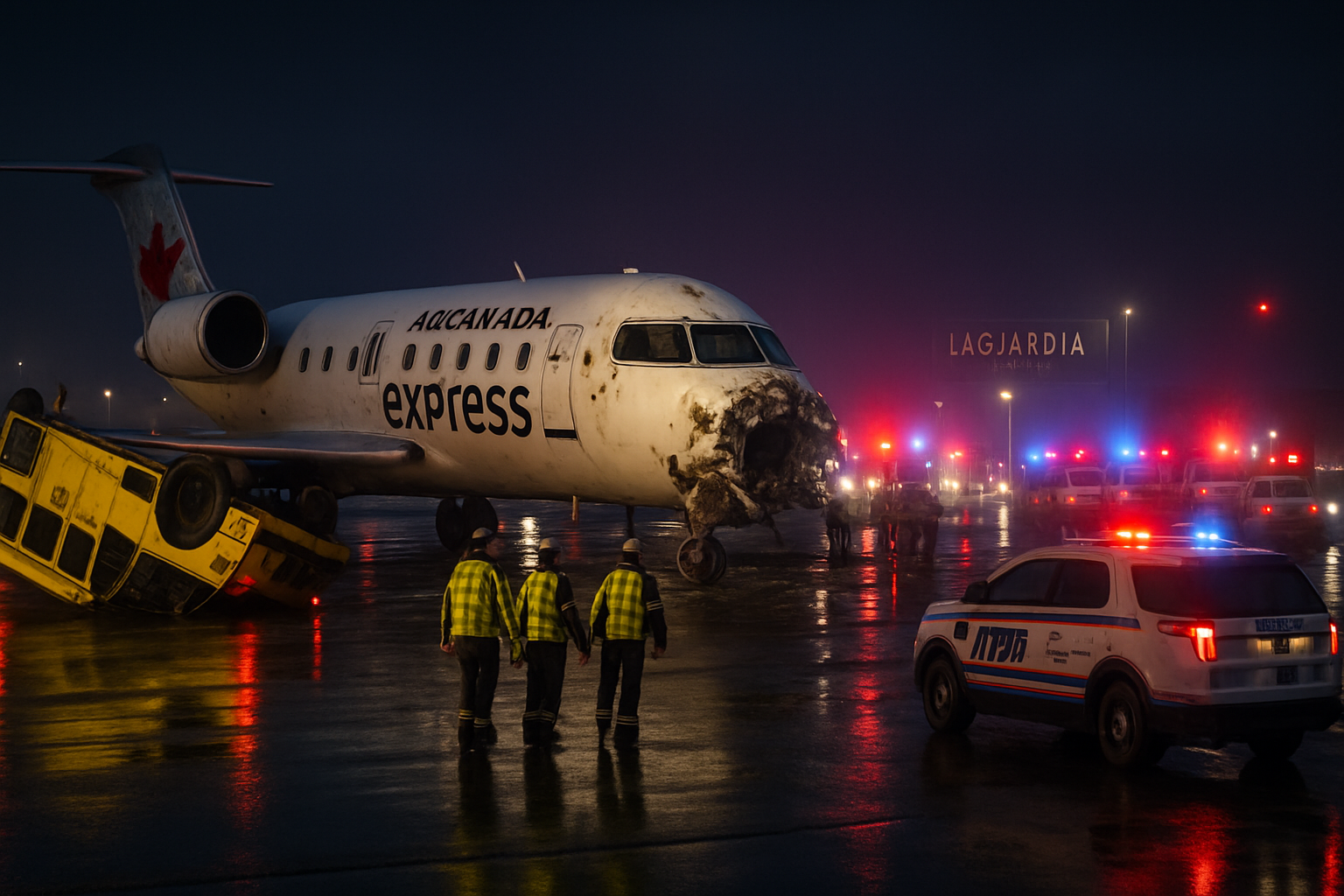
Two pilots were killed and dozens injured when an Air Canada Express regional jet collided with a Port Authority fire truck on the runway at New York's LaGuardia Airport late Sunday night, in a tragic accident that forced the complete closure of one of the nation's busiest airports.
The Bombardier CRJ-900 aircraft, operated by Jazz Aviation for Air Canada Express, struck the firefighting vehicle during landing operations at approximately 11:40 PM EST on March 22, 2026. The flight, carrying 72 passengers and four crew members, had originated from Montreal's Pierre Elliott Trudeau International Airport.
The collision crushed the aircraft's nose section and cockpit, killing both the pilot and co-pilot on impact. Social media footage from the scene showed the damaged aircraft stopped on the runway with its nose elevated and significant structural damage to the front section.
Emergency Response and Casualties
Emergency responders from the New York City Fire Department, Port Authority Police, and federal aviation authorities immediately deployed to the scene. Initial reports indicate that 13 people were transported to area hospitals, including 11 passengers and two first responders who were aboard the fire truck at the time of impact.
Port Authority officials confirmed that the fire truck was responding to a separate, unrelated emergency incident when the collision occurred on Runway 4. The aircraft had been cleared for landing as part of routine operations when the tragic accident unfolded.
"This is a devastating incident that has claimed the lives of two aviation professionals," said Kathryn Garcia, a spokesperson for the Port Authority of New York and New Jersey. "Our thoughts are with the families of those who lost their lives and everyone affected by this tragedy."
— Kathryn Garcia, Port Authority Spokesperson
The majority of passengers were successfully evacuated from the aircraft, with most injuries reported as non-life-threatening. However, the severity of the cockpit damage meant that the flight crew had no chance of survival.
Airport Operations Disrupted
LaGuardia Airport was immediately shut down following the collision, with all flights suspended and a Federal Aviation Administration (FAA) ground stop issued. The closure affected thousands of passengers throughout the night and into Monday morning, with the airport remaining closed until at least 2:00 PM Monday to allow for the investigation and cleanup efforts.
The timing of the accident during the late evening hours limited some of the operational disruption, but LaGuardia serves as a critical domestic hub in the U.S. aviation network. The prolonged closure created ripple effects throughout the national aviation system, with airlines scrambling to accommodate stranded passengers and reschedule flights.
Passengers waiting in the terminal were evacuated as a precautionary measure while emergency responders secured the crash site. Many travelers faced overnight delays and were forced to seek alternative transportation or accommodation.
Investigation Launched
Federal authorities, including the National Transportation Safety Board (NTSB) and the FAA, have launched a comprehensive investigation into the collision. Preliminary reports suggest that the accident was not related to hostile activity or terrorism, occurring instead during what officials described as routine landing operations.
The investigation will focus on several key factors, including mechanical systems, weather conditions at the time of the accident, communication protocols between air traffic control and emergency vehicles, and the coordination procedures for managing simultaneous aircraft operations and emergency responses on active runways.
The fire truck's presence on the runway during active flight operations will be a particular area of scrutiny, as investigators work to understand how the emergency vehicle and the landing aircraft came to occupy the same space at the same time.
Aviation Safety Context
The LaGuardia collision occurs during what has been characterized as a challenging year for aviation safety globally. The incident adds to a series of aviation emergencies and disruptions throughout 2026, including the massive Middle East crisis that cancelled over 18,000 flights worldwide, extensive European strikes, and multiple safety incidents across different continents.
Recent months have seen increased scrutiny of airport operations and emergency response coordination, particularly at busy airports where the complexity of managing both regular flight operations and emergency situations presents ongoing challenges.
Aviation safety experts emphasize that runway incursions and collisions between aircraft and ground vehicles remain rare but serious concerns in airport operations. The coordination between air traffic control, emergency services, and ground operations requires precise communication and timing to prevent such tragic accidents.
Air Canada Response
Air Canada issued a statement expressing its condolences to the families of the deceased crew members and confirming its full cooperation with the investigation. The airline emphasized its commitment to safety and announced it would be conducting its own internal review of the incident.
Jazz Aviation, the regional carrier that operated the flight under the Air Canada Express brand, also released a statement mourning the loss of the crew members and pledging support for the affected passengers and their families.
The aircraft involved in the accident was a Bombardier CRJ-900, a regional jet commonly used for shorter domestic routes. The model has generally maintained a strong safety record throughout its operational history.
Broader Implications
The tragic accident raises important questions about airport safety protocols, particularly regarding the coordination of emergency vehicle responses during active flight operations. As airports become increasingly busy and complex operational environments, the need for enhanced safety measures and improved communication systems becomes more critical.
The investigation's findings are expected to influence airport safety procedures not only in the United States but potentially worldwide, as aviation authorities share lessons learned from such incidents to prevent similar tragedies in the future.
The loss of the two experienced pilots represents not only a human tragedy for their families and colleagues but also a loss of valuable expertise and experience within the aviation community. Their deaths serve as a stark reminder of the risks that aviation professionals face in their daily work to maintain safe and efficient air transportation.
As the investigation continues in the coming weeks and months, the aviation industry will closely monitor the findings to identify any systemic issues that need to be addressed to prevent future accidents of this nature.