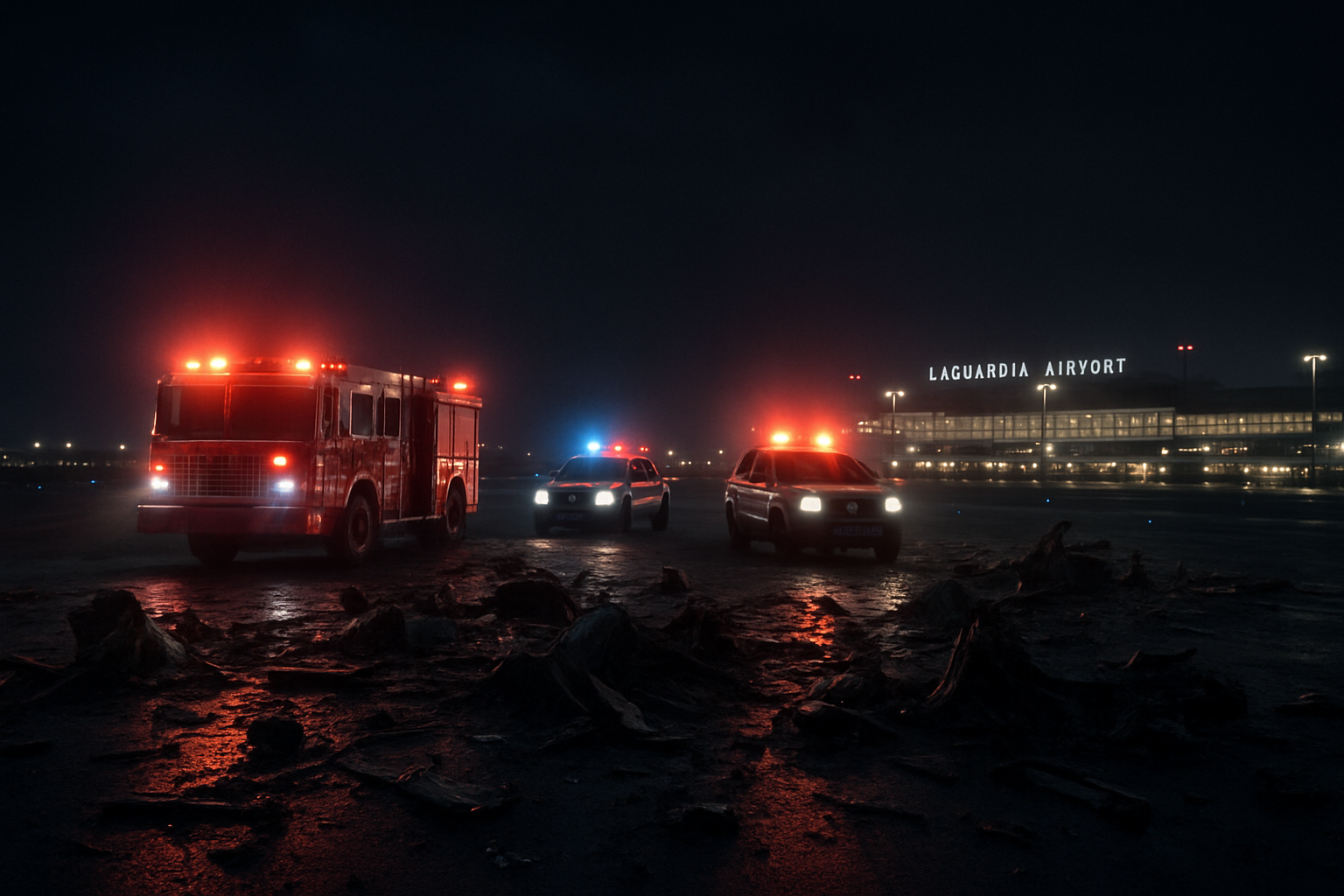
The National Transportation Safety Board has raised serious concerns about air traffic controllers working the midnight shift taking on extra responsibilities during a fatal collision at LaGuardia Airport that killed two Canadian pilots, as investigations continue into the March 22 tragedy that disrupted aviation operations nationwide.
The collision between an Air Canada Express Bombardier CRJ-900 regional jet and a Port Authority fire truck occurred at 11:40 PM EST on Sunday, March 22, killing both pilots instantly and injuring 13 others. The aircraft, operated by Jazz Aviation under the Air Canada Express banner, was carrying 72 passengers on a routine flight from Montreal when it struck a fire truck responding to a separate emergency on Runway 4.
Investigation Focus on Air Traffic Control Operations
The NTSB investigation has zeroed in on concerns about air traffic controllers managing the midnight shift at one of the nation's busiest airports. According to the safety board, controllers were juggling additional roles beyond their primary responsibilities during the incident, raising questions about operational procedures in LaGuardia's complex airspace.
"The National Transportation Safety Board said it has concerns about air traffic controllers who work the midnight shift taking on extra work in an airspace as busy as LaGuardia's," the NTSB stated in its preliminary findings.
The investigation is examining the coordination between air traffic control, emergency vehicle dispatch, and ground operations at the critical moment when the aircraft was landing and the fire truck was responding to an unrelated emergency incident on the active runway.
Victims Remembered by Communities
The two pilots who lost their lives have been identified as Antoine Forest, a 30-year-old from Coteau-du-Lac, Quebec, and co-pilot Mackenzie Gunther. Both were described as young pilots in the early stages of their aviation careers, representing a tragic loss to the aviation community.
"It is a complete tragedy," said Bryan Bedford, chief of the American aviation authority FAA.
— Bryan Bedford, FAA Chief
Forest's hometown of Coteau-du-Lac is mourning the loss of one of their own. The small Quebec community has expressed profound grief over the death of the young pilot, who was known for his dedication to aviation and his promising career prospects.
Family, friends, and community members across Canada have been mourning the two Air Canada Express pilots killed in the crash, highlighting the human cost of what investigators are calling a preventable tragedy involving coordination failures between aircraft operations and emergency vehicle responses.
Operational Impact and Airport Closure
The collision resulted in the complete closure of LaGuardia Airport through Monday at 2:00 PM, with the FAA issuing a ground stop that affected thousands of passengers nationwide. As one of the nation's critical domestic aviation hubs, LaGuardia's closure created ripple effects throughout the national aviation network.
The aircraft's nose and cockpit section were completely destroyed in the collision, which occurred when the CRJ-900 was traveling approximately 30 mph after touchdown. Despite the catastrophic damage to the front of the aircraft, the successful evacuation of passengers from the main cabin prevented what could have been a far more devastating outcome.
Broader Aviation Safety Context
This incident occurs within a challenging year for aviation safety globally. The LaGuardia collision is part of a concerning pattern of aviation incidents throughout 2026, including the Middle East crisis that resulted in 18,000+ flight cancellations globally, multiple military aviation accidents in Latin America, and various European incidents that have tested aviation safety protocols worldwide.
Aviation industry experts note that while commercial aviation maintains an exceptional statistical safety record, each incident provides crucial lessons for improving protocols and emergency response procedures across the global aviation network.
Industry and Regulatory Response
Air Canada has activated comprehensive support protocols for the victims' families and affected passengers. The incident has prompted discussions about enhanced communication systems between air traffic control and emergency vehicles, particularly at major airports where multiple simultaneous operations create complex coordination challenges.
Aviation authorities worldwide are monitoring the investigation findings, which are expected to influence international safety standards and airport operational procedures. The case highlights the ongoing need for improved coordination protocols for simultaneous aircraft operations and ground emergency response activities.
Corporate Controversy
In an unrelated controversy that has added to the tragedy's aftermath, Air Canada CEO Michael Rousseau has been summoned to Ottawa over his English-only condolence video following the crash. The linguistic controversy has drawn attention away from the primary safety concerns, highlighting ongoing tensions about bilingual communications in Canadian aviation leadership.
Investigation Timeline and Future Implications
The comprehensive NTSB and FAA investigation is examining mechanical systems, weather conditions, communication protocols, and emergency vehicle coordination procedures. Black box flight data recorders have been recovered and are being analyzed to reconstruct the sequence of events leading to the collision.
The investigation findings are anticipated to influence airport safety procedures globally, particularly regarding protocols for coordinating emergency responses with active flight operations. Questions have been raised about the adequacy of current communication systems between air traffic control and emergency vehicles operating in busy airport environments.
The tragedy underscores the critical importance of maintaining rigorous safety protocols and effective coordination between all operational elements at major airports, where the margin for error remains extremely small despite significant technological advances in aviation safety.