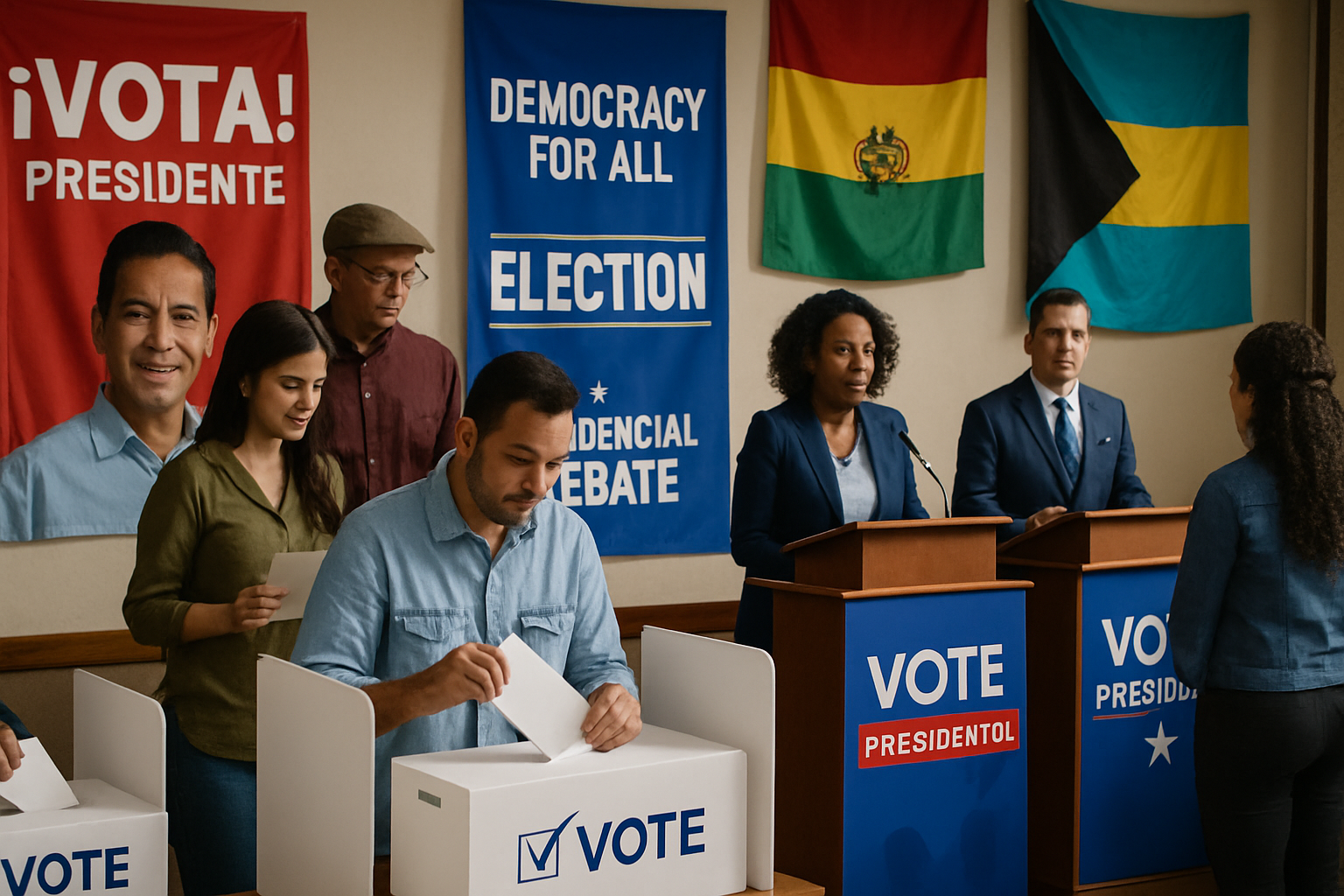
From presidential debate stages in Lima to gubernatorial campaigns in Bolivia and parliamentary dissolution announcements in Nassau, the first week of April 2026 has witnessed a remarkable surge of democratic activity across Latin America and the Caribbean, demonstrating the vital pulse of representative government in a region that has experienced significant political turbulence in recent years.
Peru's Presidential Debates Reach Critical Juncture
Peru's democratic process has taken center stage with the conclusion of the sixth and final presidential debate on April 1, 2026, organized by the Jurado Nacional de Elecciones (JNE). The three-day debate cycle from March 30 to April 1 featured 35 candidates presenting their visions to the Peruvian electorate just eleven days before the crucial April 12 general elections.
The debates, broadcast on open television and radio from 8:00 PM each evening, represented a critical democratic exercise for a nation that has experienced unprecedented political instability. With Peru having witnessed eight presidential changes since 2016, including the recent removal of José Jerí over the "Chifagate" scandal involving secret meetings with Chinese contractors, these elections carry extraordinary significance for the country's 33 million citizens.
"The number of undecided voters has been reducing following the first round of presidential debates," reported El Comercio, indicating that the democratic discourse is effectively reaching and influencing the electorate.
— El Comercio Election Coverage
The debate coverage has been extensive, with real-time minute-by-minute updates and comprehensive analysis of each candidate's performance. The JNE's commitment to transparent, accessible democratic dialogue represents a crucial institutional effort to restore public confidence in Peru's democratic processes after years of constitutional crises and political fragmentation.
Bolivia's Complex Political Landscape
In Bolivia, political dynamics continue to evolve following significant regional electoral changes. The country's democratic institutions are being tested through multiple levels of governance, from departmental elections to municipal politics, all occurring against the backdrop of the MAS party's collapse and subsequent political fragmentation.
Leonardo Loza, the elected governor of Cochabamba, has made headlines by reaffirming his unwavering support for former president Evo Morales, despite facing political pressure to distance himself from the controversial figure who currently faces an arrest warrant related to human trafficking charges. Speaking at the headquarters of the Six Federations of the Tropic, Loza declared his continued loyalty: "We will always be on the side of the people and our brother Evo."
This political positioning occurs as Bolivia navigates complex territorial governance challenges. In Tarija, the Departmental Electoral Tribunal (TED) has been conducting preparations for the second round of departmental elections scheduled for April 19, 2026. The TED selected 10,596 people to serve as electoral judges across 1,766 voting tables, maintaining strict gender parity with 50% women and 50% men representation.
Democratic Innovation in Electoral Administration
Bolivia's electoral institutions have demonstrated innovative approaches to democratic administration. The ballot organization for the Tarija runoff election was determined through transparent public lottery processes, ensuring fairness in candidate positioning. Such attention to procedural detail reflects the country's commitment to maintaining democratic legitimacy despite ongoing political challenges.
The current political landscape represents a significant departure from Bolivia's recent past, where the MAS party dominated national politics for over a decade under Evo Morales' leadership. The fragmentation has created space for new political coalitions and territorial governance arrangements, testing the resilience of Bolivia's democratic institutions.
Bahamas Prepares for Democratic Transition
In the Caribbean, the Bahamas is preparing for a significant democratic milestone with Prime Minister Philip Edward Davis announcing the dissolution of Parliament and setting the date for the 2026 General Election. The announcement, made on April 2, 2026, established May 12 as election day, with Parliament dissolving on April 8.
The timing of this announcement reflects the constitutional requirements and democratic traditions of the Commonwealth of The Bahamas. Under Article 66(2) of the constitution, the Prime Minister has the authority to advise the dissolution of Parliament and call for general elections, a process that ensures regular democratic renewal and citizen participation in governance.
This election represents a crucial test for Bahamian democracy, occurring at a time when Caribbean nations are facing multiple challenges including climate change impacts, economic pressures from the COVID-19 pandemic recovery, and evolving geopolitical dynamics in the region.
Regional Democratic Context and Historical Perspective
These electoral activities across Peru, Bolivia, and the Bahamas occur within a broader regional context of democratic resilience and adaptation. Latin America and the Caribbean have experienced significant political turbulence over the past decade, with constitutional crises, popular uprisings, and institutional challenges testing democratic governance across multiple countries.
The region's recent experience with democratic fragility provides important context for understanding the significance of current electoral processes. Peru's constitutional crises, including the weaponization of impeachment procedures and the average presidential tenure decreasing by 70% since 2016, demonstrate the challenges facing democratic institutions when political consensus breaks down.
Similarly, Bolivia's transition from MAS dominance to political pluralism represents a significant democratic evolution, while the Bahamas' regular electoral cycle demonstrates the stability that can be achieved through consistent adherence to constitutional procedures and democratic norms.
International Implications and Democratic Resilience
The simultaneous electoral activities across these three nations carry implications beyond their borders. International observers and regional organizations are closely monitoring these democratic processes as indicators of broader trends in Western Hemisphere governance.
Peru's elections, in particular, are being watched as a test of whether the country can break its cycle of political instability and achieve the institutional continuity necessary for effective governance. The success or failure of this electoral process will influence not only Peru's political trajectory but also serve as a template for other nations facing similar challenges with democratic consolidation.
Bolivia's subnational elections and political realignments offer insights into how democratic systems can adapt to major political party collapses while maintaining institutional continuity. The country's experience provides valuable lessons for other democracies facing political fragmentation and the need for institutional reform.
Economic and Social Stakes
The economic dimensions of these elections cannot be understated. Peru faces significant challenges including inflation concerns, unemployment, and the need for institutional stability to attract international investment. The country's business confederation, CONFIEP, has repeatedly warned that political uncertainty undermines economic development and international confidence.
Bolivia continues to grapple with economic management following years of political uncertainty, while the Bahamas faces the ongoing challenge of economic recovery and climate resilience in an increasingly volatile global environment.
Future Implications for Regional Democracy
As these electoral processes unfold, they will establish precedents for democratic governance in the region. The success of Peru's presidential transition, Bolivia's management of political pluralism, and the Bahamas' constitutional continuity will influence how other Latin American and Caribbean nations approach their own democratic challenges.
The coming weeks and months will be crucial for regional democratic development. Peru's April 12 elections must produce not only a legitimate government but also a political settlement that can break the cycle of institutional crisis. Bolivia's ongoing political evolution requires continued commitment to democratic norms despite factional pressures. The Bahamas' electoral process must demonstrate that regular democratic transitions remain possible even amid global democratic stress.
These developments occur during what observers have characterized as one of the most challenging periods for global democracy since World War II. The ability of Latin American and Caribbean nations to maintain democratic governance through transparent elections, constitutional procedures, and peaceful power transfers serves as a crucial example for democracies worldwide facing similar pressures from polarization, economic stress, and institutional fragility.
"Democracy is built with the participation of everyone," emphasized Bolivia's Supreme Electoral Tribunal President Gustavo Ávila, reflecting a sentiment that resonates across the region's current electoral activities.
— Gustavo Ávila, TSE President
The convergence of these electoral processes in early 2026 represents more than coincidental timing—it demonstrates the enduring vitality of democratic institutions in a region that has faced significant challenges to representative government. As voters across Peru, Bolivia, and the Bahamas prepare to exercise their democratic rights, they contribute to a broader narrative of democratic resilience and adaptation that will influence the region's political development for years to come.