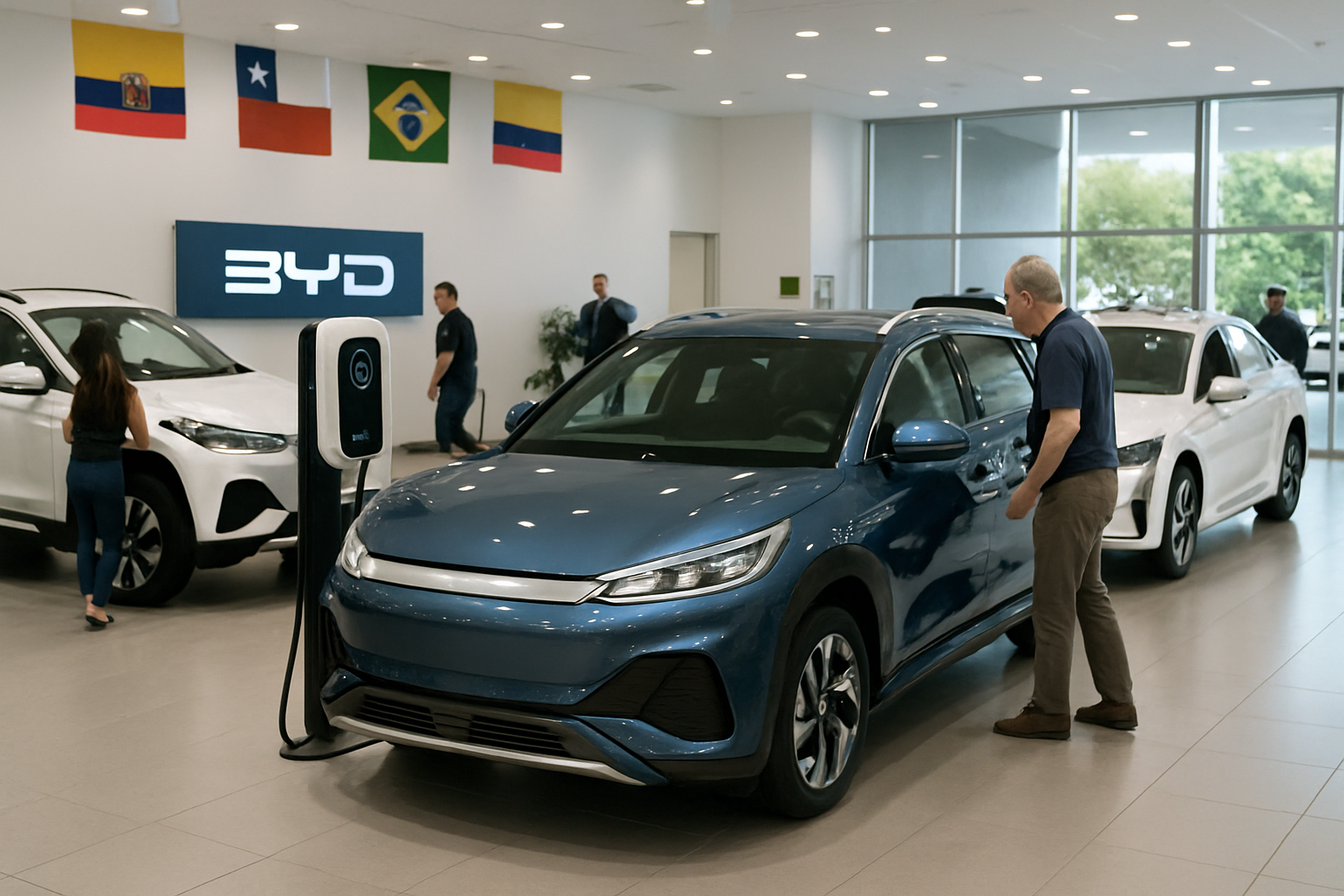
Latin America is experiencing an unprecedented electric vehicle boom, driven by soaring fuel prices and strategic expansion from Chinese manufacturers, with Ecuador leading the charge with a remarkable 460% surge in EV sales during March 2026.
The dramatic shift comes as the regional automotive market transforms amid a global energy crisis that has pushed oil prices above $119 per barrel, creating economic conditions that make electric vehicles an attractive alternative to traditional gasoline-powered cars.
Ecuador Leads Regional EV Explosion
Ecuador's electric vehicle market achieved the most spectacular growth in the region, with sales of 100% electric vehicles jumping 460.6% compared to March 2025, reaching 925 units sold in a single month. Chinese manufacturer BYD dominated this surge, selling 418 units – a 375% increase from the previous year.
The company's success reflects its strategic expansion into Latin American markets, backed by revolutionary charging technology including the Megawatt Flash Charging system that can provide 400 kilometers of range in just five minutes. This breakthrough addresses one of the primary barriers to EV adoption – charging time concerns.
Hybrid vehicles also gained significant traction in Ecuador, growing 113.5%, bringing the total share of new energy vehicles to 24.1% of the country's automotive market. March 2026 marked the best month in Ecuador's automotive history, with 14,150 new vehicles sold.
Regional Momentum Builds Across South America
The transformation extends far beyond Ecuador's borders. Colombia recorded robust growth with 5,083 electric vehicles sold in March, nearly double February's figures. The accumulated total reached 9,349 units, demonstrating sustained momentum in the region's second-largest economy.
This growth comes against the backdrop of the February 2026 oil crisis, which began when the United States and Israel launched military actions against Iran, disrupting global energy markets and accelerating the shift toward electric mobility as an economic necessity rather than merely an environmental choice.
Chinese Manufacturers Drive Expansion
BYD's remarkable performance in Latin America extends beyond vehicle sales. The company recently celebrated a milestone in Brazil's transportation infrastructure with the launch of its SkyRail monorail system in São Paulo's Metro Line 17-Ouro. This marks BYD's first monorail operation in Latin America and its entry into the railway sector in the region's largest economy.
"Since we took on this project in 2020, we transformed an old challenge into a technological and efficient solution," said BYD CEO Tyler Li. "In this case, the train had to adapt to the existing beam. This is an example of our commitment to innovation and cutting-edge engineering."
The company's integrated approach – combining automotive manufacturing with transportation infrastructure – positions it uniquely to capitalize on Latin America's broader mobility transformation.
Technology Breakthroughs Address Climate Challenges
Chinese manufacturers have made significant technological advances that directly address regional concerns. BYD's Blade Battery 2.0 technology functions effectively in temperatures as low as -30°C, while the company's water-based battery technology offers enhanced safety features described as "safe as tofu brine."
These innovations are particularly relevant as Latin American countries grapple with diverse climate conditions and infrastructure challenges. Battery longevity studies now show that electric vehicles can maintain 85-92% of their original capacity after 200,000+ miles, suggesting practical lifespans of 15-20 years.
Economic Drivers Behind the Shift
The surge in Latin American EV adoption reflects fundamental economic realities. The ongoing oil crisis has created conditions where electric vehicles offer substantial cost savings. In similar markets, EV owners save approximately $75 for every $100 compared to gasoline costs, even accounting for electricity rate increases.
The global supply chain disruptions, including memory chip shortages that have driven semiconductor prices up sixfold, have paradoxically benefited Chinese manufacturers who control 60% of critical materials production and 90% of refining capacity for lithium, cobalt, and rare earth elements essential for EV production.
Infrastructure Investment Accelerates
Supporting the vehicle sales surge, infrastructure development is accelerating across the region and globally. Austria has doubled its EV charging capacity by adding 1,000 stations, while Estonia leads with 88% renewable electricity and 90,000 household battery storage systems.
The development of vehicle-to-grid technology enables electric vehicles to serve as mobile energy storage units, charging during off-peak hours when renewable energy is abundant and discharging during high-demand periods to support grid stability.
Challenges and Opportunities Ahead
Despite the remarkable growth, challenges remain. Urban-rural adoption disparities persist, with homeowners and rural residents enjoying advantages through home charging capabilities, while urban apartment dwellers face infrastructure barriers.
The industry also faces supply chain vulnerabilities. Memory chip shortages continue to affect vehicle control systems, and the concentration of critical materials production in China creates strategic dependencies for Latin American markets.
Global Context and Climate Urgency
The Latin American EV surge occurs within a critical global context. January 2026 marked the 18th consecutive month of temperatures exceeding 1.5°C above pre-industrial levels, underscoring the urgency of transportation electrification.
Commercial vehicle electrification is also advancing, with Tesla announcing large-scale Semi truck production and BMW preparing to launch electric versions of its iconic 3 Series sedan from its Munich facility in August 2026.
Looking Forward
March 2026 represents a watershed moment where crisis-driven demand converges with technological readiness to create conditions for mass EV adoption acceleration. The combination of economic necessity, technological breakthroughs, and strategic manufacturer expansion has positioned Latin America as a crucial battleground in the global transition to electric mobility.
Success in this transformation requires sustained international cooperation, continued infrastructure investment, and strategic coordination across energy systems, materials supply chains, and regulatory frameworks. The region's experience may serve as a template for other emerging markets navigating similar transitions during what experts describe as the most significant automotive industry transformation in over a century.
As BYD's CEO noted regarding their broader mission, each vehicle and infrastructure project delivered "reinforces quality, comfort and efficiency" – principles that are driving a fundamental shift in how Latin Americans think about transportation and energy independence in an increasingly volatile global economy.