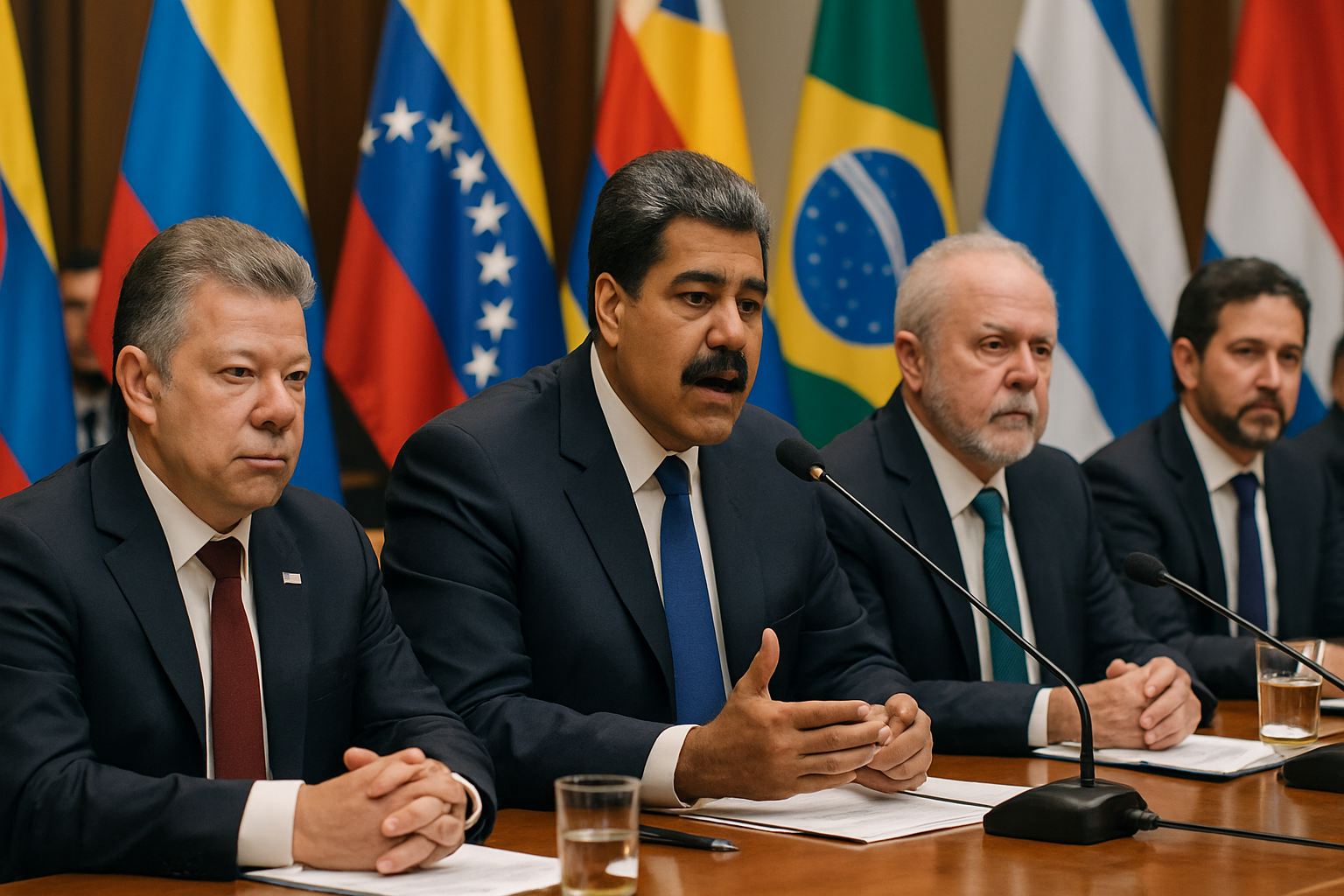
Latin America entered a decisive phase of political transformation in March 2026 as Colombia advanced landmark transitional justice initiatives and agrarian reforms, reflecting broader regional efforts to address historical injustices while strengthening democratic institutions amid ongoing political upheavals across the hemisphere.
Colombia's Transitional Justice Milestone
In a powerful demonstration of Colombia's commitment to confronting its violent past, retired Lieutenant Andrés Mauricio Rosero Bravo knelt before the family of John Darío Giraldo Quintero on March 27, accepting responsibility for his role in the 2006 "false positives" case in Cocorná before the Special Jurisdiction for Peace (JEP). The emotional scene underscored Colombia's unprecedented efforts to achieve accountability for one of the darkest chapters in its modern history.
The false positives scandal involved the systematic execution of innocent civilians by Colombian military units, who then presented the victims as guerrilla fighters killed in combat to inflate body counts and receive rewards. The practice, which peaked during the mid-2000s, represents one of the gravest human rights violations in Colombia's long-running internal conflict.
"This acknowledgment of responsibility represents a crucial step in our national healing process. The courage shown by victims' families in pursuing justice through transitional mechanisms demonstrates the strength of Colombian civil society."
— Human Rights Observer, speaking anonymously
Rosero Bravo's confession before the JEP, Colombia's transitional justice tribunal established under the 2016 peace agreement with the FARC guerrillas, signals the continuing evolution of the country's post-conflict institutions. The JEP has jurisdiction over the most serious crimes committed during the armed conflict and represents a hybrid model of restorative and retributive justice that has drawn international attention as a potential template for other post-conflict societies.
Revolutionary Agrarian Reform Legislation
Simultaneously, President Gustavo Petro signed the statutory law creating Colombia's specialized Agrarian Jurisdiction before an audience of flood-affected peasants in Cereté, Córdoba on March 27. The new legal framework establishes specialized judges and tribunals to resolve land conflicts, addressing what Petro characterized as "one of the structural causes of violence in the country."
The timing and location of the law's signing carried deep symbolic weight. Córdoba has been one of Colombia's most violence-affected regions, where disputes over land ownership have fueled decades of conflict. The presence of peasants displaced by recent flooding underscored the continuing vulnerability of rural communities and the urgent need for effective mechanisms to protect their rights.
This agrarian jurisdiction represents a fundamental shift in how Colombia addresses rural conflicts. For the first time, the country will have judges specifically trained to handle the complex intersection of land rights, environmental protection, and social justice that has long characterized disputes in Colombia's countryside.
Regional Democratic Transitions and Challenges
Colombia's institutional advances occur within a broader context of political transformation across Latin America. Historical memory research reveals that the region has experienced unprecedented democratic transitions in recent years, with Venezuela's political prisoner amnesty program representing the most comprehensive reconciliation effort in recent Latin American history.
Under Acting President Delcy Rodríguez, Venezuela has released over 750 political prisoners since January 2026 through a comprehensive amnesty law covering the 1999-2026 period. This represents the most ambitious attempt at political reconciliation spanning nearly three decades of political conflict during the entire Chávez-Maduro era.
The Venezuelan transition has drawn international attention as a potential template for peaceful political change. Former Spanish Prime Minister José Luis Rodríguez Zapatero continues to mediate the process, while Cardinal Baltazar Porras has organized nationwide prayer vigils supporting reconciliation efforts.
Argentina's Economic and Political Upheaval
Argentina presents a contrasting picture of democratic stress testing under President Javier Milei's radical economic transformation agenda. The country has experienced four major general strikes by the General Confederation of Labor (CGT), with the most recent achieving complete economic paralysis costing an estimated $489 million in a single day.
Milei's labor reform legislation, which passed the Senate 42-30 after Interior Minister Patricia Bullrich modified over 30 articles to secure centrist support, introduces a "bank of hours" overtime system and modified severance structures. The reforms complement a US-Argentina trade agreement eliminating over 1,600 tariffs, positioning Argentina as a key Trump administration partner in South America.
The sustained opposition demonstrates the capacity of organized labor to resist structural changes, while also highlighting the government's ability to build legislative coalitions. The outcome represents a critical test of democratic governance's ability to manage comprehensive economic transformation while preserving social stability.
Regional Patterns and Global Implications
These developments reflect broader patterns of democratic consolidation and institutional adaptation across Latin America. The region's experience with transitional justice, particularly Colombia's hybrid judicial mechanisms and Venezuela's amnesty process, provides valuable insights for other post-conflict societies worldwide.
The success of these initiatives depends on sustained political commitment beyond electoral cycles, comprehensive stakeholder engagement, and the delicate balance between accountability and reconciliation. Colombia's dual approach—combining individual criminal responsibility through the JEP with systemic reform through agrarian jurisdiction—offers a sophisticated model for addressing both historical injustices and structural inequalities.
International Cooperation and Regional Stability
The international community has closely monitored these political transitions as potential templates for democratic governance under pressure. The United States has dramatically shifted its approach to Venezuela from "maximum pressure" to strategic partnership, with oil exports surging 60% to 800,000 barrels daily as American companies have displaced China as Venezuela's top customer.
This geopolitical realignment reflects broader competition for influence in Latin America, where traditional alignments are being tested by new economic partnerships and changing political dynamics. The success or failure of current democratic transitions will likely influence how both regional and global powers approach future political crises.
Challenges and Prospects
Despite these advances, significant challenges remain across the region. In Colombia, security concerns persist with government officials warning of breakdowns in public order across various regions, while systematic targeting of social leaders continues in provinces like Cauca. In Venezuela, over 600 political prisoners remain detained despite the amnesty program, with many releases involving restrictive conditions rather than complete freedom.
Argentina faces the challenge of implementing its controversial reforms while managing sustained social opposition and economic pressures, including economist projections of 22.4% annual inflation compared to the government's 10.1% forecast.
The coming months will prove decisive for determining whether current political transitions represent genuine democratic consolidation or temporary arrangements among competing interests. The stakes extend far beyond national boundaries, offering crucial insights into how democratic institutions can adapt to 21st-century challenges while preserving fundamental principles of accountability, transparency, and representative governance.
As Latin America confronts this historic crossroads, the region's experience with peaceful political transition, institutional innovation, and democratic resilience under pressure will likely influence global approaches to governance challenges for decades to come. The ultimate test will be whether these societies can successfully balance the demands of political transformation with the preservation of hard-won democratic gains.