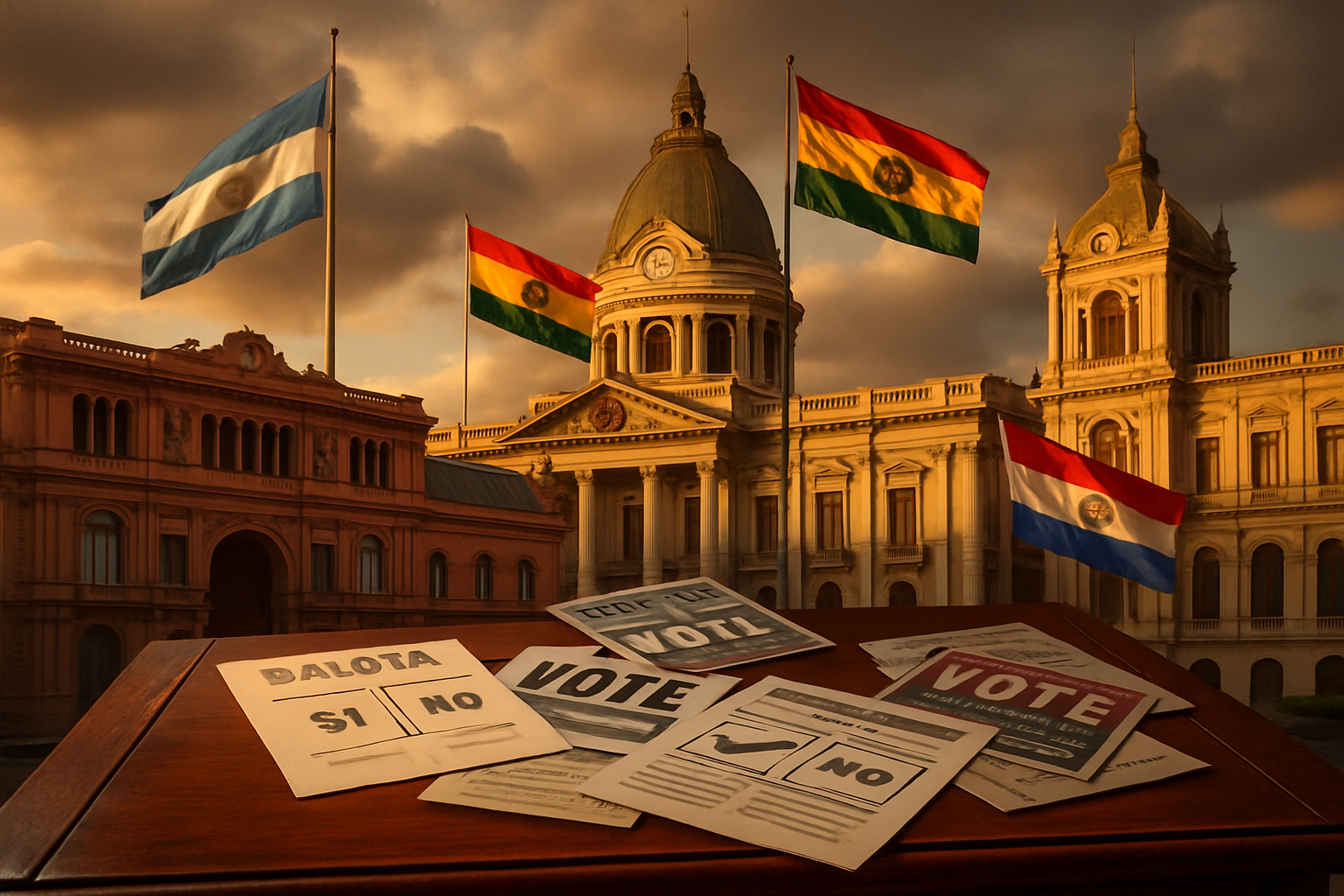
Political movements across Latin America are gaining momentum as Argentina, Bolivia, and Paraguay each confront distinct electoral challenges that could reshape the regional political landscape in 2026.
The political dynamics across these three nations reflect broader trends of democratic evolution, anti-corruption initiatives, and electoral restructuring that are defining Latin America's current political moment. While Argentina grapples with internal Peronist party restructuring, Bolivia advances anti-corruption investigations, and Paraguay prepares for municipal elections with new political alliances.
Argentina's Peronist Crossroads
Argentina's political landscape faces a critical juncture as the Peronist movement confronts internal challenges that could determine its future viability. According to analysis from Perfil, the party finds itself in a complex situation requiring strategic unity similar to Brazil's approach when Luiz Inácio Lula da Silva successfully united with former adversaries to defeat Jair Bolsonaro in 2022.
Political observers are increasingly focusing on Senator Sergio Uñac, the former Governor of San Juan, as a potential unifying figure within the movement. Uñac's profile has risen as Peronism seeks to present itself as a "superior alternative" in Argentina's evolving political landscape.
"If Peronism does not do something similar to what Lula Da Silva did to beat Bolsonaro in 2022, when he united with his worst enemy, it will hardly be able to show itself as a superior alternative"
— Political Analysis, Perfil
This internal restructuring occurs against the backdrop of President Javier Milei's economic reforms and the ongoing challenges facing Argentina's traditional political establishment. The Peronist movement's ability to adapt and unify will likely determine its role in future electoral contests.
Bolivia's Anti-Corruption Campaign Intensifies
In Bolivia, Deputy Rafael López from the Libre alliance has announced the presentation of three resolution projects to form special investigation commissions in the Legislative Assembly. The proposal seeks to investigate cases known as "Maletas" (Suitcases), "Gasolina" (Gasoline), and "Neurona," all linked to alleged irregularities and corruption.
López emphasized the commitment to transparency and effective oversight, stating during a press conference with Santa Cruz gubernatorial candidate Juan Pablo Velasco: "We are going to present three projects to form three commissions, we will supervise and we will not cover up anyone. Those who say it makes no sense to create these commissions show that they want to cover up or protect someone, and that will not happen with Libre."
The initiative represents part of Bolivia's broader efforts to address corruption concerns and strengthen democratic institutions. The Libre alliance's push for accountability comes amid ongoing political transitions and efforts to restore public trust in governmental processes.
Paraguay's Municipal Elections Gather Steam
Paraguay's political scene is energized by preparations for municipal elections, with significant figures joining campaign efforts. Richard Reichardt, Director of the Olympic Park, has joined the project of mayoral pre-candidate Camilo Pérez and will seek to reach the Asunción city council under the "Asunción Puede" (Asunción Can) banner, aligned with Honor Colorado (ANR).
Reichardt brings substantial credentials to the campaign, having been instrumental in organizing high-profile sporting events including the South American Games and Junior Pan American Games. His management achievements include securing Paraguay's successful bid against Rio de Janeiro for the 2031 Pan American Games, generating significant revenue for the country.
"I give you my word that with Camilo Pérez at the head and me in the city council, we will achieve, with order and management, to make the mother of cities reborn," Reichardt stated, focusing his campaign on returning plazas and public spaces to citizens.
Caribbean Political Movements
Beyond South America, Caribbean nations are also experiencing significant political developments. In the Bahamas, the Free National Movement (FNM) has ratified twelve additional candidates for the upcoming 2026 General Election, with notable decisions including the rejection of sitting Long Island MP Adrian Gibson, who faces legal challenges related to Water and Sewerage matters.
The candidate list includes former NBA star Rick Fox, who secured nomination for Garden Hills, demonstrating the diverse backgrounds of those seeking political office in the region.
In Barbados, electoral preparations are intensifying with the Barbados Labour Party's manifesto launch at Golden Square, described by political analyst Peter Wickham as "a mixture of infrastructure and projects which speak to the cost of living." The Democratic Labour Party is preparing to launch its competing manifesto, setting up a clear choice for voters in the upcoming election.
Regional Implications and Trends
These political developments across Latin America reflect several significant trends shaping the region's democratic landscape. The emphasis on anti-corruption measures in Bolivia aligns with broader regional movements demanding greater transparency and accountability from political institutions.
Argentina's Peronist restructuring represents the ongoing evolution of traditional political movements adapting to new electoral realities and voter expectations. The party's challenge mirrors similar situations faced by established political movements across the hemisphere.
Paraguay's municipal campaigns demonstrate the increasing importance of local governance and the entry of professional figures from various sectors into political life. The focus on urban renewal and public space management reflects contemporary priorities in Latin American cities.
These developments occur within the broader context of Latin America's democratic evolution, where voters increasingly demand effective governance, transparency, and responsive leadership. The outcomes of these political movements will likely influence regional trends and democratic development across the hemisphere.
Looking Ahead
As 2026 progresses, these political movements will continue to evolve, potentially reshaping the electoral landscape across Latin America. The success or failure of anti-corruption initiatives in Bolivia, the ability of Argentina's Peronists to achieve unity, and the outcomes of Paraguay's municipal elections will provide important indicators of broader democratic health and political evolution in the region.
The international community continues to monitor these developments, particularly given Latin America's strategic importance and the global implications of democratic strengthening or weakening in the region. The coordination between different nations' approaches to political reform and electoral processes may also influence broader hemispheric cooperation efforts.