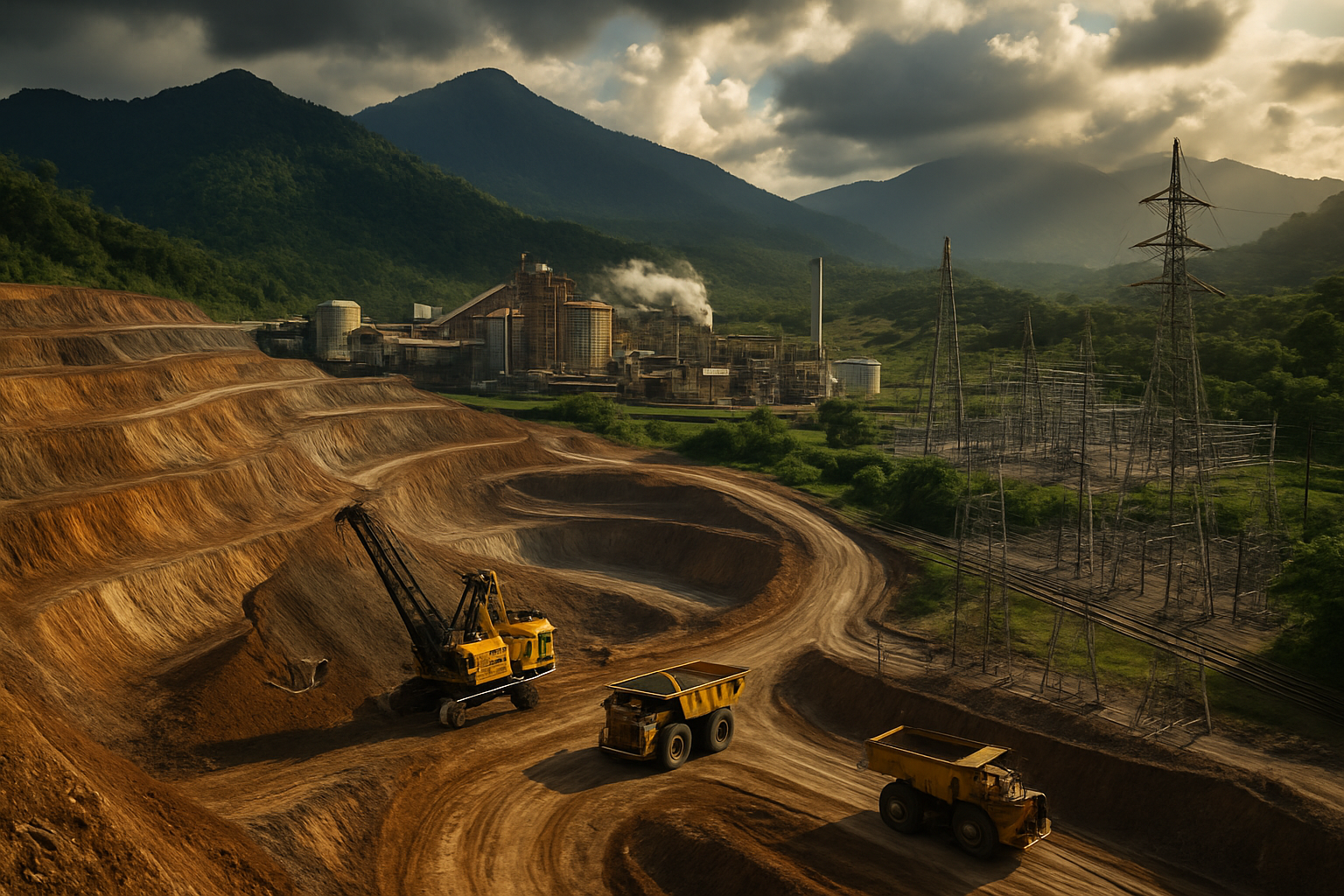
Latin America's mining and energy sector is experiencing unprecedented transformation as Venezuela's oil production surges under new leadership while regional infrastructure projects advance across multiple countries, marking a pivotal moment for the continent's resource extraction industries.
The most significant development centers on Venezuela's dramatic energy sector revival following Acting President Delcy Rodríguez's rise to power in January 2026. Venezuelan oil exports have surged 60% to 800,000 barrels daily, with the United States displacing China as the top customer after the lifting of Trump-era sanctions. This represents the most dramatic shift in Latin American energy dynamics in over a decade.
Venezuela's Energy Sector Renaissance
The transformation began with Energy Secretary Chris Wright's historic visit to Caracas in February 2026, the highest-ranking US official to visit Venezuela since the Maduro era ended. Wright declared the 2019 oil embargo "essentially ended" and predicted an "absolutely dramatic turn in trajectory" for the nation.
US companies have responded rapidly to the new opportunities. Chevron has doubled its Venezuelan shipments, while Treasury authorization has allowed BP, Shell, Eni, and Repsol to expand operations significantly. The comprehensive energy cooperation agreement signed at Miraflores Palace encompasses oil, natural gas, and electricity production through US technical assistance.
"We welcomed Burgum to address important aspects related to metallic, non-metallic, strategic and non-strategic minerals. We want the Venezuelan people to see the advantage of having good relations with the world and with the United States."
— Acting President Delcy Rodríguez
The partnership extends beyond oil into mining, with Rodriguez announcing plans to expand Venezuela's Mining Law to attract international investment. US Interior Secretary Doug Burgum's March visit highlighted "unlimited opportunities for cooperation" in critical minerals essential for US supply chain security.
Regional Infrastructure and Investment Surge
Beyond Venezuela's transformation, the broader Latin American mining and energy sector is witnessing substantial infrastructure development and investment flows. The region's strategic positioning has become increasingly important as global powers seek to diversify supply chains away from Chinese dominance in critical minerals.
Seven African countries have joined the US-EU-Japan Critical Minerals Partnership, challenging China's 60% production and 90% refining capacity dominance in materials essential for renewable energy and advanced manufacturing. This creates opportunities for Latin American nations to position themselves as alternative suppliers.
Argentina has emerged as a major lithium partner with record $6 billion mining exports in 2025, while bilateral agreements with the US have eliminated over 1,600 tariffs on Argentine goods. The country's lithium reserves in salt flats represent crucial resources for the global energy transition.
Maritime and Shipyard Development
Infrastructure development extends to maritime capabilities, as evidenced by the Bahamas' Grand Bahama Shipyard expansion. Prime Minister Philip Davis announced a $650 million investment featuring some of the world's largest floating dry docks, positioning the island as a major hub for maritime repair and services.
This maritime infrastructure development supports the broader energy sector by providing essential maintenance and logistics capabilities for offshore energy operations and transportation networks across the Caribbean and Latin American region.
Geopolitical Implications and Trade Patterns
The transformation of Latin America's mining and energy sector reflects broader geopolitical shifts. Venezuela's rapid reorientation from China to the US demonstrates the gravitational pull of American economic partnerships when combined with strategic diplomacy.
China announced zero-tariff access for 53 countries starting May 1, 2026, representing the most comprehensive China-global trade expansion in history. However, the US-Venezuela energy partnership and expanding bilateral frameworks with Argentina and other Latin American nations suggest a diversification of regional economic relationships.
The Dominican Republic has reopened relations with Venezuela, while Brazil and EU nations maintain cautious support for the democratic transition. This creates a complex diplomatic environment where Latin American nations must balance traditional partnerships with emerging opportunities.
Critical Minerals and Supply Chain Security
Latin America's role in global supply chain security has become increasingly critical. The region's vast mineral reserves—including lithium, copper, rare earth elements, and other strategic materials—position it as a key player in the transition to renewable energy and advanced manufacturing.
Venezuela's announcement of mining law reforms specifically targets American companies seeking alternatives to Chinese-dominated supply chains. The country's metallic and non-metallic mineral resources could play a crucial role in US efforts to achieve supply chain independence in critical materials.
Bolivia's inclusion in the US Critical Minerals Ministerial, despite its traditional non-aligned stance, demonstrates the strategic importance of Latin American lithium reserves. The country's salt flats contain substantial lithium deposits essential for battery production and energy storage systems.
Challenges and Implementation Hurdles
Despite the promising developments, significant challenges remain for the Latin American mining and energy sector. Venezuela's oil production, while recovering rapidly, remains well below its historical peak of 3 million barrels daily. Infrastructure decay, technical capacity constraints, and the need for sustained international investment present ongoing obstacles.
Environmental and governance standards have become prerequisites for international investment. Modern projects must incorporate digital monitoring, renewable energy integration, and community engagement as standard features rather than optional additions. This represents an evolution from traditional extractive models toward comprehensive development strategies.
Regional security concerns also impact sector development. Criminal targeting of mining operations, as seen in recent incidents in Mexico, highlights the need for enhanced security protocols and international cooperation frameworks to protect industrial investments and personnel.
Future Outlook and Strategic Positioning
The convergence of political transitions, infrastructure development, and shifting geopolitical alignments positions Latin America's mining and energy sector for potentially transformative growth. Venezuela's successful democratic transition and economic recovery could provide a template for other regional transformations.
The success of bilateral energy diplomacy in Venezuela demonstrates how strategic partnerships can achieve rapid results when combined with appropriate economic incentives and political commitment. This approach may influence future international engagement strategies throughout the region.
As global demand for critical minerals accelerates due to the energy transition, Latin America's vast resources and improving governance frameworks position the region as an essential partner for developed nations seeking supply chain diversification and security.
The coming months will be decisive in determining whether these promising developments translate into sustained economic transformation and regional integration. Success would establish Latin America as a crucial player in global energy and mining markets, while failure might represent a missed opportunity for comprehensive regional development.
The sector's evolution from traditional extractive industries toward sophisticated, environmentally conscious operations that benefit local communities represents a fundamental shift that could influence global development approaches for decades to come.