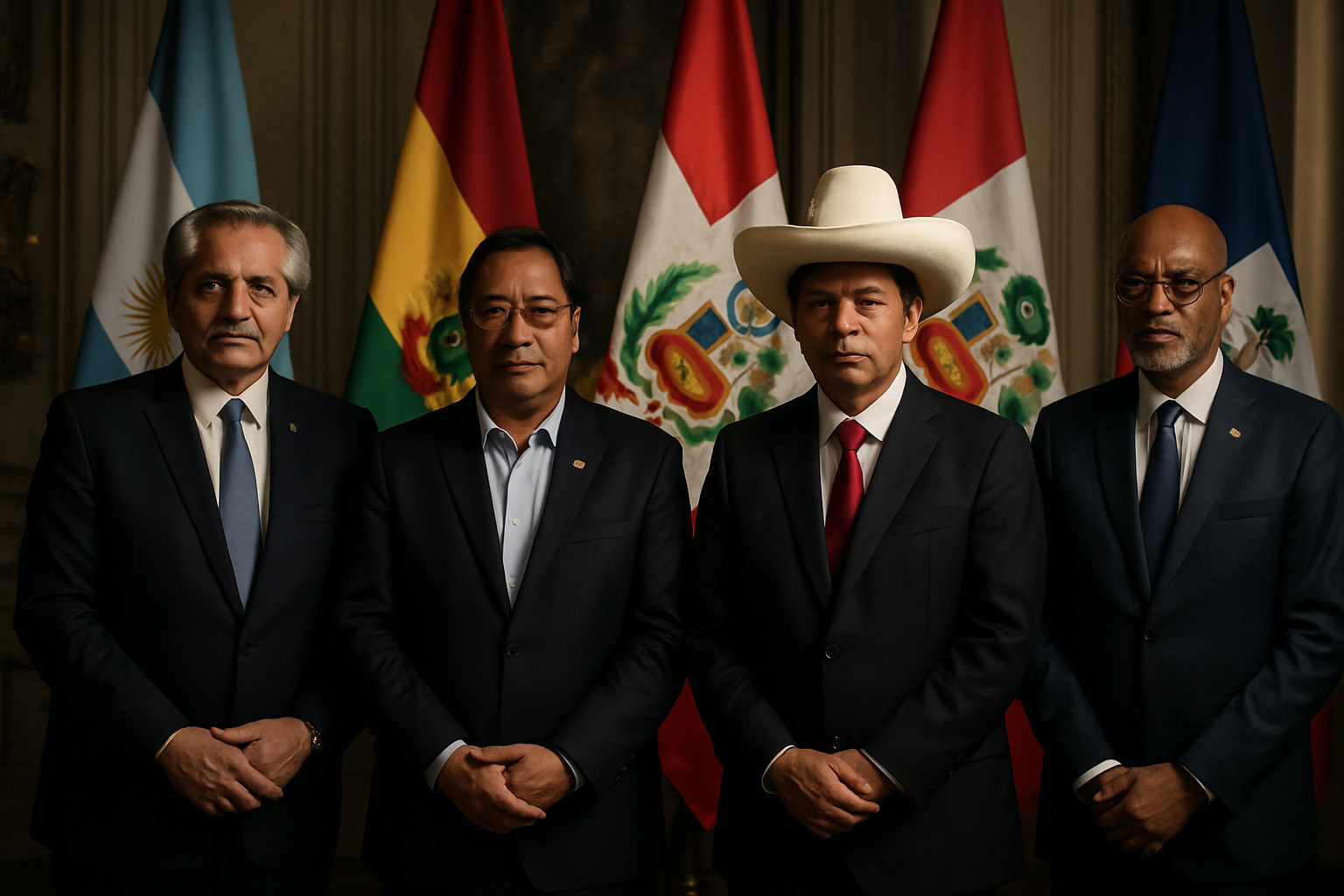
Latin America is experiencing one of its most turbulent political periods in recent memory, with Argentina locked in a fierce battle over labor reforms, Peru witnessing the removal of its seventh president in ten years, and Bolivia's new government struggling with immediate governance challenges, highlighting the fragility of democratic institutions across the region.
Argentina: Labor Reform Battle Reaches Critical Phase
President Javier Milei's administration faces its most significant political test as the controversial labor reform legislation advances to the Chamber of Deputies for final approval. The reform, which already secured Senate approval 42-30 after violent protests in February, represents a fundamental shift in Argentina's labor framework that has generated unprecedented opposition.
Interior Minister Patricia Bullrich demonstrated tactical flexibility by modifying over 30 articles of the original legislation to secure support from the Radical Civic Union (UCR) and dialoguing opposition blocs, effectively isolating traditional Peronist parties. However, the government was forced to eliminate the controversial Article 44 regarding medical leave provisions due to mounting political pressure.
"The rest doesn't get touched," Milei declared after being forced to concede on medical leave provisions, signaling his determination to push through the remaining reforms despite organized resistance.
— President Javier Milei
The reform introduces a "bank of hours" overtime system, modified severance structures while maintaining basic protections, and changes to union contribution requirements. The legislation aims to increase labor market flexibility as Argentina seeks to capitalize on the recently signed US trade agreement that eliminates over 1,600 tariffs.
Unprecedented Union Resistance
The General Confederation of Labor (CGT) has orchestrated the most sustained opposition to any government since Milei took office, organizing four general strikes. The February Senate session witnessed unprecedented violence, with protesters throwing Molotov cocktails and stones at federal police, resulting in over 50 arrests, four injured officers, and 270 million pesos in property damage.
Buenos Aires Governor Axel Kicillof has positioned himself as a leading opponent of the reforms while simultaneously building his profile for the 2027 presidential campaign. Six provincial governors have joined the union opposition, demonstrating the breadth of resistance across Argentina's federal system.
Peru: Political Crisis Reaches Breaking Point
Peru's chronic political instability reached new heights with the removal of interim President José Jeri, marking the country's seventh presidential change in just ten years. The Congressional vote of 75-24 represented an overwhelming rejection of Jeri's brief four-month presidency, which was overshadowed by the "Chifagate" scandal.
The scandal involved secret nighttime meetings between President Jeri and Chinese contractor Zhihua Yang, whose companies hold significant state contracts. Security footage showed the president arriving hooded at a Chinese restaurant for undisclosed meetings outside the official agenda, raising sovereignty concerns about Chinese influence in Peru's governance.
Constitutional expert Aníbal Quiroga declared post-censure presidential documents "totally invalid," highlighting the systematic breakdown of governmental authority. Seven censure motions were filed, reflecting complete opposition across party lines.
Pattern of Institutional Failure
Peru's political crisis extends far beyond individual leadership failures, revealing systematic governance dysfunction. The cycle includes the removal of Martín Vizcarra in 2020, Pedro Castillo's attempted coup in 2022, and Dina Boluarte's removal in 2025. The constitutional "vacancy" procedure has been repeatedly weaponized by Congress against executives, creating a pattern of institutional instability.
The business confederation CONFIEP warned Peru "cannot afford a new uncertainty stage" just weeks before April presidential and congressional elections. The timing of Jeri's removal creates questions about the interim government's authority to ensure free and fair electoral processes.
"There were so many issues to resolve that there really hasn't been a 100-day honeymoon period. The situation demanded immediate responses from day one."
— Foreign Minister Fernando Aramayo, Bolivia
Bolivia: New Government Under Immediate Pressure
Bolivia's government under President Rodrigo Paz has faced immediate challenges that Foreign Minister Fernando Aramayo acknowledges required "responses from the first moment." The administration inherited significant economic and social problems that precluded any traditional adjustment period.
Aramayo emphasized that intensive work continued even during Carnival period because the Foreign Ministry maintained an active international agenda. The government has been engaging in bilateral dialogues, including planned meetings with Brazil and maintaining an active agenda with Chile, while participating in various international events abroad.
The new administration's approach reflects the broader regional challenge of governments inheriting complex problems that demand immediate attention rather than allowing time for policy development and coalition building.
Regional Democratic Fragility
The simultaneous crises across Latin America reveal troubling patterns in democratic governance. Argentina's experience demonstrates how economic reforms, however necessary, can generate violent opposition that tests institutional stability. Peru's case shows how constitutional mechanisms designed for crisis resolution can be weaponized for political gain, creating chronic instability.
The regional context includes successful democratic transitions in other countries, such as Bangladesh's historic elections and Japan's democratic resilience under extreme conditions, providing contrasting models for institutional strength. However, Latin America's specific challenges of economic inequality, weak institutions, and polarized politics create particular vulnerabilities.
Economic Pressures and Political Consequences
Argentina faces severe economic challenges with economists projecting 22.4% annual inflation versus the government's 10.1% forecast. The country has lost 21,938 companies under the Milei administration, affecting 290,602 workers according to labor risk data. The FATE tire manufacturer's closure, eliminating 920 jobs, symbolizes broader industrial challenges under trade liberalization policies.
These economic pressures compound political tensions as governments struggle to balance necessary structural reforms with immediate social needs. The success of Argentina's labor reform and Peru's ability to stabilize its political system will significantly influence regional approaches to similar challenges.
International Implications and Regional Security
The political instability in Latin America has drawn international attention, particularly from the United States as it seeks reliable partners in the region. Argentina's strategic positioning as a Trump administration South American partner through trade agreements depends on successful reform implementation and political stability.
Peru's instability affects broader Andean cooperation and regional security initiatives, while questions about Chinese influence through infrastructure projects like the Belt and Road Initiative create additional complications for regional governance.
The broader pattern of political upheaval across Latin America occurs amid global democratic challenges, making the region's experience particularly significant for understanding contemporary governance pressures. Success in managing these transitions while preserving democratic norms could provide templates for other regions facing similar challenges.
Looking Ahead: Critical Junctures
The coming weeks will be decisive for the region's political trajectory. Argentina's Chamber of Deputies vote on labor reform will determine not only specific legislation but also President Milei's broader reform agenda. Peru's search for political stability ahead of April elections requires finding leadership capable of breaking the cycle of institutional conflict.
Bolivia's new government faces the challenge of demonstrating that immediate crisis response can evolve into sustainable governance addressing long-term development needs. The regional implications extend beyond national borders, affecting international cooperation frameworks, economic development strategies, and democratic governance models.
The intersection of economic pressures, political polarization, and institutional weaknesses creates a complex challenge for Latin American democracy. How these countries navigate their current crises will significantly influence regional development patterns and democratic resilience for years to come.