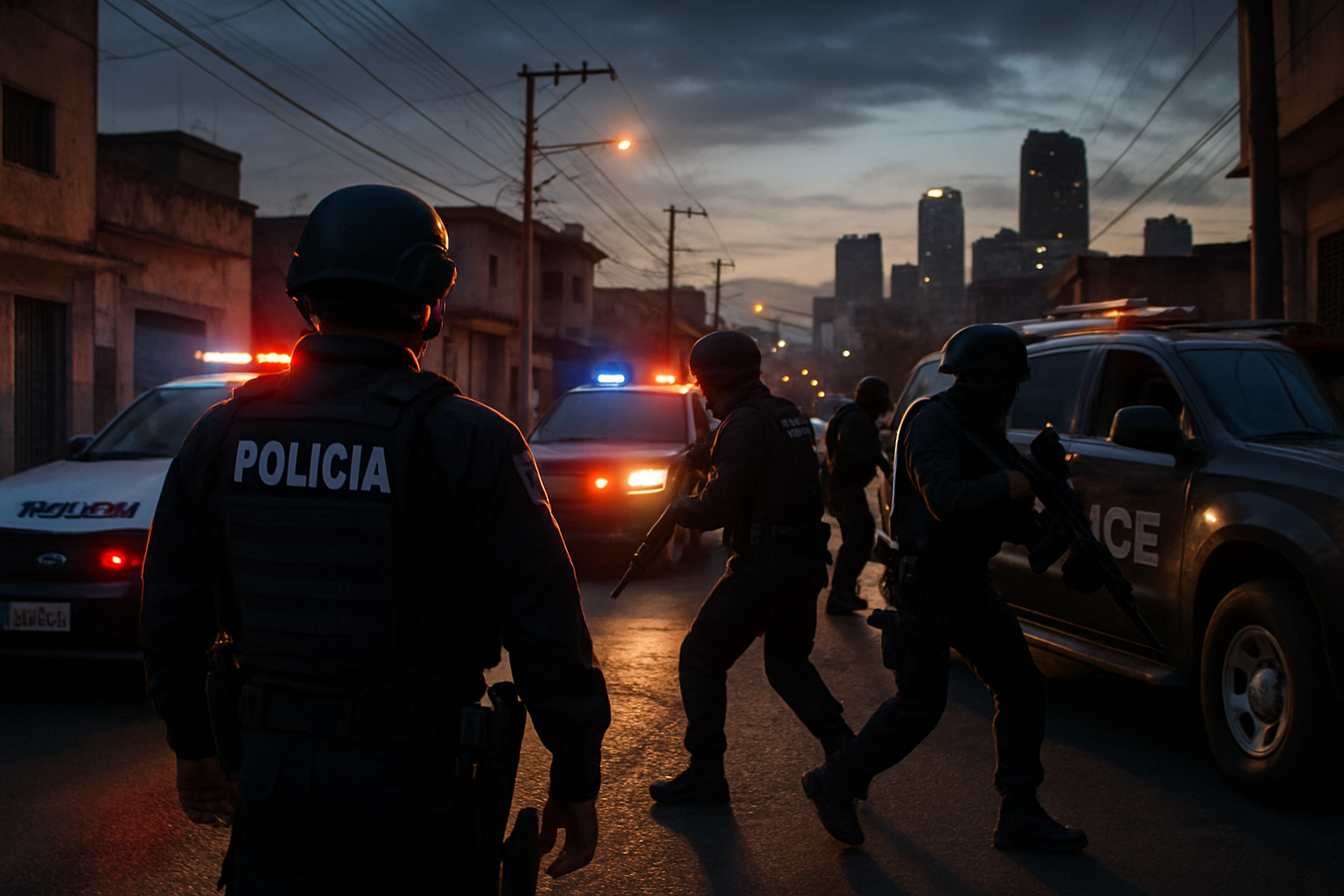
Criminal violence erupted across multiple Latin American nations this week, with deadly shootings in Colombia, massive drug seizures in Bolivia, and coordinated attacks demonstrating sophisticated criminal networks that increasingly challenge state authority across the region.
In Medellín, Colombia, security cameras captured the chilling moment when gunmen opened fire on civilians in the La Toscana neighborhood, killing two people in what authorities describe as a calculated attack using military-style weapons. Police arrested three suspects in connection with the brazen daylight assault that has sent shockwaves through the city preparing to host matches for the 2026 FIFA World Cup.
Colombia: Violence Escalates in Urban Centers
The Medellín attack represents the latest in a disturbing pattern of violence across Colombia, where criminal organizations demonstrate increasingly sophisticated operational capabilities. Video footage from the La Toscana incident shows the attackers operating with military precision, suggesting coordination that extends beyond typical street crime.
Meanwhile, in Cali, authorities launched a major operation following reports of animal cruelty that resulted in a 60 million peso fine and criminal charges. While seemingly unrelated, experts note that criminal networks often use seemingly legitimate activities as fronts for larger operations, requiring law enforcement to investigate multiple angles simultaneously.
"The level of coordination we're seeing in these attacks suggests criminal organizations with resources and capabilities that rival state institutions."
— Dr. Maria Rodriguez, University of Miami Security Expert
Bolivia: Fuel Trafficking Networks Dismantled
In Bolivia, the National Hydrocarbons Agency (ANH) dealt a significant blow to organized crime by seizing over 3,000 liters of illegally transported gasoline in Sucre. The operation, conducted in coordination with the Public Ministry and Bolivian Police, uncovered a sophisticated smuggling network using modified vehicles and compartmentalized storage systems.
The seized fuel was being transported in 38 20-liter containers, two 30-liter containers, one 50-liter container, and 11 200-liter barrels, indicating a well-organized distribution network. This operation builds on Bolivia's recent success in capturing high-value drug trafficking targets, including the March 2026 arrest of Sebastian Marset, one of the world's most wanted narcotics traffickers.
Regional Criminal Network Sophistication
The incidents across Latin America reflect broader patterns identified by intelligence agencies throughout 2026. Criminal organizations have evolved to demonstrate state-like capabilities, including advanced surveillance systems, encrypted communications, and compartmentalized international structures that often exceed law enforcement resources.
North African nations have also reported related criminal activity, with authorities in Algeria and Mauritania conducting major operations against drug trafficking networks that appear connected to Latin American supply chains. Algerian security forces dismantled a criminal network trafficking processed drugs and psychotropic substances, while Mauritanian police arrested 21 suspects, including foreign nationals, in a cross-border smuggling operation.
International Cooperation Intensifies
These incidents occur within the framework of enhanced international cooperation established through the Shield of the Americas coalition, a 17-nation alliance launched in March 2026 to combat transnational organized crime. The coalition has enabled unprecedented intelligence sharing and coordinated operations across jurisdictions.
In Mauritania, authorities seized approximately 45 kilograms of hashish, 6,000 hallucinogenic pills, and 14,000 ecstasy tablets, demonstrating the global reach of networks that often originate in or transit through Latin America. The operation resulted in the confiscation of vehicles and communication equipment, revealing the technological sophistication of modern criminal enterprises.
Technology and Criminal Evolution
Law enforcement officials note that criminal organizations are adopting commercial and military-grade technologies faster than institutional countermeasures can be developed. The use of encrypted communications, advanced surveillance, and sophisticated financial networks has created persistent vulnerabilities that require sustained international cooperation to address.
The March 27 incidents represent a critical test of whether democratic institutions can adapt quickly enough to counter criminal networks that operate without respect for national boundaries and possess resources that challenge traditional concepts of state sovereignty.
Democratic Governance Under Pressure
The escalating violence poses unprecedented challenges for democratic governance across Latin America. Criminal organizations' willingness to use advanced weaponry in urban centers, target essential infrastructure, and corrupt institutional personnel represents a comprehensive assault on state authority.
Courts worldwide are experiencing unprecedented strain from case backlogs, resource constraints, and the complex international evidence requirements needed to prosecute sophisticated criminal networks. The success of democratic institutions in maintaining public safety while preserving civil liberties will significantly influence public confidence in governance across the region.
"We're witnessing a fundamental challenge to democratic institutions from criminal organizations that possess capabilities once exclusive to nation-states."
— Dr. James Martinez, Constitutional Law Professor
Economic and Social Impact
The violence extends beyond immediate security concerns to broader economic implications. Tourism-dependent areas face reputational damage, while the systematic targeting of legitimate businesses through extortion and violence undermines economic development efforts across the region.
The fuel trafficking operations in Bolivia highlight how criminal networks exploit essential services, creating artificial scarcities that affect civilian populations while generating illegal revenue streams worth millions of dollars.
Prevention and Community Engagement
Experts emphasize that effective long-term solutions require comprehensive approaches beyond reactive enforcement. Community engagement, educational programs, economic development initiatives, and early intervention programs are essential for addressing the underlying conditions that enable criminal recruitment.
The success of recent operations demonstrates the potential for coordinated international responses, but sustained political commitment, adequate resources, and continued technological advancement remain crucial for maintaining gains against increasingly sophisticated criminal adversaries.
Looking Forward
As Latin American nations grapple with these unprecedented security challenges, the coming months will test whether enhanced international cooperation frameworks can effectively counter criminal networks that operate with state-like capabilities while preserving the democratic values and civil liberties that define open societies.
The incidents of March 27 serve as a stark reminder that criminal organizations continue to evolve, requiring equally sophisticated and coordinated responses from democratic institutions committed to maintaining the rule of law in an increasingly complex security environment.