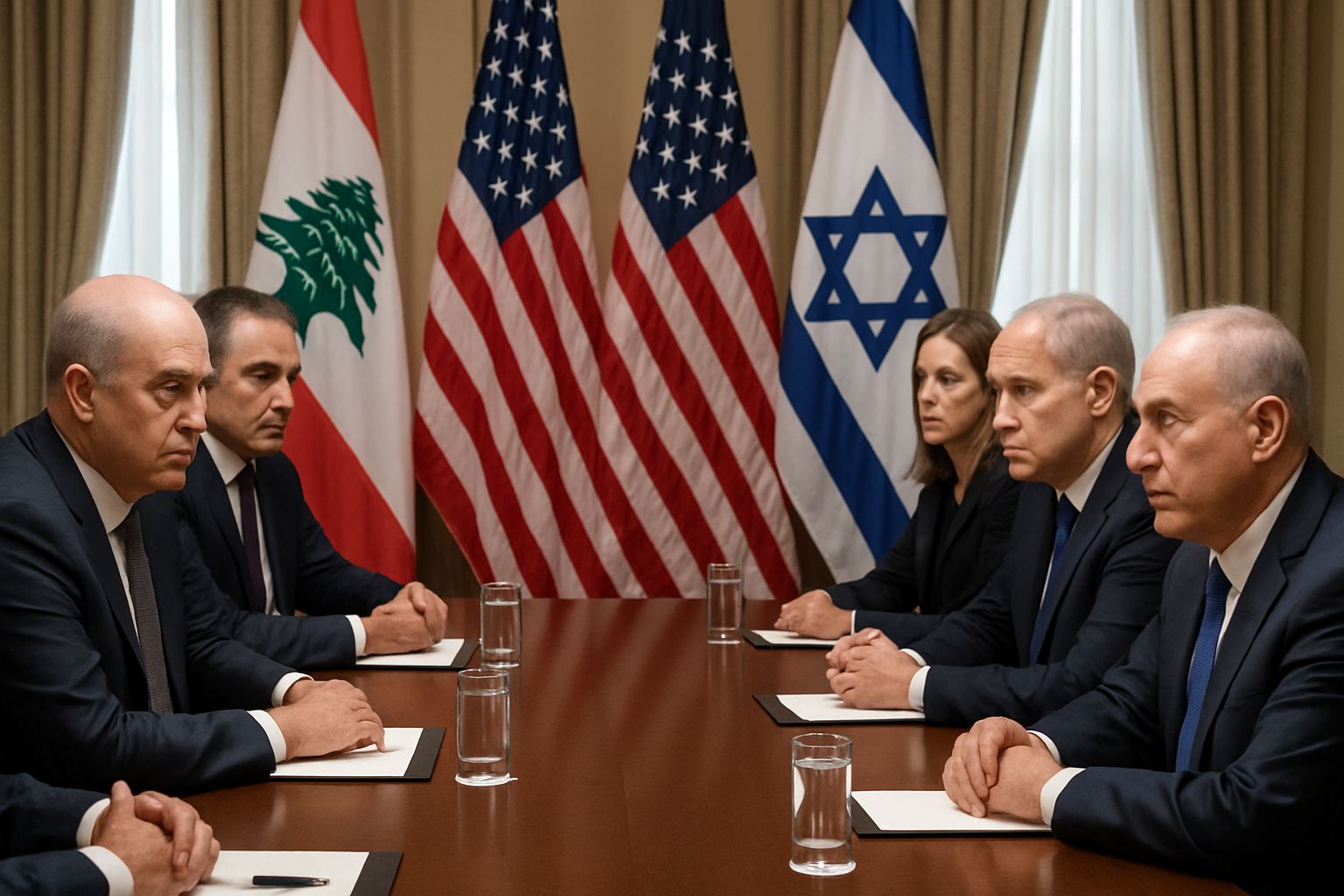
Lebanon will formally request a one-month extension of its fragile ceasefire with Israel during diplomatic talks in Washington on Thursday, as continued violations and military confrontations threaten to unravel the temporary peace agreement that has provided only limited respite from months of devastating conflict.
A Lebanese official confirmed to AFP that the extension request will be central to the discussions, marking the latest attempt to salvage diplomatic progress amid an increasingly precarious situation along the southern Lebanese border. The talks represent a critical juncture for a ceasefire that has been marked by immediate violations and ongoing tensions since its implementation.
Immediate Violations Undermine Fragile Peace
The current ceasefire, announced by President Trump following "excellent conversations" with Israeli Prime Minister Netanyahu and Lebanese President Joseph Aoun, took effect at 5 PM EST but was violated within hours of implementation. Lebanese military officials documented Israeli "acts of aggression," including artillery shelling of southern villages, while Israeli forces warned Lebanese civilians against moving south of the Litani River.
Israel projects optimism ahead of the planned Thursday talks, despite ongoing exchanges of fire in southern Lebanon. The Israel Defense Forces reported killing two Hezbollah members who allegedly crossed the ceasefire line, while Hezbollah launched drone attacks targeting Israeli troops, further straining the temporary agreement.
Humanitarian Crisis Reaches Critical Scale
The extension request comes against the backdrop of an unprecedented humanitarian catastrophe that has devastated Lebanon since the conflict's escalation in March 2026. Over 1.2 million Lebanese—representing 25% of the country's population—have been displaced from their homes, with emergency shelters overwhelmed and thousands forced to sleep on the streets of Beirut.
The systematic targeting of medical personnel has emerged as a particularly grave concern, with 26 paramedics killed and 51 wounded since March 2026. The deadliest incident occurred at the Burj Qalaouiyah healthcare center in the Bint Jbeil district, where 12 medical workers, including doctors, nurses, and paramedics, were killed in what constitutes potential violations of the Geneva Conventions.
"The healthcare system is under severe strain across five countries in the region."
— World Health Organization Emergency Appeal
The WHO has issued a $30.3 million emergency appeal to address the healthcare crisis, while the total civilian death toll since the March escalation has exceeded 2,196 people, according to Lebanese Health Ministry figures.
November 2024 Ceasefire Collapse Context
The current crisis stems from the complete collapse of the November 2024 US-French brokered ceasefire between Israel and Hezbollah, which had held for over a year until March 2026. The previous agreement required the withdrawal of both Israeli forces and Hezbollah from southern Lebanon, with Lebanese army and UN peacekeeping forces establishing a buffer zone.
Hezbollah faced what officials described as an "impossible choice" between maintaining the ceasefire and responding to Iranian pressure following the death of Supreme Leader Ali Khamenei on March 1. The organization ultimately chose "Iranian solidarity over Lebanese sovereignty," declaring that "resistance was the only option" and pulling Lebanon into the broader Iran-Israel confrontation.
Critical Loophole Threatens Regional Peace
A significant complication affecting the extension talks is the "Lebanon loophole" in the broader Pakistan-mediated "Islamabad Accord" between the US and Iran. Prime Minister Netanyahu has explicitly excluded Lebanon from this ceasefire framework, creating what Vice President JD Vance acknowledged as Iran's "legitimate misunderstanding" about the scope of the agreement.
Iran has threatened to withdraw from regional peace talks unless comprehensive enforcement is implemented across all fronts, including Lebanon. This loophole has created dangerous strain on the broader diplomatic framework and threatens to undermine the historic Pakistan-mediated breakthrough that prevented what Trump had warned could be the destruction of "whole civilizations."
Military Escalation Continues
Despite the ceasefire, military operations have continued on multiple fronts. Hezbollah, with an estimated 20,000 fighters, has conducted over 40 operations targeting northern Israeli sites, including strikes reaching as far as Haifa. The organization has declared "direct confrontations" with Israeli forces in southern Lebanon, marking a significant operational escalation from their previous restraint strategy.
Israeli forces maintain control over an estimated 10% of Lebanese territory between the border and the Litani River. Military operations have expanded beyond the November 2024 ceasefire positions, including the destruction of the Qasmiyeh Bridge and the issuing of civilian home demolition orders. IDF Chief Zamir has indicated that operations are "just beginning," with "several weeks" of continued ground operations planned.
International Response and Diplomatic Pressure
The international community has responded with unified condemnation of civilian targeting and calls for de-escalation. The UK has expressed being "deeply troubled" by the situation, France has called Israeli actions "unacceptable," and Italy has condemned the bombings of civilian populations.
French President Emmanuel Macron has offered to host direct Israel-Lebanon talks in Paris, representing the first such diplomatic initiative since the ceasefire collapse. UN Secretary-General António Guterres has characterized the crisis as "the greatest test of multilateral cooperation in the modern era" during his visit to Beirut.
The UN peacekeeping mission UNIFIL has also come under attack, with bases near Mais al-Jabal struck and peacekeepers wounded. Most seriously, French UN Peacekeeper Staff Sergeant Florian Montorio was killed in what President Macron directly attributed to Hezbollah, calling it a "deliberate attack" on international peacekeeping forces.
Global Economic and Security Implications
The Lebanon crisis has contributed to broader global disruptions, including the cancellation of over 18,000 flights worldwide—approaching COVID-scale aviation disruption—and oil prices reaching $100+ per barrel for the first time since 2014. The International Energy Agency has implemented its largest strategic reserve release of 400 million barrels in its 50-year history.
Natural gas prices have surged 24% in Europe and 78% in the United States, threatening household costs globally. The crisis has also affected the Strait of Hormuz, with Iran imposing restrictions that impact 40% of global oil transit, demonstrating the interconnected nature of regional conflicts and global energy security.
Template-Setting Diplomatic Moment
Thursday's extension talks represent what analysts describe as a "template-setting moment" for 21st-century conflict resolution. The rapid transition from diplomatic breakthrough to military escalation demonstrates the fragility of negotiated agreements when underlying political tensions remain unresolved.
The stakes extend far beyond the bilateral Lebanon-Israel relationship, affecting regional war prevention, energy security, nuclear governance credibility, and international law enforcement with implications that could resonate for decades. The success or failure of maintaining even this fragile ceasefire while addressing the Lebanon crisis will establish precedents for future territorial disputes and conflict resolution mechanisms in an increasingly multipolar world.
Framework for Sustainable Peace
For the extension talks to succeed, negotiators must address several critical components: immediate ceasefire establishment, force withdrawal from buffer zones, deployment of Lebanese army and UN peacekeeping forces, and long-term security guarantees for both sides. The fundamental challenge lies in creating enforcement mechanisms that prevent external pressure from undermining agreements while addressing the underlying political dynamics that allowed the November 2024 collapse.
The talks must also confront the reality that Hezbollah maintains categorical opposition to the current framework. Secretary-General Naim Qassem has called the negotiations "pointless" and demanded that the Lebanese government take a "historic heroic stance" by withdrawing from talks. The organization has documented over 10,000 Israeli violations of the previous agreement, resulting in 500+ civilian deaths.
As Lebanese families continue to face displacement and uncertainty, with thousands still sleeping on Beirut streets and emergency shelters at capacity, the extension talks represent perhaps the last immediate diplomatic intervention opportunity to prevent a return to the most serious Middle East crisis since the Cold War's end. The international community's commitment to diplomatic solutions over military confrontation faces its ultimate test, with global governance credibility hanging in the balance.