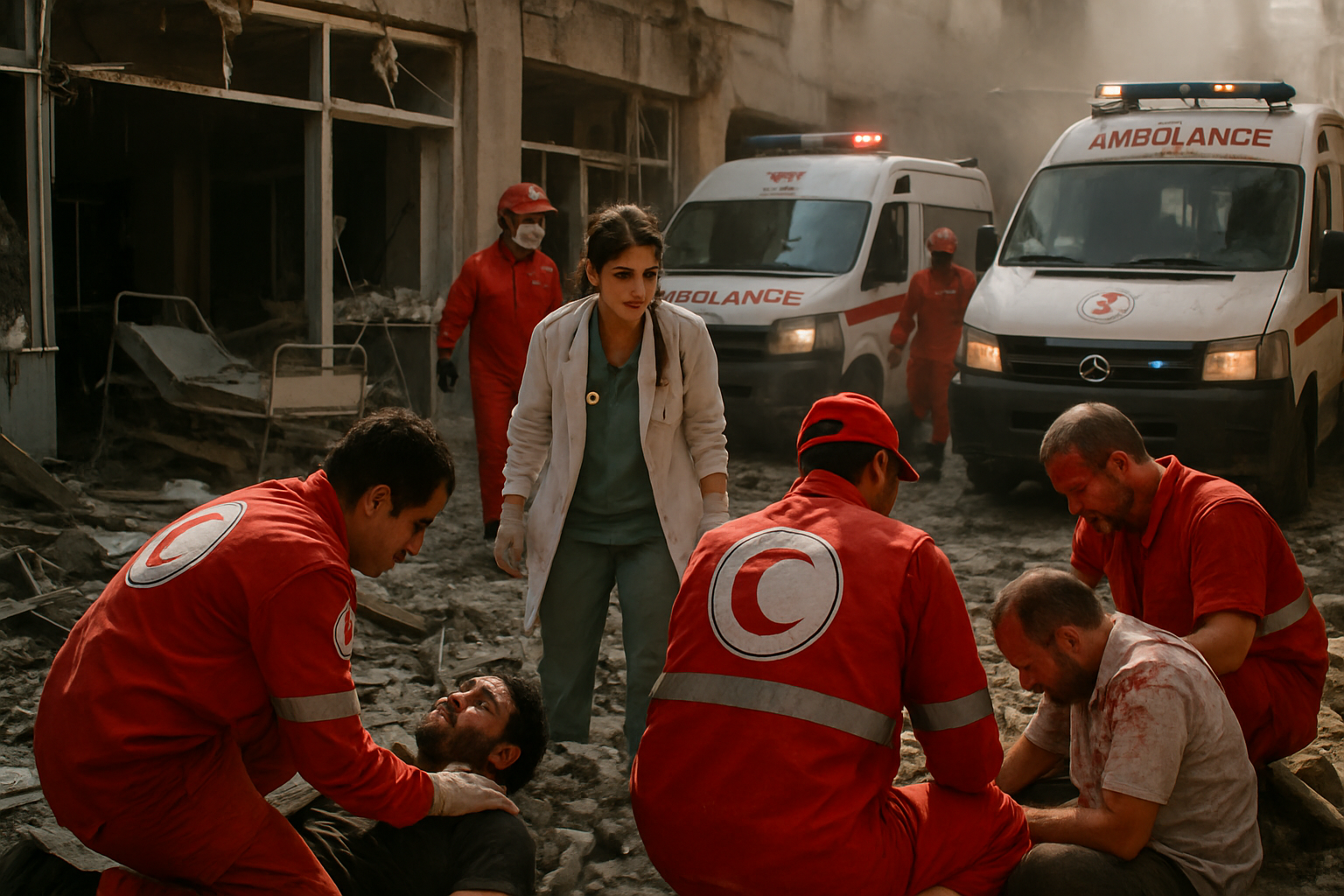
Israeli military operations in Lebanon have resulted in mounting casualties among medical workers and civilians, with Lebanon's Health Ministry reporting that 26 paramedics have been killed and 51 others wounded since the conflict erupted between Israel and Hezbollah on March 2, 2026.
The escalation comes amid Israel's broader military campaign following the death of Iran's Supreme Leader Ali Khamenei and Hezbollah's decision to join the regional conflict in solidarity with Iran. The Lebanese Health Ministry has documented systematic targeting of emergency responders and medical personnel, raising serious concerns about violations of international humanitarian law.
Medical Personnel Under Fire
The most devastating single attack occurred at a primary healthcare center in Burj Qalaouiyah, in the Bint Jbeil district of Nabatieh, where an Israeli airstrike killed 12 medical workers including doctors, paramedics, and nurses. Rescue teams are continuing to search for people trapped under the rubble of the destroyed facility.
Lebanon's Health Ministry statement accused Israel of repeatedly "targeting ambulance crews while they were performing rescue duties," describing the casualties as "the most eloquent evidence of the violent practices of the enemy." The ministry's comprehensive casualty count covers the period since March 2, when Hezbollah first launched attacks against Israel in retaliation for Khamenei's death.
Israeli military spokesman Avichai Adraee warned on Saturday that Israel may strike ambulances and medical facilities, claiming without providing evidence that "Hezbollah is using ambulances extensively for military purposes." A Hezbollah official categorically denied these allegations, stating that the group was not using ambulances and medical facilities for military purposes.
Rising Death Toll Among Civilians
According to multiple sources, the overall death toll from Israeli strikes has reached alarming proportions. Russian state media TASS reported that the Lebanese death toll from Israeli attacks has risen to more than 800, with 2,000 injured, citing the Arab republic's Ministry of Public Health.
The casualties include both combatants and civilians, with at least 23 people killed in separate Israeli airstrikes across Lebanon since early Saturday. Four people were killed after an Israeli strike targeted an apartment in Haret Saida in southern Lebanon, while seven more people were killed in another Israeli strike targeting the Al-Rahibat neighborhood in Nabatieh.
French President Emmanuel Macron has called on Israel to accept "direct discussions" with the Lebanese executive and "all components" of Lebanon, offering to "facilitate" such talks by "hosting them in Paris."
International Humanitarian Law Concerns
The targeting of medical personnel and facilities has drawn international condemnation and raised serious questions about compliance with the Geneva Conventions. Under international humanitarian law, medical personnel, facilities, and vehicles are protected and attacks against them may constitute war crimes.
"The total toll of martyred paramedics from March 2 until today, totaling 26 martyrs and 51 wounded, is the most eloquent evidence of the violent practices of the enemy."
— Lebanese Health Ministry
The systematic nature of attacks on emergency responders has prompted calls for investigations by international human rights organizations. The deliberate targeting of medical personnel during rescue operations violates fundamental principles of distinction and proportionality under international humanitarian law.
Regional Context and Escalation
The current escalation in Lebanon is part of the broader Middle East crisis that began when Iran's Supreme Leader Ali Khamenei was killed in US-Israeli Operation Epic Fury on March 1, 2026. Hezbollah's decision to enter the conflict marked the complete collapse of the November 2024 ceasefire that had maintained relative stability for over a year.
The Israeli military has issued the most extensive evacuation warnings in its history, affecting over 300,000 Lebanese civilians according to IDF estimates. The Lebanese Red Cross suggests the actual number of displaced persons may be significantly higher. Emergency shelters across the country are at breaking point, with schools, places of worship, and community centers converted to accommodate displaced families.
According to memory from previous reporting, 454,000 Lebanese civilians had already been displaced by March 8, representing an unprecedented humanitarian catastrophe. The current escalation has only worsened this crisis, with thousands more forced to flee their homes daily.
Broader Middle East War Context
Lebanon's crisis unfolds within the context of what has become the most dangerous international crisis since the Cold War's end. The broader Iran-Israel conflict has resulted in global aviation disruptions affecting over 18,000 flights worldwide, oil prices surging past $80 per barrel, and the closure of the Strait of Hormuz affecting 40% of global oil transit.
The collapse of the November 2024 US-French brokered ceasefire between Israel and Hezbollah has drawn Lebanon directly into the regional war. The agreement, which had required Israeli forces and Hezbollah to withdraw from southern Lebanon with Lebanese army and UN peacekeepers maintaining a buffer zone, is now completely defunct.
International Response
Multiple European nations have issued travel warnings for Lebanon, while several countries have begun evacuating their nationals. The European Union has called for immediate de-escalation and civilian protection, while regional mediators struggle to contain the expanding crisis.
The targeting of medical workers has particular significance given Lebanon's fragile healthcare system, already strained by years of economic crisis and political instability. Hospitals treating massive casualty influxes are struggling to reach affected areas due to ongoing military operations.
Humanitarian Implications
The deliberate targeting of emergency responders not only violates international law but also has devastating cascading effects on civilian protection. When ambulance crews and medical facilities are attacked, the entire emergency response system becomes compromised, leaving civilians without access to life-saving care.
Traditional support systems are breaking down under the unprecedented scale of displacement. Religious institutions, schools, and community centers that typically provide shelter during crises are at capacity, forcing families to seek shelter anywhere possible. Many Lebanese families are sleeping in cars, on streets, or on Beirut's corniche, with observers describing scenes reminiscent of civil war-era desperation.
The international Lebanese diaspora is watching with anguish as families struggle to find safety. Vancouver's Lebanese-Canadian community has organized support networks, while Lebanese communities worldwide experience communication difficulties with family members in affected areas.
Looking Ahead
As the conflict enters its second week, there appears to be no immediate diplomatic solution in sight. The broader Middle East war context, including the succession crisis in Iran following Khamenei's death, makes regional de-escalation extremely challenging.
The coming days and weeks will be crucial in determining whether the violence can be contained through diplomatic intervention or whether Lebanon faces an extended period of warfare with devastating humanitarian consequences. International humanitarian organizations emphasize that civilian protection must remain paramount regardless of military objectives.
The systematic targeting of medical personnel represents not just a violation of international law, but an assault on the fundamental principle that healthcare must be protected even during armed conflict. As casualties mount and the humanitarian crisis deepens, the international community faces a critical test of its commitment to upholding humanitarian norms in the 21st century.