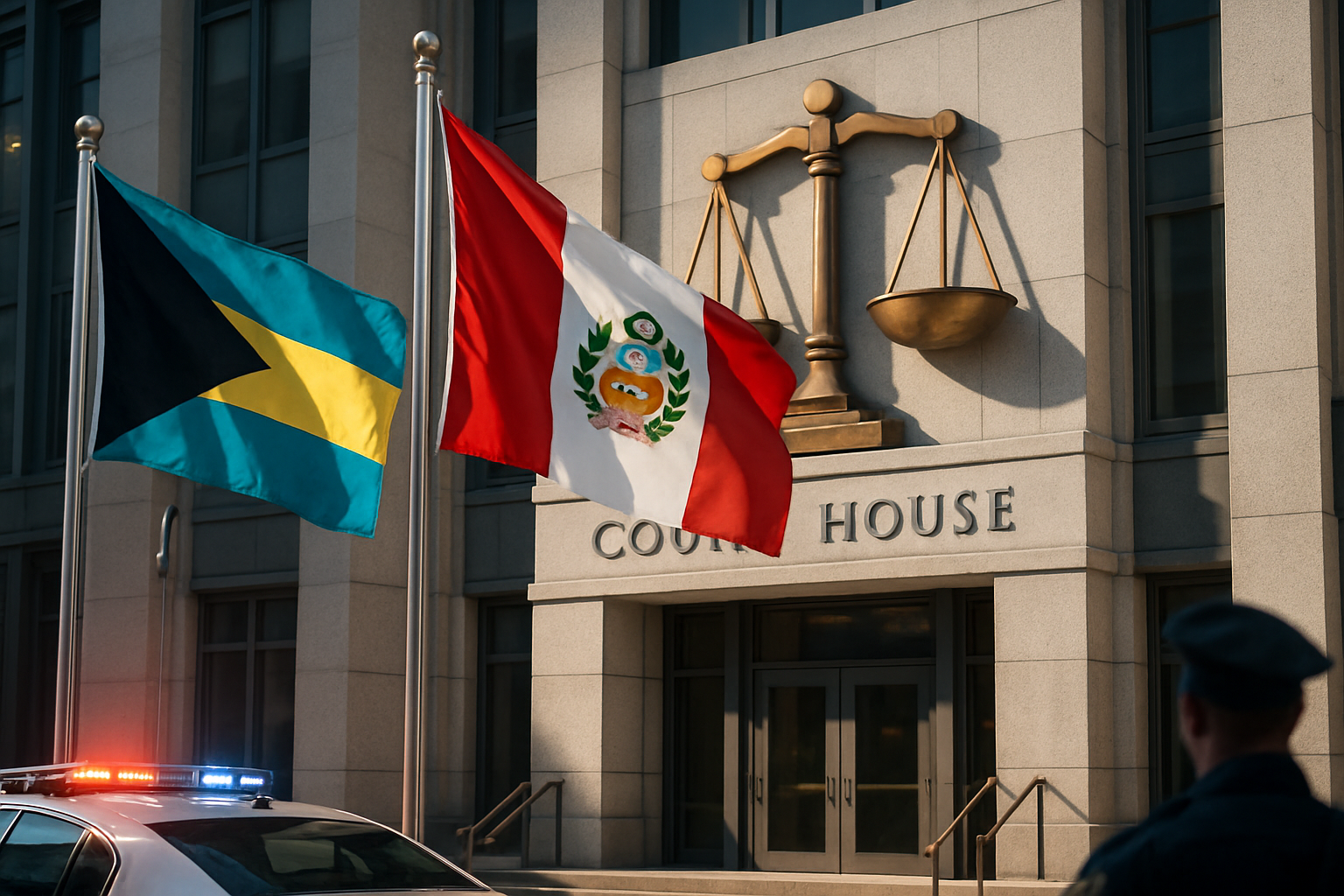
A comprehensive investigation into legal and criminal justice developments across the Bahamas and Peru has uncovered a web of corruption, violence, and institutional failures that experts say represents one of the most significant challenges to democratic governance in the Western Hemisphere.
The revelations, spanning high-profile drug trafficking cases involving former government officials to shocking instances of police-on-police violence, demonstrate what legal analysts describe as systemic breakdowns in institutions designed to uphold the rule of law. These developments come at a time when international criminal networks are becoming increasingly sophisticated, exploiting weaknesses in national judicial systems.
Bahamas: High-Level Drug Trafficking Scandal
The most shocking revelation centers on the Bahamas, where the U.S. Department of Justice has set March 1, 2027, as the trial date for a drug trafficking case that has ensnared former government officials and senior police officers. The case involves the vessel "Reel Xperience," owned by prominent figures and financed through a credit union loan, which was intercepted carrying 200 kilograms of cocaine.
According to court documents obtained by Planet News, the investigation has exposed connections between high-ranking Bahamian officials and international drug trafficking networks. The case represents a significant test of the Bahamas' commitment to combating corruption within its own governmental structures.
"How does a former Minister and MP and SENIOR POLICE get caught up in all this WICKEDNESS?!"
— Bahamaspress.com Editorial
The involvement of senior law enforcement officials in drug trafficking operations highlights a troubling pattern of institutional corruption that experts say has undermined public trust in Caribbean law enforcement agencies. The case is being closely monitored by international anti-corruption organizations as a potential bellwether for regional judicial reform efforts.
Peru: Wave of Violence Against Law Enforcement
Meanwhile, in Peru, a series of violent crimes targeting police officers has exposed deep-seated problems within the country's law enforcement community. The most disturbing case involves the murder of Police Sub-Officer Marleni Martha Rucana, whose body was discovered after a colleague confessed to the crime.
The killing of Rucana represents part of a broader pattern of violence that has shaken Peru's National Police (PNP). In a separate high-profile case, authorities are seeking nine months of preventive detention for Adrián Villar in connection with the hit-and-run death of Lizeth Marzano in San Isidro, with prosecutors citing flight risk and potential obstruction of justice.
Perhaps most significantly, the Peruvian justice system has sentenced Wanda del Valle Bermúdez, known as "La Bebecita del Crimen," to more than six years in prison for orchestrating a planned assassination attempt against a PNP general. The case demonstrates the extent to which organized crime has infiltrated attempts to corrupt or eliminate law enforcement officials.
Institutional Crisis and Reform Challenges
Legal experts analyzing these developments point to several systemic issues plaguing judicial institutions across the region. Resource constraints, political interference, and the increasing sophistication of criminal networks have created what some describe as a "perfect storm" challenging democratic governance.
Dr. Maria Rodriguez, a specialist in Caribbean legal systems at the University of Miami, tells Planet News that these cases represent "a fundamental crisis of institutional legitimacy that goes beyond individual criminal acts to systemic failures in democratic governance."
The international dimension of these crimes has necessitated unprecedented cooperation between national law enforcement agencies and international bodies. The U.S. Department of Justice's involvement in the Bahamas case, for instance, reflects the transnational nature of modern criminal enterprises that exploit jurisdictional boundaries.
Technology and Modern Criminal Networks
Investigators note that contemporary criminal organizations employ sophisticated technology and financial instruments that often surpass the capabilities of traditional law enforcement agencies. The financing of drug trafficking operations through seemingly legitimate financial institutions, as evidenced in the Bahamas case, demonstrates how criminal networks have adapted to modern banking systems.
Enhanced international cooperation has become essential for addressing these challenges. European law enforcement agencies describe current criminal network investigations as representing "the largest international elite criminal network exposure in recent memory," requiring coordination across multiple jurisdictions and legal systems.
Democratic Accountability Under Pressure
The cases highlighted in this investigation raise fundamental questions about the relationship between democratic institutions and criminal justice systems. When former government officials and senior police officers become subjects of criminal investigations, it tests the capacity of democratic societies to hold powerful individuals accountable regardless of their political connections or institutional status.
Constitutional law professor Dr. James Martinez of the Inter-American University explains that "these cases represent a critical test of whether democratic institutions can demonstrate that no one is above the law, while maintaining the institutional integrity necessary for effective governance."
"The true measure of a democracy is not whether it can prevent corruption, but whether it can prosecute it fairly and effectively when it occurs."
— Dr. James Martinez, Constitutional Law Expert
Regional Security Implications
The scale and scope of criminal activity documented in these cases have significant implications for regional security throughout the Caribbean and Latin America. Drug trafficking networks that can corrupt senior government officials and law enforcement officers pose threats that extend far beyond national boundaries.
Intelligence analysts note that the Caribbean has become a critical transit point for narcotics flowing from South America to North American and European markets. The corruption of local institutions facilitates these operations and undermines international counter-narcotics efforts.
The involvement of financial institutions in facilitating criminal activities, as evidenced in the credit union financing of the "Reel Xperience," highlights the need for enhanced financial oversight and anti-money laundering measures throughout the region.
International Response and Cooperation
International bodies have responded to these developments by enhancing cooperation mechanisms and providing technical assistance to national judicial systems. The Organization of American States and various UN agencies have announced initiatives aimed at strengthening institutional capacity and improving international coordination.
However, experts caution that sustainable solutions require more than enhanced cooperation between existing institutions. Fundamental reforms may be necessary to address the root causes of institutional weakness and corruption that enable criminal networks to flourish.
The European Union has indicated that similar patterns of institutional corruption and criminal network infiltration are being observed globally, necessitating comprehensive approaches that address not only law enforcement cooperation but also governance reforms and economic development initiatives.
Looking Forward: Institutional Reform and Accountability
As these cases proceed through the judicial system, they will serve as important tests of institutional resilience and democratic accountability. The March 2027 trial date in the Bahamas case will provide a crucial opportunity to demonstrate that democratic institutions can function effectively even when investigating their own officials.
Legal observers emphasize that the outcomes of these proceedings will establish important precedents for how democratic societies address high-level corruption and institutional failures. Success in prosecuting these cases fairly and effectively could strengthen public confidence in democratic institutions, while failures could further undermine already fragile public trust.
The international community will be watching closely as these cases unfold, recognizing that the challenges facing the Bahamas and Peru are indicative of broader threats to democratic governance throughout the hemisphere and beyond.
Conclusion: Democracy's Resilience Test
The legal and criminal justice developments documented in this investigation represent more than isolated criminal cases—they constitute a fundamental test of democratic institutions' capacity to maintain the rule of law under pressure from sophisticated criminal networks and internal corruption.
As Dr. Rodriguez observes, "The true measure of these institutions will not be whether they can prevent such problems from arising, but whether they can respond effectively when they do, maintaining both accountability and institutional integrity in the process."
The coming months will reveal whether democratic institutions in the Caribbean and Latin America possess the resilience necessary to meet these challenges while preserving the principles of democratic governance that underpin legitimate political authority. The stakes could not be higher, as failure to address these systemic issues risks further erosion of public confidence in the institutions essential for democratic society.