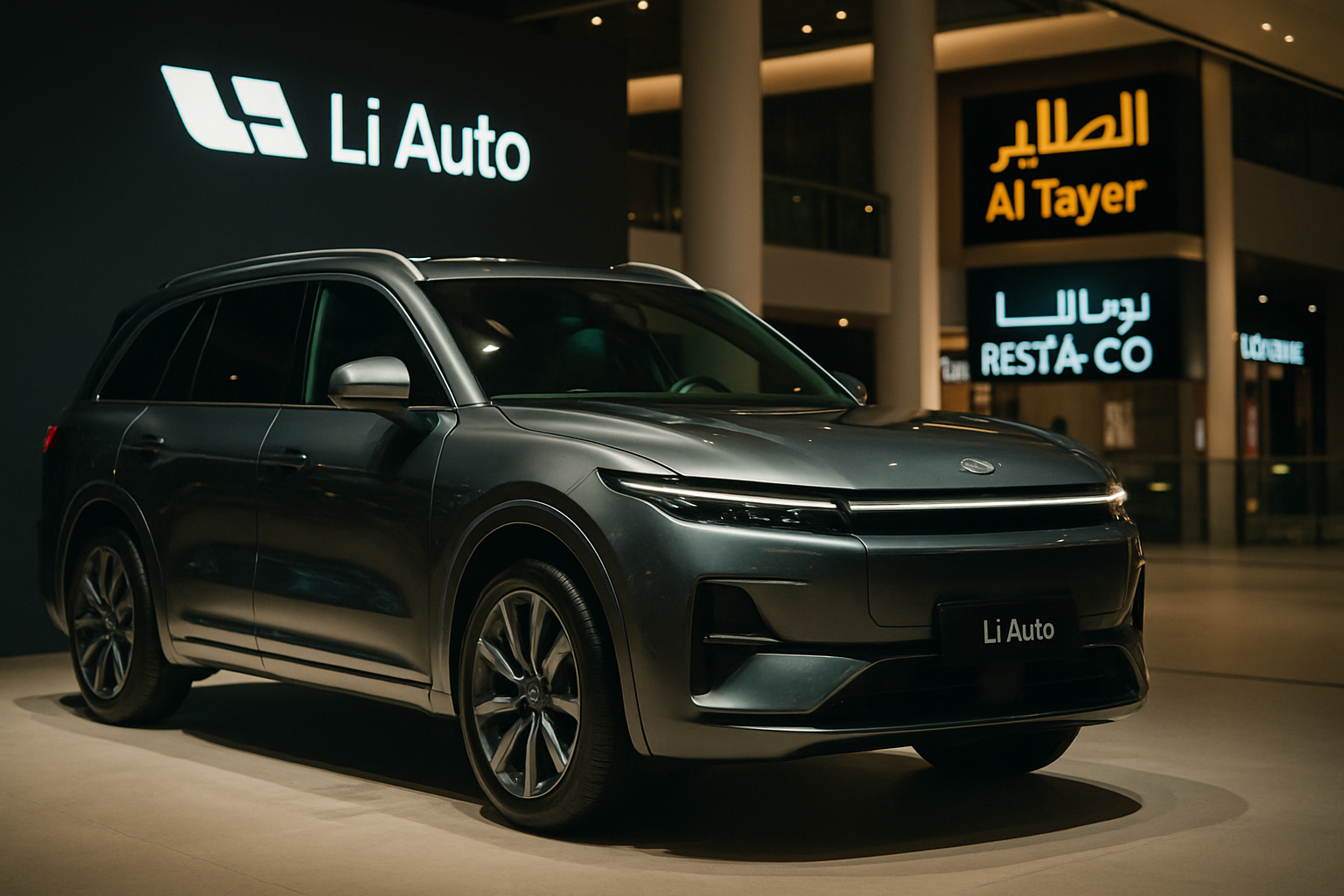
Li Auto, one of China's leading electric vehicle manufacturers and a major Tesla rival, has announced ambitious plans to challenge premium German automakers BMW and Mercedes-Benz in the Middle East and Asia-Pacific regions with its intelligent SUV lineup, marking a significant escalation in the global automotive competition.
The Beijing-based electric vehicle maker, which is actively building an international sales network, expects overseas deliveries to account for 30 percent of its total sales by 2030, according to president Ma Donghui. This strategic expansion represents a direct challenge to established luxury brands in their traditional strongholds.
"It is inevitable that we will compete against BMW, Benz and Audi," Ma stated, signaling Li Auto's confidence in taking on the German luxury triumvirate that has dominated premium automotive markets for decades. The company's expansion comes at a time when Chinese manufacturers are increasingly asserting their technological and competitive advantages on the global stage.
Strategic Market Positioning
Li Auto's international expansion strategy reflects broader Chinese automotive industry ambitions amid unprecedented technological transformation. The company's premium intelligent models leverage advanced electric vehicle technology, including sophisticated battery management systems and cutting-edge autonomous driving capabilities that position them competitively against traditional luxury manufacturers.
The targeting of Middle East and Asia-Pacific markets represents careful strategic positioning, as these regions show strong growth potential for premium electric vehicles while offering less entrenched competition than European or North American markets. The Middle East, in particular, presents opportunities as governments across the region invest heavily in electric vehicle infrastructure as part of economic diversification efforts.
Simultaneously, Chinese manufacturers are establishing production footprints in Europe itself. French sources reveal a new trend where Chinese industrial companies are installing operations at existing European manufacturer sites. Partnerships between Dongfeng and Leapmotor with Stellantis, and discussions between Chery and Nissan, signal Chinese manufacturers' intention to produce directly within European markets, potentially including operations at facilities like the Citroën plant in Rennes.
Technological Advantages and Market Context
Chinese electric vehicle manufacturers have achieved remarkable technological breakthroughs that underpin their global expansion ambitions. Companies like BYD have developed Megawatt Flash Charging technology capable of delivering 400km range in just 5 minutes, while advanced battery systems like Blade Battery 2.0 function effectively in temperatures as low as -30°C, addressing key adoption barriers in diverse global markets.
The timing of Li Auto's expansion coincides with a critical period in global automotive transformation. The ongoing oil crisis, with Brent crude prices reaching $119.50 and WTI at $108.15 following Iran's Strait of Hormuz closure, has made electric vehicles an economic necessity rather than merely an environmental choice. This crisis-driven demand creates unprecedented opportunities for manufacturers with strong electric vehicle portfolios.
China maintains strategic dominance in the electric vehicle supply chain, controlling 60% of global critical materials production and 90% of refining capacity for lithium, cobalt, and rare earth elements. This supply chain control, combined with technological innovation, provides Chinese manufacturers with significant competitive advantages as traditional automakers struggle with semiconductor shortages that have driven chip prices up sixfold.
European Manufacturing Strategies
The expansion into European manufacturing represents a sophisticated approach to global market penetration. Rather than simply exporting from China, manufacturers are establishing local production capabilities that reduce logistics costs, minimize supply chain vulnerabilities, and potentially circumvent trade restrictions.
This strategy follows successful models where Chinese companies have leveraged existing European automotive infrastructure. The approach allows for rapid market entry while benefiting from established supplier networks and skilled workforces. European facilities also provide strategic positioning for broader regional expansion and help address any potential regulatory preferences for locally-manufactured vehicles.
The integration with existing European sites demonstrates the pragmatic approach Chinese manufacturers are taking toward international expansion. By partnering with established players like Stellantis and potentially Nissan, Chinese companies gain immediate access to distribution networks, regulatory expertise, and market knowledge that would take years to develop independently.
Competitive Landscape and Market Response
Li Auto's expansion occurs amid intensifying global competition in the premium electric vehicle segment. Traditional luxury manufacturers like BMW and Mercedes-Benz are rapidly electrifying their lineups, with BMW announcing electric 3 Series production beginning August 2026 at its Munich facility, while simultaneously developing hydrogen vehicle technology at its Austrian operations under new director Harald Gottsche.
European automakers are increasingly seeking government support to compete with Chinese manufacturers who benefit from integrated supply chains and strategic government backing. The competitive pressure has prompted calls for Brussels financial assistance as European companies struggle to match the cost advantages and technological capabilities of Chinese rivals.
The transformation extends beyond passenger vehicles to commercial applications, with companies like Tesla scaling Semi truck production and various manufacturers expanding into fleet electrification. This comprehensive approach to transportation electrification creates multiple competitive fronts where Chinese manufacturers can leverage their technological advantages.
Infrastructure and Regulatory Environment
The success of Li Auto's expansion strategy depends significantly on supportive infrastructure development and regulatory frameworks. Austria has doubled its EV charging capacity by adding 1,000 stations, while Estonia leads continental Europe with 88% renewable electricity and the continent's largest battery storage network serving 90,000 households.
China's role as a global automotive standards-setter is evident in regulations like the hidden door handle ban effective January 2027, which affects Tesla, BYD, NIO, and XPeng, requiring mechanical releases that prioritize safety over aesthetics. Such regulatory leadership demonstrates China's growing influence in shaping global automotive safety and design standards.
Vehicle-to-grid technology advancement enables electric vehicles to serve as mobile energy storage systems, supporting grid stability during peak demand periods. This capability aligns with broader energy transition goals and provides additional value propositions for premium electric vehicles in target markets.
Long-term Strategic Implications
Li Auto's expansion represents more than individual company growth—it signals a fundamental shift in global automotive competitive dynamics. Chinese manufacturers' success in combining technological innovation with strategic market positioning challenges the traditional dominance of European and American automotive giants.
The climate urgency context, with January 2026 marking the 18th consecutive month exceeding 1.5°C above pre-industrial levels, provides additional momentum for transportation electrification. This environmental imperative, combined with economic necessity driven by volatile oil markets, creates favorable conditions for electric vehicle adoption acceleration.
Regional cooperation and strategic partnerships are becoming increasingly important as manufacturers navigate complex global supply chains and diverse market requirements. Li Auto's success in challenging established premium brands could influence broader Chinese manufacturing strategies and international trade relationships.
The company's ambition to capture 30% overseas market share by 2030 represents a significant milestone that could reshape global automotive market dynamics. Success would demonstrate that Chinese manufacturers can compete effectively across all vehicle segments, from mass market to luxury, fundamentally altering consumer perceptions and market positioning worldwide.
As the automotive industry undergoes its most significant transformation in over a century, Li Auto's expansion into premium markets signals the emergence of a truly multipolar global automotive landscape where technological capability and strategic execution matter more than traditional brand heritage.