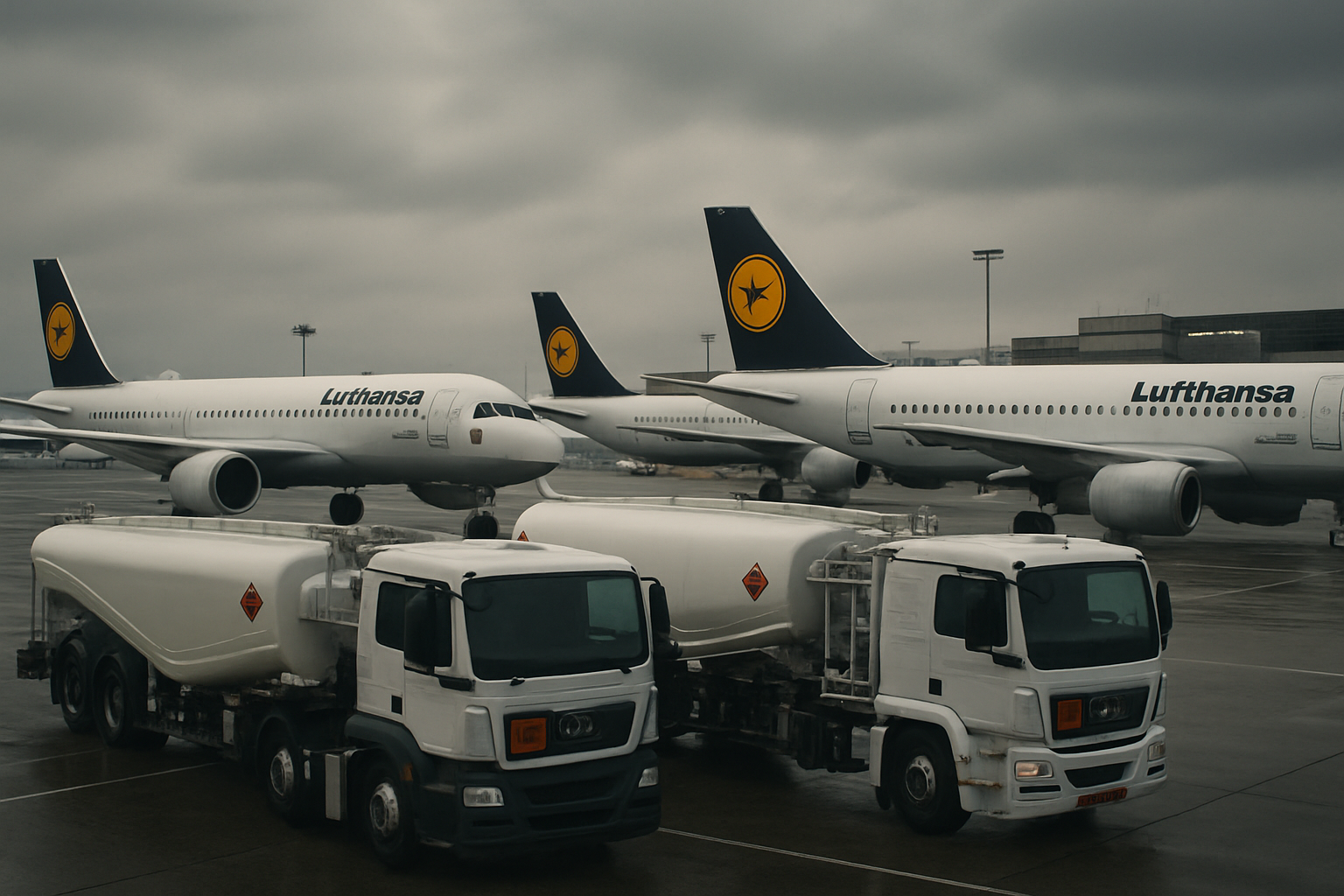
Lufthansa Group, Europe's largest airline, announced Tuesday the cancellation of 20,000 short-haul flights through October as the global aviation industry grapples with the most severe fuel crisis since World War II, driven by Middle East conflicts that have doubled jet fuel prices and forced airlines worldwide to implement unprecedented operational cuts.
The German aviation giant's decision represents the latest in a cascading series of industry cutbacks affecting airlines across the globe, as jet fuel prices have surged 122% from $85-90 per barrel to $150-200 following Iran's closure of the Strait of Hormuz, which handles 40% of the world's seaborne oil transit.
Dramatic Scale of Lufthansa's Response
The 20,000 flight cancellations will primarily affect European routes operated by the Lufthansa Group, reducing the company's summer capacity by approximately 1%. According to company statements, the measures are expected to save around 40,000 tons of jet fuel—a critical conservation effort as the airline struggles with costs that have become "economically unsustainable."
Initial cancellations have already begun, with Lufthansa eliminating approximately 120 flights daily through the end of May. Affected passengers have been notified of changes to routes including Frankfurt to Bydgoszcz, Rzeszow, and Stavanger, which have been temporarily suspended.
"The company is facing unprecedented challenges due to fuel cost increases of this magnitude, making it necessary to react in order to maintain stable and reliable operations."
— Lufthansa Group spokesperson
The airline has also permanently closed its CityLine subsidiary, citing the unsustainable operational environment created by the fuel crisis. This marks one of the most significant restructuring moves in Lufthansa's 100-year history, eliminating a key regional connector service that had served European destinations.
Global Aviation Industry in Crisis
Lufthansa's announcement comes amid the worst global aviation disruption since the COVID-19 pandemic, with over 18,000 flights cancelled worldwide since the crisis began in March 2026. The International Energy Agency (IEA) Director Fatih Birol has warned that Europe has "perhaps six weeks of jet fuel" remaining before systematic flight cancellations become inevitable by early June.
The crisis has forced airlines across the globe to implement emergency measures:
- Air France-KLM has added emergency surcharges of €50 for economy class and €200 for business class on long-haul routes
- Norwegian Airlines deployed 125 additional flights to capture market share after SAS cancelled over 1,000 flights due to unsustainable fuel costs
- Ryanair CEO Michael O'Leary is conducting daily emergency calls with European fuel suppliers
- Multiple Italian airports, including Milan Linate, Venice, and Bologna, are experiencing severe fuel supply limitations
The Strait of Hormuz Blockade
The root cause of the crisis lies in Iran's Revolutionary Guard maintaining control of the Strait of Hormuz, a 21-mile waterway that serves as the world's most critical energy chokepoint. The blockade, which began following the breakdown of US-Iran nuclear negotiations in February, has stranded over 150 oil and LNG tankers worth billions in cargo.
The geopolitical standoff has created a catastrophic supply chain collapse, with major shipping companies Maersk and MSC suspending all Persian Gulf operations. Qatar's LNG facilities at Ras Laffan and Mesaid, which account for approximately 20% of global LNG exports, remain shut down following Iranian attacks.
Historic Government Response
The crisis has prompted the largest strategic petroleum reserve release in 50-year history, with the IEA coordinating the deployment of 400 million barrels from 32 countries—double the amount released during the 2022 Ukraine crisis. Japan is contributing 80 million barrels, marking its first strategic release since the 2011 Fukushima disaster.
European governments have abandoned traditional free-market principles to protect consumers and critical industries:
- Hungary has implemented immediate price caps on gasoline and diesel to counter "war-driven explosions"
- France has deployed 500 fuel inspectors to prevent price manipulation
- Romania has outlined five emergency scenarios to prevent diesel from exceeding 10 lei per liter
- Germany has strengthened antitrust laws targeting gas station manipulation
Consumer Impact Across Europe
The fuel crisis is hitting European consumers with unprecedented force. In Sweden, electricity costs have increased by 10-20 öre with gasoline prices rising by 1-2 kronor, with Malmö being the most exposed due to continental integration. Ireland is experiencing heating oil prices approaching €2 per liter, which officials have condemned as "brazen rip-offs."
The transportation sector faces particular strain, with Romania's freight companies experiencing acute pressure from fuel cost increases that have pushed diesel prices up by 10%. Companies are being forced to reduce speeds to a maximum of 82 km/hour to conserve fuel and optimize routes while absorbing cost differences that clients refuse to accept.
Financial Markets in Turmoil
The aviation fuel crisis has triggered historic crashes in global financial markets. Pakistan's KSE-100 index suffered its largest single-day decline in history at -8.97%, while South Korea's KOSPI plummeted 12%, triggering circuit breakers as the Korean won hit 17-year lows.
PayPal postponed its $1.1 billion IPO indefinitely due to market volatility, while central banks from the European Central Bank to the Bank of Japan are coordinating emergency liquidity measures. Traditional monetary policy has proven limited in effectiveness against such structural geopolitical disruptions.
"This represents the most severe energy security crisis in decades, with single-chokepoint vulnerabilities fully exposed."
— Samuel Ciszuk, Energy Security Analyst
Summer Travel Season in Jeopardy
The timing of the crisis poses maximum challenges for the European aviation industry as it approaches the peak summer travel season. With systematic flight cancellations potentially beginning in June, millions of travelers face the prospect of disrupted vacation plans and significantly higher airfares.
The crisis is already reshaping tourism patterns across the continent. Croatia is positioning itself as a safer European alternative with its extensive network of 62 medical clinics—Europe's most comprehensive seasonal healthcare infrastructure. Spain, with its capacity of 513.6 million annual nights, is capturing demand redirected from traditional Middle Eastern destinations.
Travel insurance gaps have been exposed, as standard policies exclude war-related cancellations, leaving individual travelers financially vulnerable. This has driven a significant shift toward package tours over independent travel, as tour operators can provide more comprehensive protection.
Industry Transformation Accelerated
The crisis is accelerating permanent changes across the aviation industry. Enhanced security screening, mandatory conflict insurance, and pre-approval for high-risk destinations are becoming standard operating procedures. Airlines are urgently reassessing route structures to reduce dependence on Middle Eastern hubs that have served as critical connection points between Europe and Asia.
The technological integration is advancing rapidly, with airlines implementing AI-powered fuel optimization systems, real-time routing adjustments, and predictive maintenance protocols to maximize efficiency during these challenging times.
Nuclear Diplomacy Context
The energy crisis stems from the complete breakdown of US-Iran nuclear negotiations despite what had been considered a breakthrough in Geneva talks—the most progress since the 2018 JCPOA collapse. The fundamental disagreement centered on Iran's exclusion of ballistic missiles and proxy forces from any agreement versus US demands for comprehensive coverage including missiles, armed groups, and human rights issues.
This diplomatic failure led to Operation Epic Fury, the largest US-Israeli coordinated military operation since 2003, which prompted Iran's massive retaliation under Operation True Promise 4, with Iranian officials declaring "no red lines remain."
The nuclear governance context has been further complicated by the expiration of the New START treaty in February 2026—the first time in over 50 years that the US and Russia have operated without nuclear constraints. Iran continues uranium enrichment at 60% levels with over 400kg of weapons-grade material, sufficient for multiple nuclear weapons.
Template-Setting Crisis Management
UN Secretary-General António Guterres has described the current situation as the "greatest test of multilateral cooperation in the modern era," with nuclear risks at their "highest level in decades." The crisis represents a watershed moment for 21st-century international relations, determining whether diplomatic or military frameworks will dominate future conflict resolution.
Energy security experts warn that the over-dependence on strategic chokepoints like the Strait of Hormuz requires fundamental restructuring of global energy architecture. While strategic petroleum reserves provide temporary buffers, sustained disruptions demand long-term supply diversification and accelerated renewable energy transitions.
Uncertain Recovery Timeline
Unlike weather-related disruptions that follow predictable patterns, the recovery timeline for this crisis depends entirely on military and diplomatic resolution of the Middle East conflicts. Airlines are conducting daily operational reviews but cannot make long-term scheduling decisions with multiple airspaces closed and fuel prices remaining volatile.
Qatar's Energy Minister Saad Al Kaabi has warned that Gulf states may be forced to declare force majeure "within weeks" if the situation continues, potentially pushing oil prices to $150 per barrel and threatening to "bring down the economies of the world."
"The aviation industry faces a choice between maintaining global connectivity despite security risks or adopting regionalized, security-conscious travel patterns that fragment the network we've built over decades."
— Industry Analysis Report
Long-Term Implications
The April 2026 crisis represents a defining moment that will influence aviation operational practices, regulatory frameworks, and international cooperation approaches for decades ahead. The success or failure of containing this regional crisis will provide either a framework for future nuclear crisis resolution or accelerate military solutions that reshape Middle Eastern geopolitics while encouraging nuclear proliferation globally.
For European aviation, Lufthansa's 20,000 flight cancellations mark not just an operational adjustment, but a fundamental reckoning with the vulnerabilities of modern transportation networks in an increasingly volatile geopolitical environment. The industry's ability to adapt and emerge stronger from this crisis will determine whether global air travel remains a connector of peoples and economies or fragments into security-conscious regional networks.
As the six-week countdown to potential systematic European flight shutdowns continues, the aviation industry faces its greatest test since World War II—one that will reshape how we think about energy security, crisis management, and international cooperation in the 21st century.