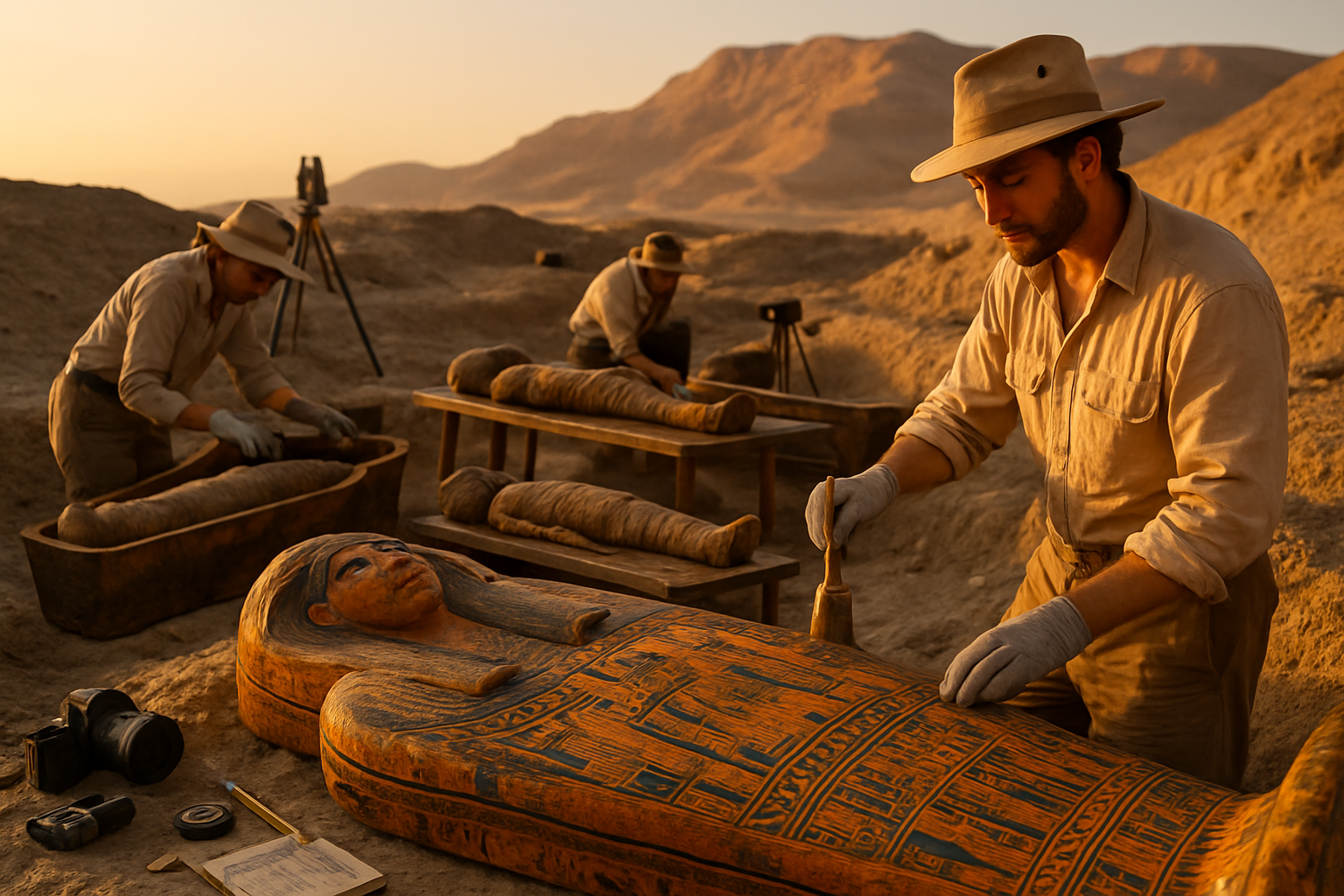
An Egyptian archaeological mission has made a spectacular discovery in Al-Qurna on the West Bank of Luxor, uncovering a cache of 22 colorful wooden coffins containing mummies alongside a collection of rare papyri dating back to the Third Intermediate Period of Ancient Egypt, specifically Dynasties 21 to 25.
The remarkable find was made by a joint mission from the Supreme Council of Antiquities and the Zahi Hawass Foundation for Archaeology and Heritage while conducting excavations in the southwestern corner of the courtyard of the tomb of Seneb. This discovery represents a significant milestone in what historians are calling the "2026 Archaeological Renaissance," a period marked by unprecedented global discoveries that are fundamentally reshaping our understanding of ancient civilizations.
A Treasury Hidden in Stone
The painted wooden coffins were discovered inside a rectangular chamber carved directly into the rock, their vibrant decorations remarkably preserved despite their age of over 2,500 years. Each coffin contains mummified remains, providing researchers with an extraordinary opportunity to study ancient Egyptian burial practices, religious beliefs, and daily life during one of the most tumultuous periods in Egyptian history.
According to Egypt's Minister of Tourism and Antiquities Sherif Fathy, the discovery "represents a significant addition to Egypt's growing list of archaeological finds and reflects the state's continued support for archaeological research and heritage preservation." The find comes at a time when Egypt has been investing heavily in archaeological research, building on previous discoveries that have already yielded remarkable insights into ancient Egyptian civilization.
The Third Intermediate Period Context
The Third Intermediate Period, spanning roughly from 1070 to 664 BCE, was a time of political fragmentation and foreign rule in Egypt. During this era, the unified Egyptian state had broken down into competing regional powers, with various dynasties ruling simultaneously in different parts of the country. The coffins and their contents provide crucial evidence of how religious and burial practices evolved during this complex period.
Previous archaeological work in the region has revealed that many of the individuals buried in similar coffins were Amun chanters – religious officials who played crucial roles in the ceremonies at ancient Thebes (modern Luxor). These religious personnel were essential to maintaining the spiritual life of one of Egypt's most important religious centers, even during politically unstable times.
"The painted decorations show intricate religious imagery and hieroglyphic texts that reveal spiritual beliefs and daily practices of ancient Egyptian religious personnel."
— Archaeological Research Team, Supreme Council of Antiquities
Rare Papyri Provide Written Records
Perhaps even more significant than the coffins themselves is the collection of rare papyri discovered alongside them. These ancient documents, found in pristine condition, contain religious texts, administrative records, and personal correspondence that illuminate the complex temple bureaucracy of ancient Egypt. The exceptional preservation of these papyri makes this discovery particularly valuable to scholars studying ancient Egyptian society.
The papyri provide unprecedented insights into the daily operations of ancient Egyptian temples, including details about religious ceremonies, economic transactions, and the hierarchical structure of religious institutions. Such well-preserved written documents from this period are extraordinarily rare, making this discovery a treasure trove for Egyptologists and historians worldwide.
Part of a Global Archaeological Renaissance
This Egyptian discovery joins a remarkable series of archaeological breakthroughs that have characterized 2026 as a landmark year for historical research. The current archaeological renaissance has seen major discoveries across multiple continents, from ancient human ancestors in Cyprus to prehistoric settlements in various parts of the world.
The phenomenon represents more than just fortunate timing; it reflects the convergence of advanced analytical techniques with traditional archaeological methods. Modern tools including ground-penetrating radar, advanced chemical analysis, and sophisticated dating methods are enabling researchers to uncover and understand artifacts that previous generations of archaeologists could only dream of accessing.
Technological Innovation Meets Ancient Wisdom
The success of the Luxor excavation exemplifies how modern archaeological methodology has evolved to combine cutting-edge technology with time-tested excavation techniques. The research team employed advanced imaging technologies to document the find, while careful manual excavation ensured that delicate artifacts were preserved for future study.
Digital documentation techniques are creating permanent records of these discoveries, allowing researchers worldwide to study the artifacts virtually while ensuring that the originals remain protected in appropriate conservation environments. This approach represents a significant advancement in archaeological practice, making discoveries globally accessible while respecting the cultural heritage of source communities.
International Cooperation and Scholarly Impact
The excavation demonstrates the importance of international collaboration in modern archaeology. The joint mission between Egyptian institutions and the Zahi Hawass Foundation represents a model for how archaeological research can benefit from diverse expertise while respecting local ownership of cultural heritage.
The discovery is expected to attract significant international scholarly attention, with researchers from universities and museums worldwide likely to request access to study the artifacts. Such collaboration enhances the global understanding of ancient Egyptian civilization while contributing to Egypt's position as a leader in archaeological research and cultural preservation.
Climate Change and Archaeological Urgency
The timing of this discovery underscores the growing urgency of archaeological preservation efforts. Climate change and environmental pressures are threatening archaeological sites globally, with many potentially valuable locations facing deterioration or destruction. The success of the Luxor excavation highlights the critical importance of systematic archaeological investigation before such sites are lost forever.
The current period represents a crucial window for archaeological research, as advanced techniques become available just as environmental threats to historical sites are intensifying. This combination creates both unprecedented opportunities and urgent responsibilities for the global archaeological community.
Economic and Cultural Impact
Beyond their scholarly significance, discoveries like the Luxor coffins and papyri contribute substantially to Egypt's cultural tourism industry and international profile. Archaeological discoveries attract visitors from around the world, generating economic benefits for local communities while raising awareness of Egypt's rich historical heritage.
The find also contributes to Egypt's cultural diplomacy efforts, strengthening international relationships through shared appreciation of human history and cultural achievement. Such discoveries remind the global community that archaeological sites represent humanity's common heritage, deserving protection and study for future generations.
Future Research Directions
The analysis of the coffins and papyri is expected to continue for years, with researchers planning detailed studies of the mummified remains, chemical analysis of the painted decorations, and comprehensive translation of the written documents. Each aspect of the discovery promises to yield new insights into ancient Egyptian civilization during a pivotal period in its history.
The success of this excavation also indicates that the tomb of Seneb and surrounding areas may contain additional undiscovered treasures. Future excavations in the region are likely to build on this discovery, potentially revealing more about the religious and social structures of ancient Thebes.
As the global archaeological renaissance of 2026 continues, discoveries like the Luxor coffins and papyri demonstrate humanity's capacity to uncover and preserve knowledge about our shared past. They remind us that much of human history remains hidden, waiting to be discovered by dedicated researchers using the best tools and methods available to modern archaeology.