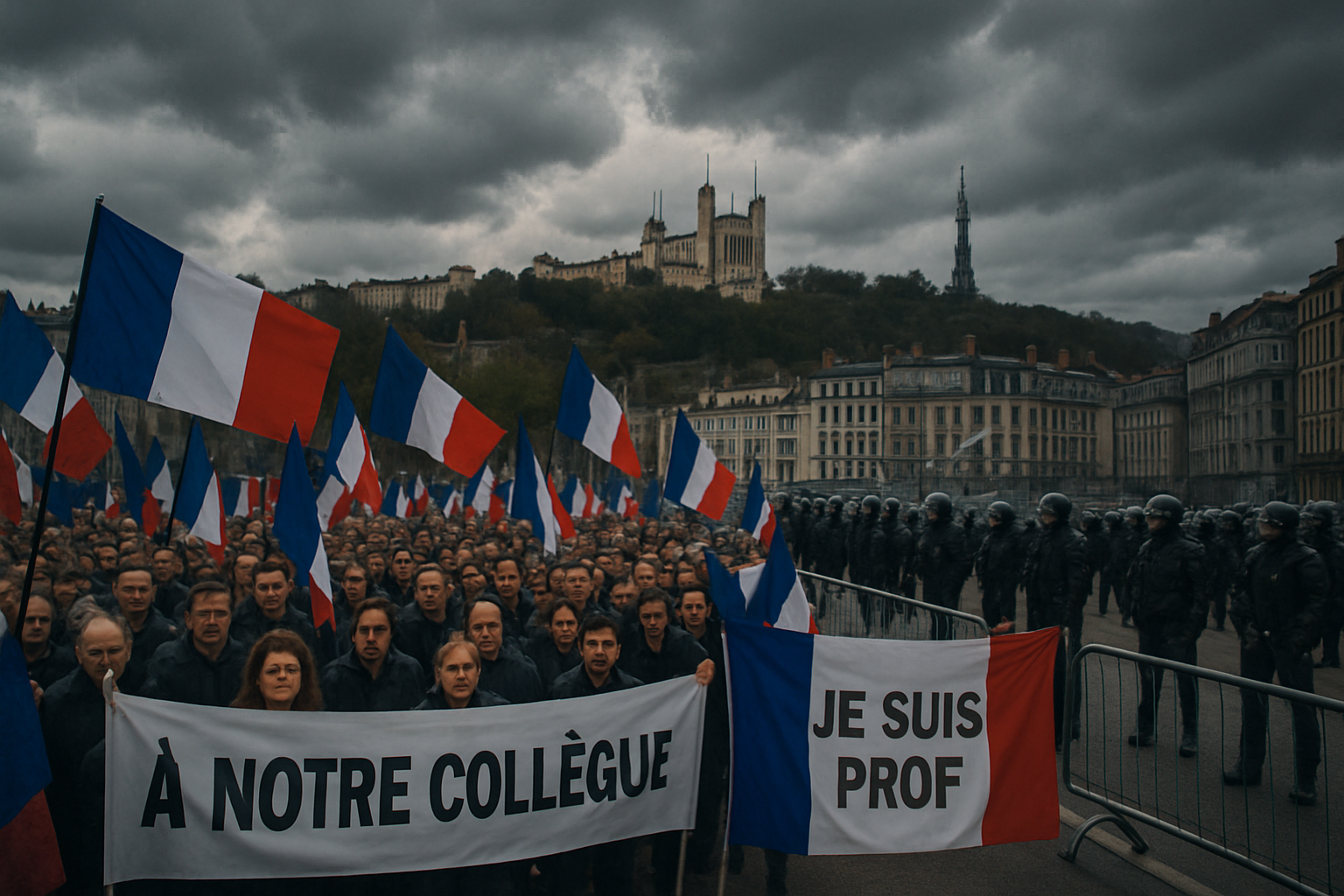
France faces its gravest political crisis in years as thousands prepare to attend memorial rallies for Quentin Deranque, the 23-year-old far-right activist whose death in Lyon has inflamed tensions between extremist groups and sparked international diplomatic incidents.
President Emmanuel Macron made an urgent appeal for "calm and restraint" as authorities authorized rallies in both Rennes and Lyon on Saturday, February 21, 2026, despite security concerns that have mobilized hundreds of police officers across both cities. The death of Deranque, a mathematics student and devout Catholic, has become a rallying cry for Marine Le Pen's National Rally and has isolated Jean-Luc Mélenchon's La France Insoumise movement ahead of crucial March 2026 municipal elections.
The Fatal Incident That Shocked France
Deranque died on February 15 from severe cranial injuries sustained during violent clashes on the margins of a pro-Palestinian conference featuring MEP Rima Hassan. The 23-year-old was beaten by at least six masked assailants during counter-protests, transforming what should have been a university political discussion into a deadly confrontation that has reverberated across French politics.
Seven suspects have been formally charged with intentional homicide, including Jacques-Elie Favrot, a parliamentary assistant to La France Insoumise deputy Raphaël Arnault. This connection has intensified political pressure on Mélenchon's movement, with Justice Minister Gérald Darmanin blaming the "ultra-left" for the killing and National Rally's Jordan Bardella declaring Mélenchon's "immense moral responsibility."
"We ask for cooler heads to prevail. This is a test of our democratic institutions' ability to manage political violence through legal channels rather than vigilante justice."
— Emmanuel Macron, President of France
International Diplomatic Fallout
The case has strained France's relationships with key European allies. Italian Prime Minister Giorgia Meloni called Deranque's death a "wound for all of Europe," condemning what she described as a "climate of ideological hatred." This prompted a sharp response from President Macron, who told Rome not to "comment on what is happening in other countries" and criticized nationalists who "interfere in others' affairs."
The Trump administration has also weighed in, with officials denouncing what they termed "terrorism" and left-wing violence in France, adding an unwelcome international dimension to an already volatile domestic situation. This diplomatic friction occurs as France grapples with its own internal divisions and the challenge of maintaining European unity.
Unprecedented Security Measures
Interior Minister Laurent Nuñez authorized the memorial rallies despite Lyon's mayor urging a ban due to "proven risks of public disorder." The decision to allow the demonstrations, expected to draw 2,000-3,000 participants in Lyon alone, reflects the delicate balance between preserving freedom of expression and maintaining public order.
The rally, titled "March in Homage to Quentin," is scheduled for 3:00 PM in Lyon, with similar events in Rennes beginning at 11:00 AM. Heavy police deployments have been arranged, with authorities expressing concerns about potential infiltration by ultra-right groups and the risk of counter-demonstrations.
This marks the second major political violence incident in Lyon within months, following previous clashes that resulted in 16 police officers being hospitalized and multiple arrests. The pattern of escalating violence has raised serious questions about France's ability to contain political extremism through democratic means.
Political Realignment and Electoral Consequences
The tragedy has triggered a significant political realignment within France's left-wing coalition. The Socialist Party has begun distancing itself from La France Insoumise, leaving Mélenchon's movement increasingly isolated as the March 2026 municipal elections approach. This fragmentation of the left comes at a crucial time, with Marine Le Pen's National Rally seeking to capitalize on the incident to broaden their electoral appeal.
Government announcements of restrictions on political meetings at universities represent a broader concern about the state of democratic discourse in France. The move, while aimed at preventing future violence, has raised questions about academic freedom and the right to political expression on campus.
The Victim and the Broader Context
Quentin Deranque was described by those who knew him as a committed student with strong religious convictions. His death has resonated beyond political circles, touching on broader themes of youth disillusionment, political radicalization, and the dangerous intersection of ideology and violence in contemporary France.
The case has been complicated by false accusations spread on social media, including targeting a Lyon woman from La Jeune Garde who was actually in South America at the time of the incident. She has filed a defamation complaint, highlighting how disinformation can compound the damage from political violence.
"This represents a defining moment for French democracy's ability to process political violence through legal mechanisms during a crucial electoral period."
— Political Analyst, commenting on the crisis
European Context and Democratic Resilience
The French crisis occurs within a broader context of political tensions across Europe. Recent months have seen increased polarization in multiple EU member states, with traditional coalition mathematics breaking down and personality-driven politics undermining institutional respect. The Deranque case represents a particularly dangerous escalation where political confrontation has turned deadly.
European observers are closely monitoring France's response, as it may establish precedents for how democratic institutions across the continent address the intersection of political extremism and criminal violence. The effectiveness of legal channels in delivering justice while maintaining social cohesion will influence approaches in other EU countries facing similar challenges.
Looking Forward: Tests of Democratic Institutions
As thousands prepare to gather for Saturday's memorial rallies, France faces a critical test of its democratic resilience. The ability to maintain public order while preserving fundamental rights, to deliver justice while preventing further polarization, and to address legitimate grievances while rejecting violent extremism will determine whether this tragedy becomes a turning point toward greater stability or deeper division.
The investigation continues under intense political pressure, with Lyon prosecutors managing one of the most sensitive cases in recent French history. The outcome will not only determine individual accountability but also influence public confidence in democratic institutions' capacity to address political violence.
President Macron's call for "calm and restraint" reflects the recognition that France stands at a crossroads. The coming days will test whether a nation that has long prided itself on its democratic traditions can navigate this crisis while preserving both justice and social cohesion in an increasingly polarized political landscape.