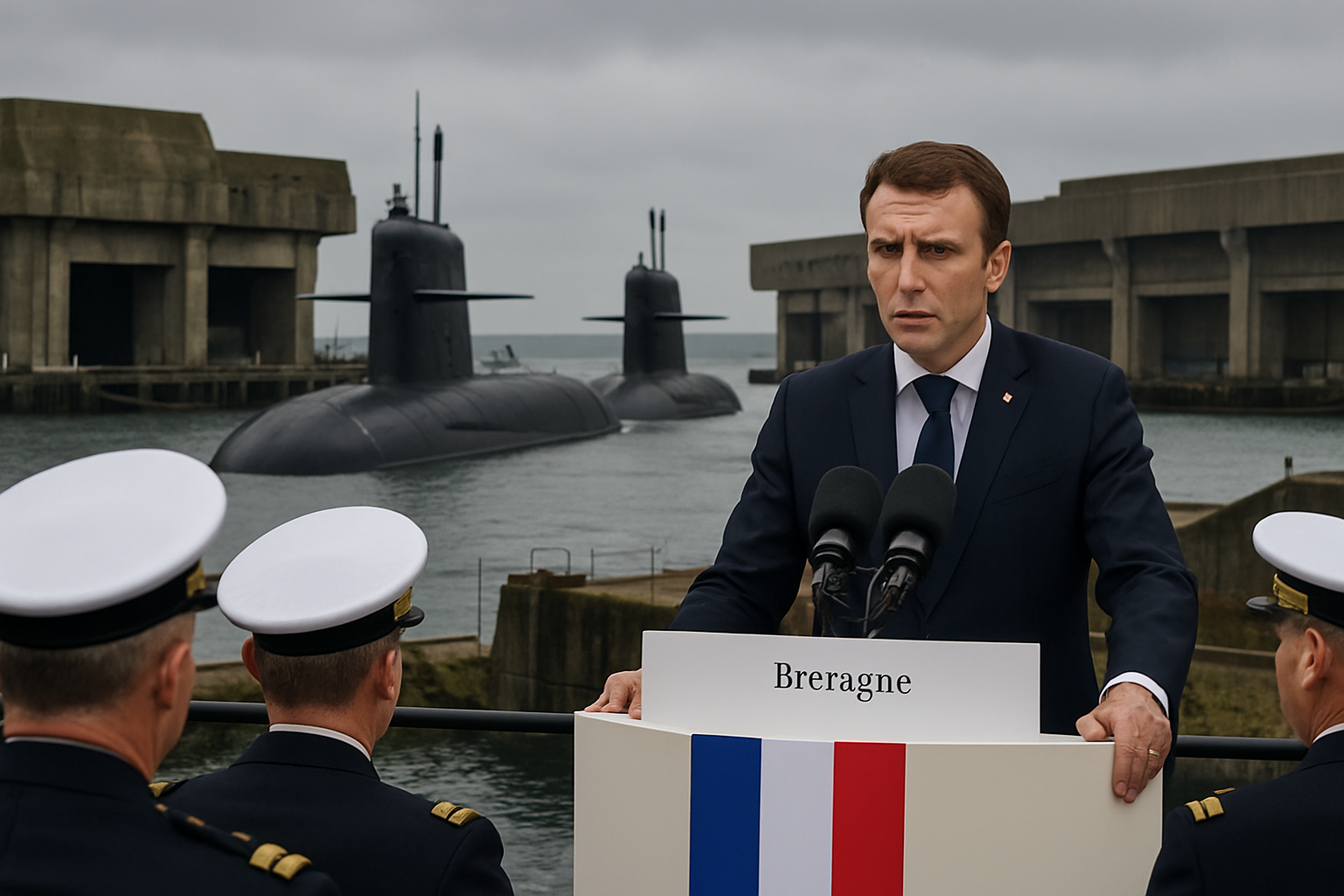
French President Emmanuel Macron announced on Monday that France will increase its nuclear arsenal and establish a groundbreaking "advanced deterrence" strategy that could see French nuclear-armed aircraft deployed to allied European nations for the first time, fundamentally reshaping continental security architecture.
Speaking at the Île Longue nuclear submarine base in Brittany, Macron unveiled what represents the most significant transformation of French nuclear doctrine since the Cold War's end. The announcement comes amid growing European concerns about American security guarantee reliability and the collapse of nuclear arms control frameworks.
"We must strengthen our nuclear deterrent in the face of multiple threats, and we must consider our deterrence strategy deep within the European continent, with full respect for our sovereignty," Macron declared, standing before France's strategic nuclear submarine fleet.
Eight European Nations Join Advanced Deterrence Framework
The French President confirmed that eight European countries—Germany, Britain, Poland, the Netherlands, Belgium, Greece, Sweden, and Denmark—have agreed to participate in the new "advanced deterrence" strategy. This unprecedented cooperation will involve joint nuclear deterrence exercises and the potential temporary deployment of French nuclear-capable aircraft to allied territories.
Swedish Defense Minister Pål Jonson's recent announcement that Sweden would be willing to host nuclear weapons during wartime conditions represents a dramatic departure from the Nordic nation's nuclear-free policy maintained throughout the Cold War, signaling the depth of European security transformation.
"To be free, one needs to be feared," Macron said, outlining a doctrine designed to reinforce Europe's deterrence posture amid shifting global security dynamics.
— Emmanuel Macron, French President
Crucially, Macron emphasized that France would retain sole decision-making authority over its nuclear weapons, stating that the framework would not involve sharing control with any other nation while providing extended deterrence benefits to European allies.
Nuclear Arsenal Expansion for First Time in Decades
For the first time since the Cold War, France will increase its nuclear warhead count from its current level of approximately 290-300 warheads. While Macron did not specify the exact scale of the expansion, he indicated the modernization was "essential" given the current strategic environment.
The President also announced the launch in 2036 of a new nuclear-armed submarine to be called "The Invincible," representing a significant investment in France's sea-based nuclear deterrent capabilities.
This expansion occurs against the backdrop of unprecedented nuclear governance challenges. The New START Treaty between the United States and Russia expired on February 5, 2026, marking the first time in over 50 years that the world's two largest nuclear powers operate without bilateral constraints on their arsenals.
Strategic Context: European Security at a Crossroads
The announcement reflects profound shifts in European strategic thinking following Russia's invasion of Ukraine and growing doubts about the reliability of American security guarantees. At the recent Munich Security Conference, German Chancellor Friedrich Merz declared that the "post-war order no longer exists," setting the stage for fundamental reconsiderations of continental defense arrangements.
European leaders have been engaging in unprecedented discussions about nuclear deterrence alternatives since the Cold War's end, with preliminary conversations between France, Germany, and Poland about extended deterrence arrangements reflecting concerns about NATO Article 5 commitment reliability under changing American leadership.

Operational Framework and NATO Coordination
French officials emphasized that the advanced deterrence framework would be "distinct but complementary to NATO," avoiding conflicts with existing alliance structures while providing additional deterrence options. The initiative includes provisions for:
- Temporary deployment of French strategic air forces to allied countries
- Joint nuclear deterrence exercises with participating nations
- Enhanced intelligence sharing and strategic coordination
- Coordinated planning for various threat scenarios
Defense analysts note that this represents the first serious attempt to create European nuclear arrangements independent of American guarantee structures since NATO's founding, potentially serving as a template for other regions facing similar security challenges.
International Reactions and Implications
The initiative has drawn mixed international responses. Russian officials condemned the plans as "escalatory," threatening unspecified countermeasures, while Chinese observers noted the shift toward European strategic autonomy with apparent satisfaction given ongoing Sino-American tensions.
Within Europe, reactions reflect existing divisions on nuclear policy. Spanish Prime Minister Pedro Sánchez has previously called nuclear rearmament a "historic error," while Eastern European nations facing direct Russian threats have expressed strong interest in additional deterrent arrangements.
Polish Prime Minister Donald Tusk referenced the announcement on social media, noting the changing strategic landscape, while German officials confirmed they are in "direct negotiations" with France about nuclear cooperation frameworks.
Technical and Financial Challenges
The implementation of Macron's vision faces formidable obstacles. Expanding nuclear deterrence coverage across multiple European nations requires:
- Significant modifications to French nuclear doctrine and operational procedures
- New legal frameworks and parliamentary approvals across participating countries
- Massive financial investments estimated in the hundreds of billions of euros
- Complex coordination mechanisms to avoid competing authorities during crises
French officials acknowledged that even preliminary frameworks would require years to develop, with full operational capability not expected until the next decade.
Global Nuclear Governance Crisis
Macron's announcement occurs during what UN Secretary-General António Guterres has called a "grave turning point" in global nuclear governance. With the expiration of the New START Treaty, the world's two largest nuclear arsenals—Russia with approximately 4,380 warheads and the United States with 3,708—are now free to expand without bilateral constraints for the first time since the early Cold War.
The collapse of nuclear arms control frameworks has coincided with China's nuclear expansion and Iran's continued nuclear program development, creating what experts describe as the most dangerous nuclear environment in decades.
"The next 50 years will be an era of nuclear weapons," Macron warned, justifying the need for European deterrent capabilities.
— Emmanuel Macron, French President
Historical Precedent and Future Implications
France's initiative represents the most significant shift in European nuclear arrangements since the 1960s when President Charles de Gaulle developed France's independent nuclear deterrent, the "force de frappe." Unlike that earlier unilateral decision, Macron's advanced deterrence concept explicitly involves European partnership while maintaining French sovereignty over nuclear decisions.
The success or failure of this initiative will have profound implications for global security architecture. If successful, it could provide a template for regional nuclear cooperation that strengthens deterrence while maintaining non-proliferation principles. If it fails, it might fragment Western alliance structures at a critical moment in great power competition.
Timeline and Next Steps
Implementation will proceed gradually, with initial focus on establishing legal and political frameworks for cooperation. The first joint exercises are expected within two years, with operational capabilities developing throughout the decade.
European Parliament and national legislative bodies will need to approve the necessary legal changes, while defense industries across participating nations will require massive investments to support the enhanced deterrence architecture.
The initiative also coincides with ongoing diplomatic efforts to resolve the Ukraine conflict, including upcoming peace talks that may determine the broader European security environment in which these nuclear arrangements would operate.
Conclusion: Europe's Strategic Awakening
Macron's nuclear doctrine announcement represents far more than military policy adjustment—it signals Europe's determination to assume greater responsibility for its own security in an increasingly multipolar world. Whether this leads to renewed Western unity through adaptation or continued fragmentation amid global power competition remains the pivotal question for international relations in the coming decade.
As European leaders grapple with fundamental questions about sovereignty, alliance obligations, and strategic autonomy, France's expanded nuclear role may prove to be either the foundation for a more independent European security architecture or a bridge too far that undermines existing cooperation frameworks.
The stakes could not be higher: success could establish Europe as a credible strategic actor capable of defending its interests independently, while failure might leave the continent more vulnerable to external pressure and internal divisions at precisely the moment when unity is most essential.