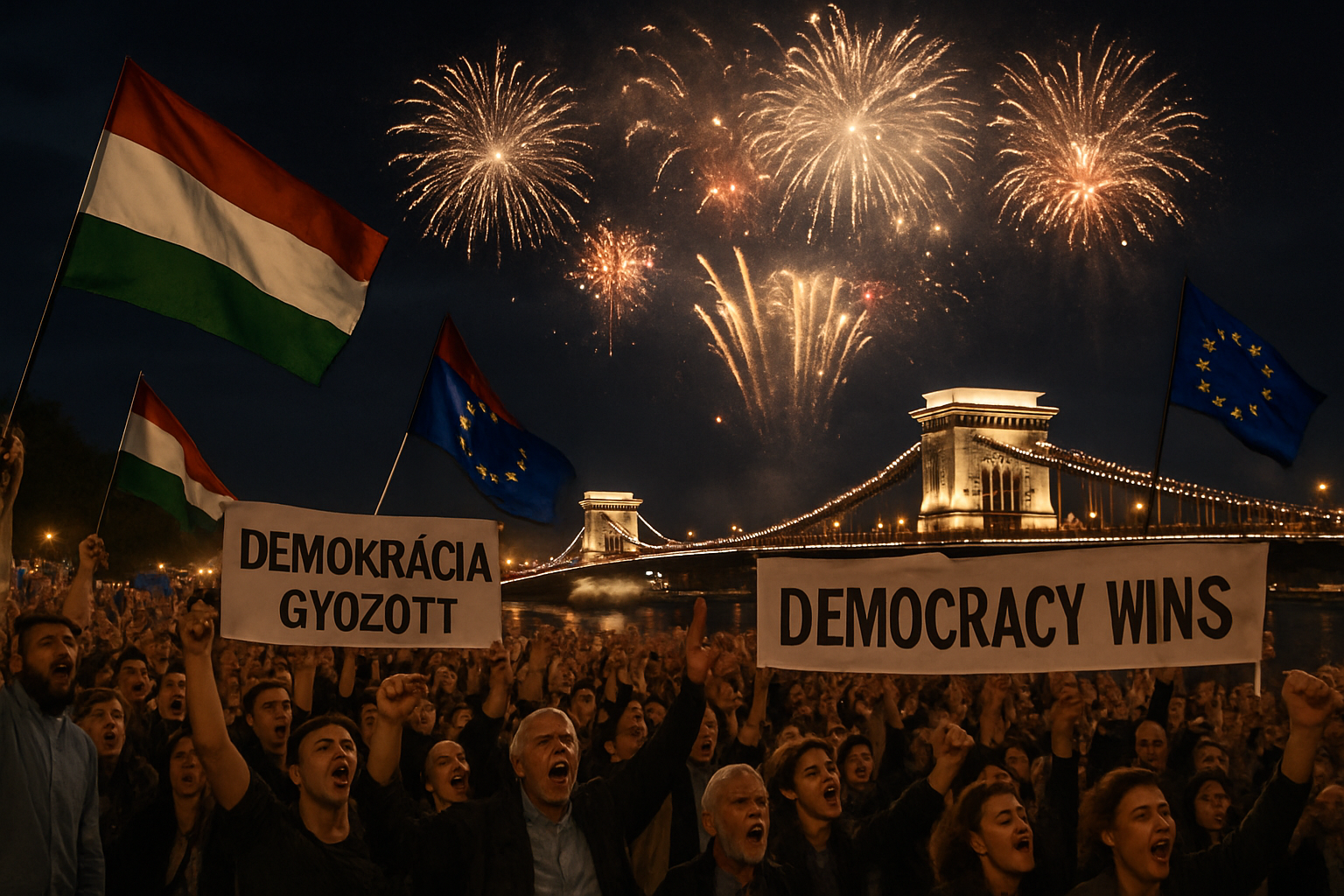
In a historic electoral earthquake that has sent shockwaves across Europe, opposition leader Péter Magyar's Tisza Party has achieved a stunning landslide victory in Hungary's parliamentary elections, ending Viktor Orbán's 16-year rule with a constitutional supermajority and record-breaking voter turnout of 80%.
The results, confirmed in the early hours of Monday morning, represent the most dramatic political transformation in Central Europe since the end of the communist era. Magyar's Tisza Party secured 138 seats out of 199 in parliament, achieving the crucial two-thirds majority needed for comprehensive constitutional reforms, while Orbán's Fidesz party collapsed to just 55 seats—its worst electoral performance since returning to power in 2010.
A Democratic Watershed Moment
Speaking to tens of thousands of celebrating supporters gathered along Budapest's Danube embankment, a triumphant Magyar declared: "We have liberated Hungary. Today, the Hungarian people have said yes to Europe, yes to democracy, and yes to our future." The victory speech, delivered as Frank Sinatra's "My Way" played in the background, marked the symbolic end of what critics called Europe's most entrenched authoritarian system.
The election saw unprecedented scenes of celebration across Budapest, with the famous Chain Bridge illuminated in Hungary's national colors as crowds waved both Hungarian and European Union flags. Cars honked their horns well into the early morning hours as supporters toasted with champagne in paper cups, many comparing the moment to the fall of communism in 1989.
"I feel amazing! Really amazing! Like, I never thought this would actually happen. I've been praying for this for 16 years."
— Budapest resident celebrating the victory
The Rise of Péter Magyar
The 45-year-old Magyar's journey from Orbán loyalist to his most formidable opponent reads like a political thriller. A former government insider who once worked within the Fidesz system, Magyar broke all ties with the ruling party to become its fiercest critic. His transformation began as a "child admirer" of Fidesz and evolved into a political insurgent who promised to dismantle the Orbán system "brick by brick."
Magyar's campaign crystallized around his promise to crack down on corruption and rebuild Hungary's damaged relationships with the European Union and NATO. His pro-European platform included wealth taxes, euro adoption process initiation, and transparent governance—a stark contrast to Orbán's nationalist sovereignty approach that had isolated Hungary from its European partners.
Record Turnout and Generational Shift
The election witnessed the highest voter turnout since Hungary's 1989 transition to democracy, with preliminary data showing 80% participation—a clear signal that this was a referendum on the country's democratic future. Most significantly, the so-called "Generation Orbán"—voters aged 18-30 who came of age during his rule—decisively rejected the nationalist messaging that had defined their political landscape.
Digital resistance played a crucial role in the opposition's success, with platforms like "Partizán" building counter-narratives that reached millions of young Hungarians despite the government's extensive control over traditional media. This breakthrough in escaping state media control proved instrumental in reaching demographics that had previously been isolated from alternative viewpoints.
International Reactions and Implications
The victory has prompted celebration across European capitals, with EU leaders welcoming what they see as Hungary's return to European values. European Commission President Ursula von der Leyen declared that "Hungary has chosen Europe, the country has found its European path again." French President Emmanuel Macron called it a "victory for democratic participation," while Ukrainian President Volodymyr Zelensky expressed hope that a "constructive approach will prevail."
European Council President António Costa welcomed the prospect of Hungary rejoining mainstream European cooperation, particularly regarding the immediate lifting of Hungary's blockade of a €90 billion Ukraine aid package that had created the deepest institutional crisis in EU history.
Foreign Interference Backfires
In an unprecedented development, the election saw documented foreign interference from both Russian operatives and the Trump administration. Investigative reports by Szabolcs Panyi and VSquare revealed the first concrete evidence of Russian teams actively supporting Fidesz, while US Vice President JD Vance's visit to Budapest just five days before the election—where he condemned EU "shameless interference"—represented the most direct American intervention in a European election in modern history.
The failure of this dual foreign interference to prevent Magyar's victory demonstrates the resilience of democratic institutions when faced with external pressure and provides a template for other nations confronting similar challenges.
Immediate Policy Reversals Expected
With his constitutional supermajority, Magyar has the power to enact comprehensive democratic reforms that will reverse 16 years of what critics called authoritarian drift. His first official visit will be to Poland, symbolically reconnecting Hungary with Central Europe and the broader European project.
Expected immediate changes include:
- Restoration of judicial independence
- Dismantling of media oligarchy structures
- Implementation of wealth taxes on the richest Hungarians
- Initiation of the euro adoption process
- Strengthening of governmental transparency
- Hungary's joining of the European Public Prosecutor's Office led by Laura Codruța Kovesi
Economic and Market Response
Hungarian financial markets responded positively to the election results, with the forint appreciating by 1.9% to reach its highest level against the euro in four years. Investors are optimistic that the political change will lead to the immediate restoration of frozen EU funding worth €19 billion and an end to the ongoing rule-of-law disputes that had isolated Hungary from European financial support.
A Template for Democratic Resilience
Senior EU officials have described the Hungarian election as Europe "writing the template for 21st-century crisis management," with the world watching how democratic institutions can adapt while preserving European values. The successful channeling of political tensions through electoral competition rather than extra-legal means strengthens the European democratic model globally.
The victory provides hope for democratic movements facing similar authoritarian pressures worldwide, demonstrating that well-established authoritarian systems can be defeated through united opposition, credible leadership, and clear alternatives presented to voters.
Regional Celebrations and Global Impact
The results have rewritten the European political map, with Putin losing his most reliable EU ally and right-wing populist movements across the continent losing their most successful model. The victory accelerates European integration by removing the bloc's most persistent internal critic and promises to strengthen unity during critical geopolitical challenges.
Estonian Prime Minister and Foreign Minister congratulated Hungarian voters for choosing "change, democracy, and a stronger place in Europe," while German Chancellor Friedrich Merz expressed relief that the result "was so clear," noting that Magyar's victory shows that "our democratic societies resist Russian propaganda."
Historic Significance
April 12, 2026, will be remembered as a defining moment for European democracy. The peaceful transfer of power through record democratic participation demonstrates the effectiveness of electoral competition against authoritarianism. It marks the beginning of a new chapter characterized by democratic renewal, European integration, and a return to founding values that have underpinned European success since 1945.
For Hungary, it represents liberation from what many saw as increasing isolation from European partners and a return to the democratic path the country had chosen after 1989. For Europe, it removes a persistent obstacle to collective action and restores faith in the power of democratic institutions to adapt and overcome authoritarian pressure.
As celebrations continue across Budapest and European capitals, the world witnesses a powerful reminder that democracy, when given the chance, can still triumph over authoritarianism through the simple but profound act of citizens casting their votes for their future.