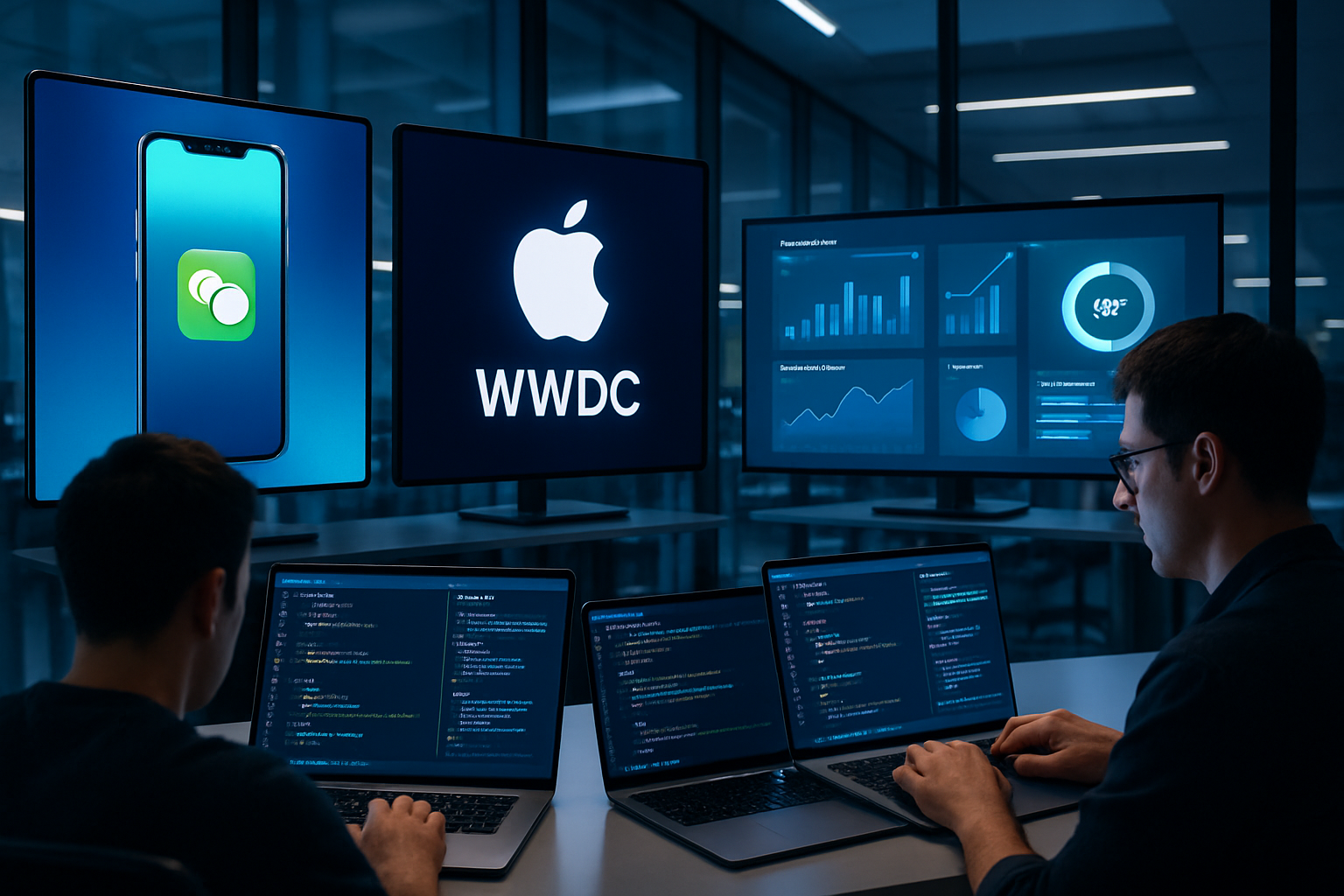
The global technology sector reached a pivotal moment in March 2026 as major corporations unveiled transformative artificial intelligence initiatives, with Tencent integrating AI capabilities into WeChat for over one billion users while Apple announced strategic developer conference dates, signaling an industry-wide acceleration toward AI-powered productivity solutions.
The convergence of these developments occurs during what industry experts have termed the "March 2026 Critical Inflection Point" - a decisive period marking the transition of artificial intelligence from experimental applications to essential business infrastructure across multiple sectors simultaneously.
Tencent's WeChat AI Revolution
Tencent Holdings announced the rollout of a "ClawBot" plug-in for WeChat, China's most popular messaging application, enabling the platform's more than 1 billion monthly active users to command OpenClaw artificial intelligence agents directly through the app. This integration represents one of the most significant consumer AI deployments in history, leveraging WeChat's deep embedding in daily Chinese life.
The move comes amid what Chinese media has dubbed the "OpenClaw craze," with almost every major Chinese technology company announcing new offerings based on AI agent technology. However, authorities continue to issue warnings about potential privacy and security risks associated with rapid AI adoption.
"WeChat's AI integration represents the fastest laboratory-to-production transition we've seen in consumer technology," noted a senior analyst tracking Chinese tech developments.
— Industry Technology Analyst
The WeChat integration builds upon Tencent's broader AI strategy, which has included previous successful implementations of QClaw AI agents as mini-programs within the platform. This latest development allows users to control personal computers remotely from mobile devices through WeChat, enabling seamless file transfers between mobile and desktop environments.
Apple's Strategic Developer Conference Announcement
Apple confirmed plans to hold its annual Worldwide Developers Conference (WWDC) from June 8, marking a critical date for the technology industry as developers and industry observers await announcements about the company's artificial intelligence strategy and integration plans across its ecosystem.
The timing of Apple's announcement coincides with intensifying competition in AI integration, as the company faces pressure to demonstrate how it will incorporate artificial intelligence capabilities across its product lineup while maintaining its focus on privacy and user experience.
Industry speculation centers on potential AI enhancements to Siri, developer tools for AI integration, and new frameworks that could enable third-party applications to leverage Apple's AI capabilities while maintaining the company's strict privacy standards.
European Central Bank Productivity Projections
The European Central Bank released significant research suggesting that artificial intelligence could boost eurozone productivity growth by 4% over the next decade, providing economic validation for the massive investments technology companies are making in AI infrastructure.
The ECB's analysis represents one of the most comprehensive assessments of AI's potential economic impact from a major financial institution, lending credibility to industry projections about productivity enhancements from AI adoption across various sectors.
"Our research indicates that AI implementation, when properly managed, can deliver substantial productivity gains without the widespread job displacement many fear."
— ECB Economic Research Division
The projection comes amid ongoing debates about AI's employment impact, with some economists arguing that productivity gains could offset job displacement through economic growth and new job category creation.
Industry Infrastructure Challenges
These developments occur against the backdrop of significant infrastructure constraints affecting the technology sector. The global memory semiconductor crisis continues to drive prices up sixfold, affecting major manufacturers including Samsung, SK Hynix, and Micron, with shortages expected to persist until 2027 when new fabrication facilities come online.
Despite these constraints, major technology companies continue massive AI investments. Alphabet has committed $185 billion to AI infrastructure in 2026—the largest single-year corporate technology investment in history—while Amazon has announced over $1 trillion in AI development plans extending through the decade.
Global Regulatory Landscape
The accelerated AI deployment occurs amid intensifying international regulatory scrutiny. Spain has implemented the world's first criminal executive liability framework for technology platforms, creating potential imprisonment risks for executives. France has conducted AI company cybercrime raids, while the United Nations has established an Independent Scientific Panel comprising 40 experts to provide the first fully independent global AI assessment.
This regulatory intensification represents the most sophisticated global technology governance effort since internet commercialization, with European coordination aimed at preventing regulatory arbitrage and ensuring uniform standards across jurisdictions.
Successful Human-AI Collaboration Models
Amid concerns about AI displacement, several successful integration models have emerged globally. Canadian universities have implemented AI teaching assistants that maintain critical thinking standards, while Malaysia operates the world's first AI-integrated Islamic school, combining artificial intelligence with traditional religious and academic learning.
Singapore's WonderBot 2.0 heritage education program has demonstrated how AI can enhance cultural preservation and education simultaneously. These models share common characteristics: treating AI as amplification tools rather than replacement mechanisms, maintaining sustained human development commitment, and ensuring technology serves specific human goals.
Economic Implications and Market Transformation
The technology sector is experiencing what analysts have termed the "SaaSpocalypse"—the elimination of hundreds of billions of dollars in traditional software market capitalization as AI systems demonstrate direct replacement capabilities for conventional solutions.
Microsoft's Mustafa Suleyman has predicted that AI will replace the majority of office workers within two years and lawyers and auditors within 18 months. However, regional variations in implementation approaches have emerged, with Western companies pursuing traditional layoff strategies while Asian corporations implement comprehensive worker transition programs emphasizing reskilling over displacement.
Environmental and Sustainability Considerations
The World Bank projects that AI systems will require 4.2-6.6 billion cubic meters of water annually by 2027 for data center cooling—equivalent to four to six times Denmark's total annual water consumption. This projection has driven increased investment in renewable energy and efficient computing architectures as companies seek to minimize the environmental impact of AI deployment.
The infrastructure constraints have paradoxically spurred innovation in memory-efficient algorithms and sustainable deployment strategies, potentially democratizing access to advanced AI capabilities by reducing hardware requirements.
Future Trajectory and Critical Decisions
Industry experts characterize March 2026 as a "civilizational choice point" that will determine whether artificial intelligence serves human flourishing or becomes primarily an exploitation tool. The decisions made regarding AI governance, international cooperation frameworks, and sustainable business models will establish patterns for human-AI relationships extending decades into the future.
Success in navigating this transition requires unprecedented coordination between governments, technology companies, educational institutions, and civil society. The challenge involves balancing innovation acceleration with safety governance, commercial interests with human welfare, and national competitiveness with international cooperation.
"The most promising path involves sophisticated human-AI collaboration that amplifies capabilities while preserving the creativity, cultural understanding, and emotional intelligence that define human potential."
— International Technology Policy Researcher
The evidence suggests that organizations treating AI as sophisticated amplification tools for human capabilities, rather than wholesale replacement mechanisms, achieve superior outcomes in productivity, employee satisfaction, and long-term sustainability.
Multipolar AI Leadership Emerging
The current developments reflect an emerging multipolar AI landscape, with Chinese technological advancement, European regulatory frameworks, and American corporate investments creating distributed capabilities that prevent single-entity dominance while enabling culturally sensitive development approaches.
This distributed model may prove beneficial for global AI governance, as it reduces the risk of any single nation or corporation controlling critical AI infrastructure while allowing different regions to develop approaches suited to their cultural and economic contexts.
The window for coordinated international action is narrowing rapidly as AI development accelerates. The decisions made in 2026 will largely determine the trajectory of human-AI relationships for the remainder of the 21st century, making this period one of the most consequential in modern technological history.
As major technology companies continue to integrate AI capabilities into fundamental platforms and services, the industry has moved decisively beyond theoretical discussions toward practical implementation affecting billions of users worldwide. The challenge now lies in ensuring this technological transformation serves humanity's highest aspirations while addressing the complex governance, economic, and social challenges that accompany such rapid change.