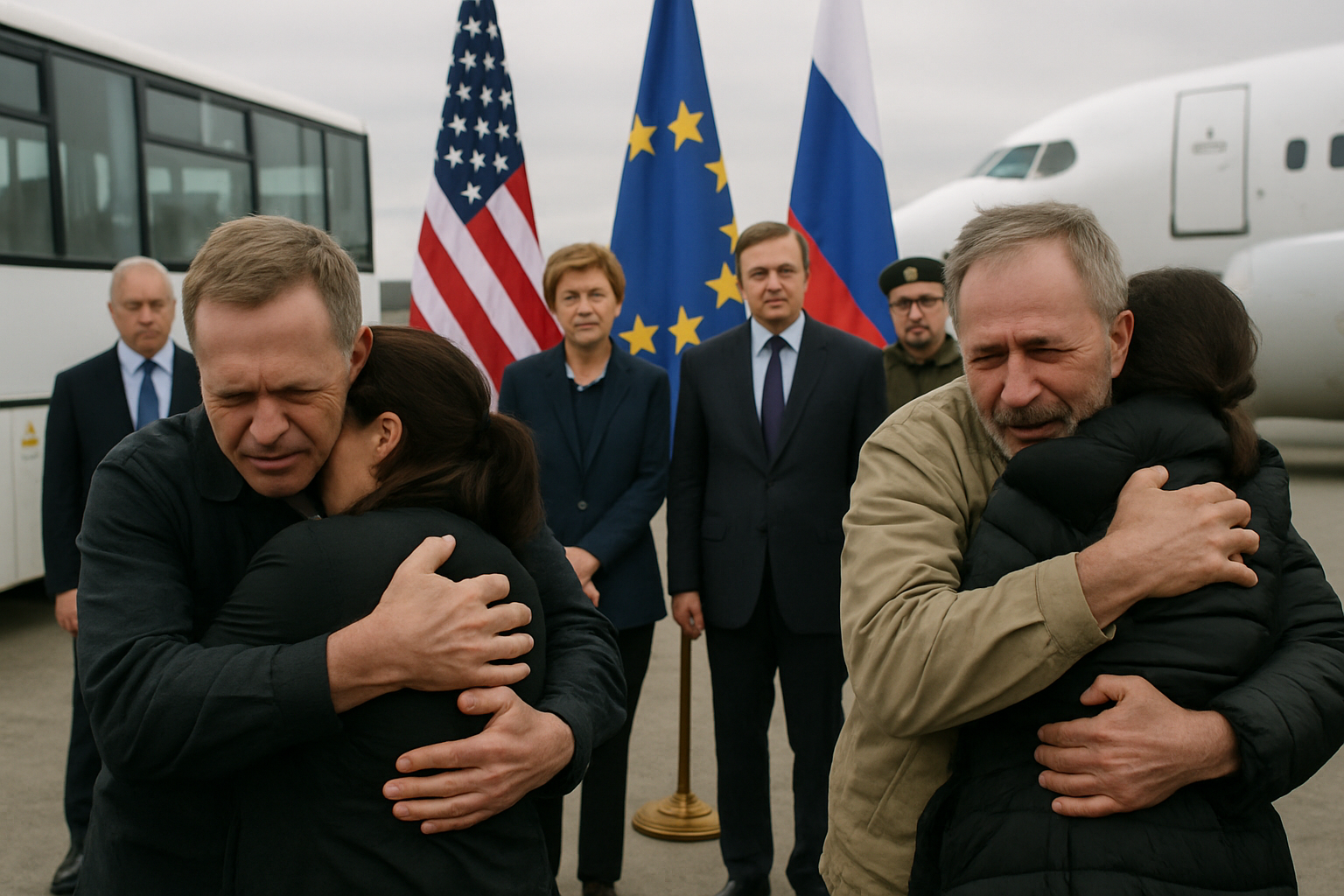
Ukraine and Russia completed one of the largest prisoner exchanges of the conflict, with over 1,000 people released across two days of operations, marking a significant humanitarian breakthrough amid ongoing diplomatic efforts to end the nearly four-year war.
The historic exchange, conducted over Thursday and Friday, saw 500 personnel from each side returned home, with Ukrainian President Volodymyr Zelensky confirming families received "the most anticipated message" with photos of their released relatives. The operation was facilitated through continued mediation by the United States and United Arab Emirates, building on frameworks established through recent trilateral peace talks.
Unprecedented Scale of Exchange
The two-day operation began Thursday with 200 personnel exchanged from each side, followed by a larger swap Friday involving 300 individuals per country. This represents the 72nd prisoner exchange since Russia's February 2022 invasion and stands as one of the most substantial single operations since the conflict began.
Russian Presidential Advisor Vladimir Medinsky confirmed the operation was conducted within the Geneva agreements framework, referencing the diplomatic progress achieved during February 17-18 peace talks that included European "Big 5" observers for the first time.
"This exchange demonstrates that structured diplomatic engagement can produce concrete humanitarian results even when broader territorial disputes remain unresolved."
— Senior Western Diplomat
Building on Diplomatic Momentum
The exchange stems directly from the diplomatic breakthrough achieved through trilateral talks between Ukraine, Russia, and the United States. The February Geneva negotiations achieved "significant progress" on ceasefire monitoring mechanisms, according to US Special Envoy Steve Witkoff, despite territorial disagreements remaining unresolved.
This latest exchange builds on the historic Abu Dhabi success in February, which saw 314 prisoners exchanged – the first swap in five months – alongside the restoration of US-Russia military communications after a four-year suspension. The Pentagon confirmed the establishment of deconfliction protocols covering operations globally, representing the most significant US-Russia military agreement since the conflict began.
Humanitarian Diplomacy Framework
The UAE's neutral hosting has proven crucial in facilitating these exchanges, leveraging diplomatic relationships with both sides while maintaining strict neutrality. The methodology involves working groups organized by topic and joint position synchronization, which has consistently produced concrete humanitarian results even during periods of military escalation.
The exchange serves as a critical confidence-building measure supporting broader peace efforts, particularly as the Trump administration has established a June 2026 deadline for comprehensive peace negotiations in Washington, potentially involving presidential-level engagement.
Continued Military Context
The prisoner exchange occurs against the backdrop of continued military operations and systematic civilian targeting. Russian territorial gains have accelerated to 481 square kilometers in January versus 260 square kilometers in December 2025, while energy infrastructure attacks have left over 1,170 Kyiv buildings without heating during extreme winter conditions.
President Zelensky previously disclosed that 55,000 Ukrainian soldiers have been officially killed, with a "large number" still missing. International estimates suggest actual casualties could be two to three times higher, underscoring the human cost of the conflict and the importance of humanitarian gestures like prisoner exchanges.
Nuclear Crisis Backdrop
The exchange takes place amid an unprecedented nuclear governance crisis, with the New START treaty having expired February 5, 2026 – the first time in over 50 years without US-Russia nuclear constraints. Both nations control 80% of global nuclear weapons, prompting UN Secretary-General António Guterres to warn of a "grave turning point" with nuclear risks at their "highest in decades."
The restored military communications between the Pentagon and Russian General Staff represent the only remaining formal diplomatic channel between the nuclear superpowers, making humanitarian exchanges even more critical for maintaining dialogue.
International Response
The international community has welcomed the exchange as a positive development in an increasingly challenging diplomatic landscape. The European Union's historic €90 billion loan package to Ukraine – the largest single-nation assistance ever provided – demonstrates sustained commitment to supporting Ukraine while maintaining hope for diplomatic solutions.
However, divisions persist, with Slovakia, Czech Republic, and Hungary refusing to participate in the EU package, exposing deep European disagreements over engagement strategies with Russia.
Path Forward
Despite the humanitarian success, fundamental territorial sticking points remain unchanged. Eastern Ukrainian territories under Russian control continue to be the core disagreement, with Russia demanding territorial recognition and insisting on Moscow as the venue for any Putin-Zelensky talks. Ukraine maintains its territorial integrity position while seeking long-term security guarantees.
The prisoner exchange demonstrates that diplomatic innovation can produce concrete results even when broader political solutions appear distant. The success provides momentum for continued negotiations as parties work toward the June 2026 Washington talks, which represent the most significant diplomatic opportunity since the conflict began.
"These exchanges maintain hope for families while preserving essential communication channels between the warring parties, even as territorial disputes continue."
— International Red Cross Official
Strategic Implications
The operation represents more than humanitarian relief – it serves as a critical test of whether sustained diplomatic engagement can produce breakthrough results in complex territorial conflicts. Success in maintaining these humanitarian channels could provide a template for 21st-century conflict resolution, while failure might intensify military operations and undermine diplomatic credibility globally.
The stakes extend beyond Ukraine and Russia to include European security architecture, international law enforcement, and territorial sovereignty principles that will shape power competition for decades to come. As the conflict approaches its fourth anniversary, the prisoner exchange offers a glimmer of hope that diplomatic solutions remain possible even in Europe's deadliest war since World War II.