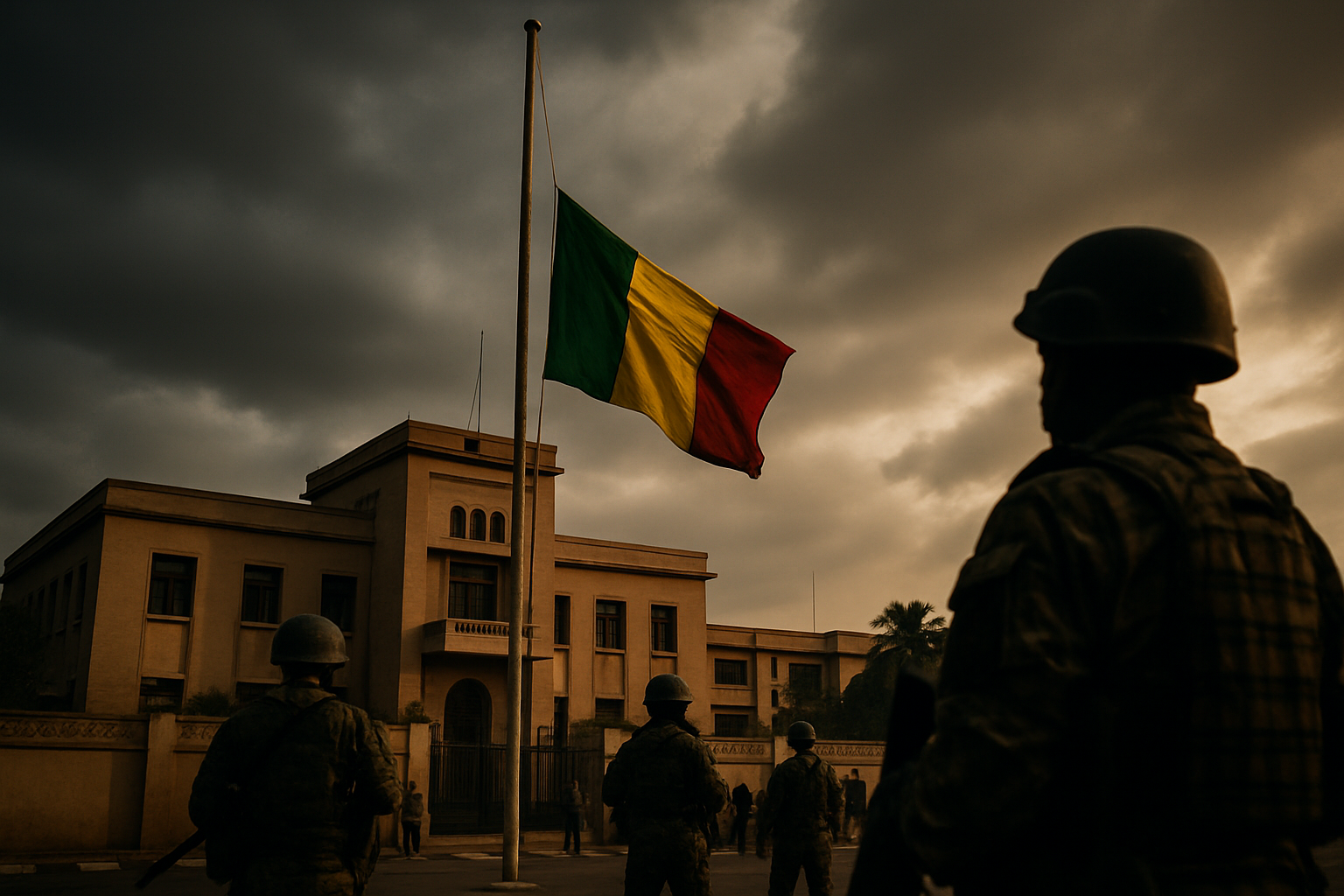
Mali's military junta faces its gravest security crisis yet after Defense Minister General Sadio Camara was killed in coordinated attacks by armed groups across multiple cities on April 25, 2026, marking a devastating blow to the government's authority and security apparatus.
The transitional government officially announced the death of General Sadio Camara, State Minister in charge of Defense and Veterans Affairs, who succumbed to injuries sustained during a terrorist attack that began at dawn on Saturday. The announcement triggered the declaration of national mourning and exposed critical vulnerabilities in the junta's security infrastructure.
Sophisticated Multi-Front Operations
Armed groups launched unprecedented coordinated assaults across Mali beginning at 6:00 AM GMT on April 25, targeting military and civilian infrastructure in the capital Bamako, the military stronghold of Kati where ruling generals reside, and northern cities including Gao, Kidal, and Sevare.
The attacks demonstrated extraordinary sophistication, requiring extensive advance planning, intelligence capabilities, and organizational coordination across Mali's vast 1.24 million square kilometer territory. Jama'at Nasr al-Islam wal Muslimin (JNIM), an Al-Qaeda affiliate, claimed responsibility for the operations, stating they successfully targeted what they described as "sensitive Israeli military sites" and key government installations.
"This represents the most dramatic setback for the junta government and Russian security partners in years"
— Andrew Lebovich, Clingendael Institute security expert
The coordinated nature of the assault involved an unprecedented alliance between JNIM jihadist forces and the Azawad Liberation Front (FLA), combining ideological extremism with ethnic separatist ambitions from Tuareg rebels. This tactical development marks a new evolution in Mali's security challenges.
Defense Leadership Vacuum
General Camara's death creates a significant defense leadership vacuum at a critical moment when Mali faces escalating security threats. As the number two figure in the military junta and a key architect of the alliance with Russian security partners, his loss represents a devastating blow to the government's military capabilities and international partnerships.
The defense minister was reportedly killed alongside his second wife in an attack on their residence in Kati, the military base located 15 kilometers from Bamako where the country's ruling generals live. The successful penetration of this heavily fortified location exposes critical vulnerabilities in the security apparatus protecting Mali's leadership.
Government sources confirmed that 16 people were injured, including both civilians and military personnel, before security forces managed to regain control by evening. However, the FLA claimed complete control over the northern city of Kidal, with limited government resistance remaining in the area.
Russian Partnership Under Scrutiny
The attacks raise serious questions about the effectiveness of Mali's security arrangements with Russian Wagner Group forces, now operating under the Africa Corps framework. Despite ongoing military operations and the presence of Russian security partners, the extremist networks demonstrated sophisticated intelligence gathering and operational coordination capabilities.
The Russian embassy condemned what it termed "criminal acts" and expressed condolences while praising the Malian Armed Forces' "firm coordinated response." However, intelligence failures that enabled the simultaneous multi-front operations suggest persistent vulnerabilities in the current security architecture.
Former US envoy Zalmay Khalilzad has previously criticized regional military approaches, stating that military pressure often fails to address underlying issues driving extremist recruitment and territorial disputes.
Opposition Calls for Change
The "Coalition of Forces for the Republic" in Mali seized on the crisis to call for the military council's resignation and an immediate transition to civilian rule. The coalition characterized the violence as a "national tragedy" and blamed the military authorities for the deteriorating security situation.
In a statement, the opposition coalition argued that the continuing crisis reflects the authorities' failure to adopt a path of political dialogue, accusing the military council of isolation and rejecting negotiated solutions. The group demanded an end to what it called the military's closed-door approach to governance.
Junta Leader Missing
Adding to the crisis atmosphere, there has been no public appearance by junta leader General Assimi Goita since the attacks began. According to journalist Khalil Ould Ajdoud, Goita may be "negotiating safe passage" out of the country as the security situation deteriorates.
Reports suggest the situation in Bamako remains "difficult," with significant losses among military and security leadership beyond the defense minister. The absence of the junta leader during this critical period has fueled speculation about the government's stability and ability to respond to the crisis.
Ongoing Security Response
The General Staff of the Malian Armed Forces announced that pursuit operations against "armed groups" continue in the Kidal, Kati, and other regions following the attacks. The military imposed heightened security alert status across the country, with curfews in some areas and enhanced military patrols.
However, the scale and coordination of the attacks suggest that extremist groups have maintained and potentially enhanced their operational capabilities despite ongoing military pressure. The successful targeting of Kati, where ruling generals reside, demonstrates the groups' intelligence penetration and planning sophistication.
Humanitarian and Economic Impact
The crisis threatens Mali's economic stability, including its record gold production worth over $6 billion in 2025. The attacks also complicate humanitarian operations in a country where 88% of female-headed households cannot meet minimum requirements according to World Food Programme reports.
The World Health Organization has reported that only 23 hospitals have emergency oxygen supplies, while hundreds of health centers have closed due to security concerns and funding shortfalls. The new security crisis further threatens the delivery of essential services to Mali's population.
Regional Implications
The successful coordinated attacks in Mali have significant implications for regional security within the Alliance of Sahel States framework, which includes Mali, Niger, and Burkina Faso. The demonstration of sophisticated extremist capabilities provides a potential template for similar operations in neighboring countries.
International partners have reaffirmed counter-terrorism support, but the crisis highlights the need for enhanced regional cooperation mechanisms and innovative diplomatic approaches that address root causes including poverty, unemployment, weak governance, and climate-related resource competition.
The success or failure of Mali's response to this crisis will influence security strategies across West Africa and serve as a template for addressing 21st-century complex threats that require coordinated responses in the volatile Sahel environment. The death of Defense Minister Camara marks a critical turning point that will test the junta's ability to maintain control and effectiveness of international security partnerships in one of the world's most challenging operating environments.