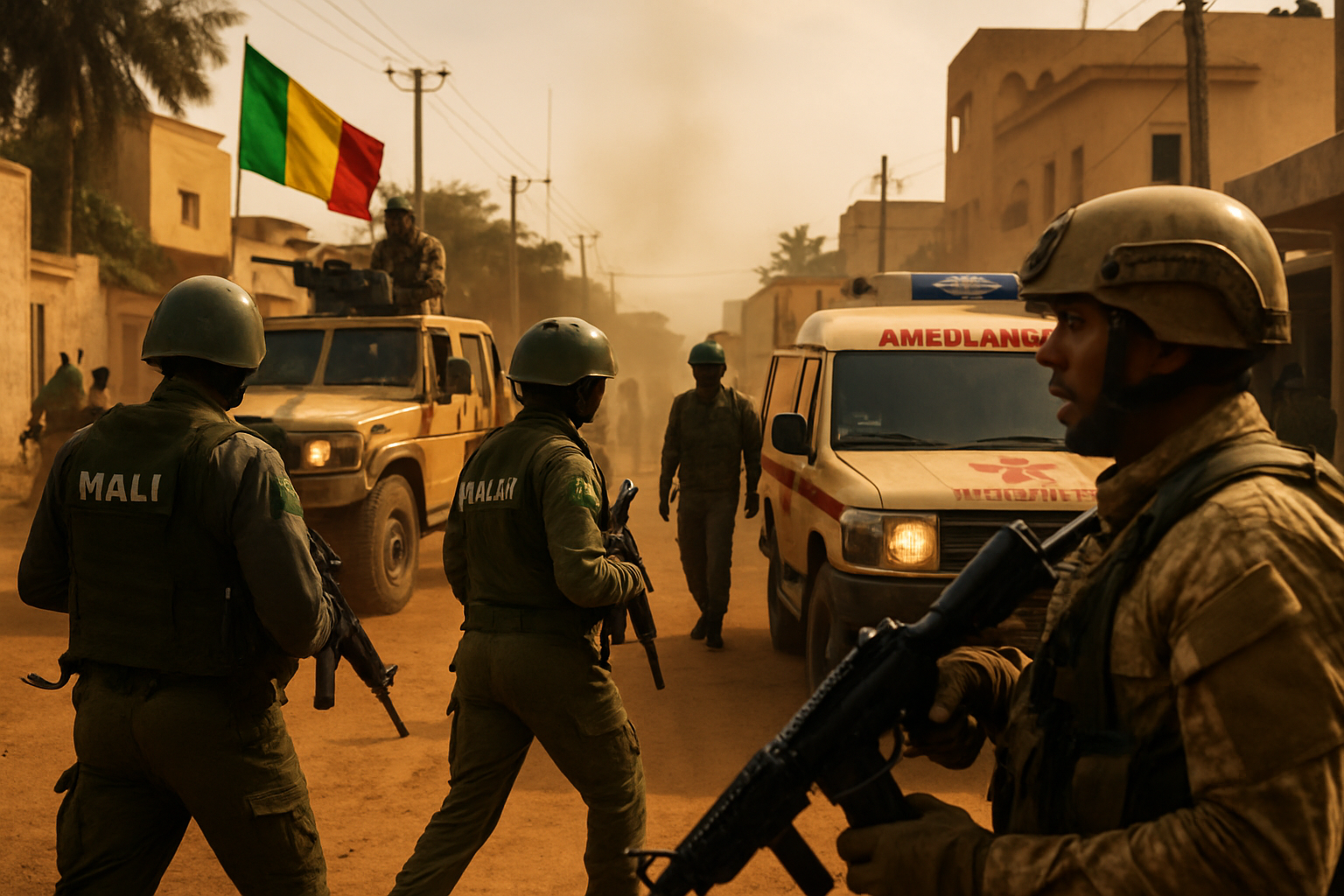
Mali's Defense Minister Sadio Camara was killed in coordinated attacks targeting military installations across the West African nation, dealing a devastating blow to the ruling military junta and exposing critical vulnerabilities in the country's security apparatus.
The sophisticated assault, launched by Jama'at Nasr al-Islam wal Muslimin (JNIM) in coordination with Tuareg separatist forces, struck multiple cities simultaneously including the capital Bamako, the strategic military stronghold of Kati, and northern cities of Gao and Kidal. The attacks began at 6:00 AM GMT on Saturday, April 25, 2026, with explosions and sustained gunfire targeting both military and civilian infrastructure.
Death of a Key Military Leader
Family sources confirmed that Defense Minister Sadio Camara died alongside his second wife in an attack on their residence in Kati, the military stronghold located 15 kilometers from Bamako where the country's ruling generals reside. Camara's death represents one of the most significant losses for Mali's military leadership since the 2020 coup that brought the current junta to power.
The 58-year-old defense minister had been a central figure in Mali's counter-terrorism operations and military governance structure. His killing demonstrates the sophisticated intelligence capabilities of extremist networks and their ability to target high-value individuals even in supposedly secure locations.
"The death of Minister Camara represents a devastating blow to our security apparatus at a time when Mali faces unprecedented threats,"
— Senior Malian Military Official
Coordinated Multi-Front Assault
The attacks revealed unprecedented coordination between JNIM, an Al-Qaeda affiliate group, and elements of the Azawad Liberation Front (FLA), representing a dangerous evolution in extremist tactical cooperation. Security experts described the operation as combining ideological extremism with ethnic separatist ambitions, creating a more complex threat matrix.
Government forces backed by Russian partners successfully regained control of Bamako by evening, but the assault exposed significant intelligence failures and operational vulnerabilities. The transitional government confirmed 16 people were injured, including both civilians and military personnel, before security forces established control.
The Azawad Liberation Front claimed complete control over Kidal with only limited military resistance remaining, while government forces conducted comprehensive sweeping operations across affected regions. Military sources reported "several hundred armed elements neutralized" during response operations.
Regional and International Response
The attacks prompted immediate condemnation from international partners, with Russia's embassy describing the assault as "criminal acts" undermining regional security and stability. The Russian diplomatic mission praised what it called the "firm and coordinated response" of Malian Armed Forces while expressing condolences to victims' families.
Jordan's Ministry of Foreign Affairs condemned the terrorist attacks that targeted military and civilian areas across multiple Malian cities, emphasizing the kingdom's solidarity with Mali. The coordinated international response highlighted the global concern over escalating Sahel security challenges.
Mauritanian officials reported widespread regional condemnation of the attacks, with the African Union Peace and Security Council expressing deep concern over the deteriorating security situation. The systematic nature of the assault demonstrated what security analysts called a "template for complex threats requiring coordinated responses."
Strategic Implications for Sahel Security
The coordinated attacks represent a significant escalation in the sophistication and scope of extremist operations in the Sahel region. Military analysts noted that the assault required extensive advance planning, intelligence gathering, and logistical coordination across Mali's vast 1.24 million square kilometer territory.
Andrew Lebovich from the Clingendael Institute characterized the attacks as a "dramatic setback" for both the junta government and its Russian security partners, highlighting persistent challenges in securing desert and semi-arid terrain favorable to guerrilla operations.
The success of the coordinated assault raises questions about the effectiveness of current security arrangements, including partnerships with Russian Wagner Group forces (now operating as Africa Corps). Despite ongoing military operations and international assistance, extremist networks have retained significant operational capabilities.
Humanitarian and Economic Impact
The security crisis compounds Mali's existing humanitarian challenges, with the World Food Programme reporting that 88% of female-headed households are unable to meet minimum requirements. The WHO has been forced to provide emergency oxygen to only 23 hospitals, with hundreds of health centers closed due to security and funding concerns.
Economic implications threaten to undermine Mali's recent achievements, including record gold production of 94 tons worth over $6 billion in 2025. The mining sector, critical to Mali's economy, faces renewed confidence challenges as security deteriorates in key operational areas.
The attacks also impact broader regional economic integration efforts under the African Continental Free Trade Area (AfCFTA), demonstrating how security crises can derail long-term development initiatives across the Sahel.
Intelligence Failures and Security Gaps
The successful penetration of Kati, where the country's top military leadership resides, exposed critical intelligence failures within Mali's security apparatus. The ability of extremist forces to conduct simultaneous operations across multiple cities suggests sophisticated planning and potential infiltration of government communications.
Local communities had reportedly provided advance warnings about armed groups camping in surrounding areas, but authorities failed to act effectively on the intelligence. This pattern of reactive rather than proactive security responses has become a recurring challenge in the Sahel region.
The attacks also highlighted the vulnerability of urban areas previously considered secure, with explosions and gunfire reported near Modibo Keita International Airport and other critical infrastructure in the capital.
Alliance of Sahel States Context
The crisis occurs within the broader context of changing regional security dynamics, including Mali's membership in the Alliance of Sahel States alongside Niger and Burkina Faso. This alliance has distanced itself from traditional regional cooperation frameworks like ECOWAS, complicating coordinated security responses.
The sophisticated nature of the attacks demonstrates that extremist networks have adapted to the new political landscape, exploiting reduced cooperation between traditional partners while developing enhanced organizational capabilities across borders.
Russian involvement through the Africa Corps represents a significant shift from previous international partnerships, but the attacks suggest that new security arrangements have yet to achieve the effectiveness needed to counter evolving threats.
Path Forward and International Cooperation
The death of Defense Minister Camara creates a significant leadership vacuum at a critical moment for Mali's security. The transitional government will need to quickly rebuild confidence in its security capabilities while addressing the root causes that enable extremist recruitment and operations.
International partners have reaffirmed their commitment to supporting Mali's counter-terrorism efforts, but the attacks demonstrate the need for enhanced regional cooperation mechanisms. The sophisticated coordination between different extremist factions requires equally sophisticated responses combining intelligence sharing, rapid response capabilities, and economic development initiatives.
Enhanced security measures have been implemented across affected regions, with pursuit operations continuing against fleeing militants. However, long-term success will require addressing underlying factors including poverty, unemployment, weak governance structures, and climate-related resource competition.
Broader Implications for West Africa
The Mali attacks represent part of a broader pattern of expanding extremist capabilities across West Africa, with similar incidents recently reported in Nigeria, Burkina Faso, and Niger. The geographic spread and operational sophistication highlight the transnational nature of the threat facing the region.
The success of the coordinated assault may inspire similar operations elsewhere, making regional cooperation and international support more critical than ever. The template established by this attack demonstrates both the vulnerabilities of current security architectures and the sophisticated capabilities extremist networks have developed.
As Mali's government begins the process of replacing its defense minister and rebuilding damaged security infrastructure, the broader Sahel region watches closely for lessons that might prevent similar attacks elsewhere. The response to this crisis will likely influence security strategies across West Africa for years to come.
The coordinated nature of the April 25 attacks, combining Al-Qaeda affiliates with Tuareg separatists, represents a new phase in Sahel security challenges that will require innovative diplomatic, military, and economic responses from both regional actors and international partners.