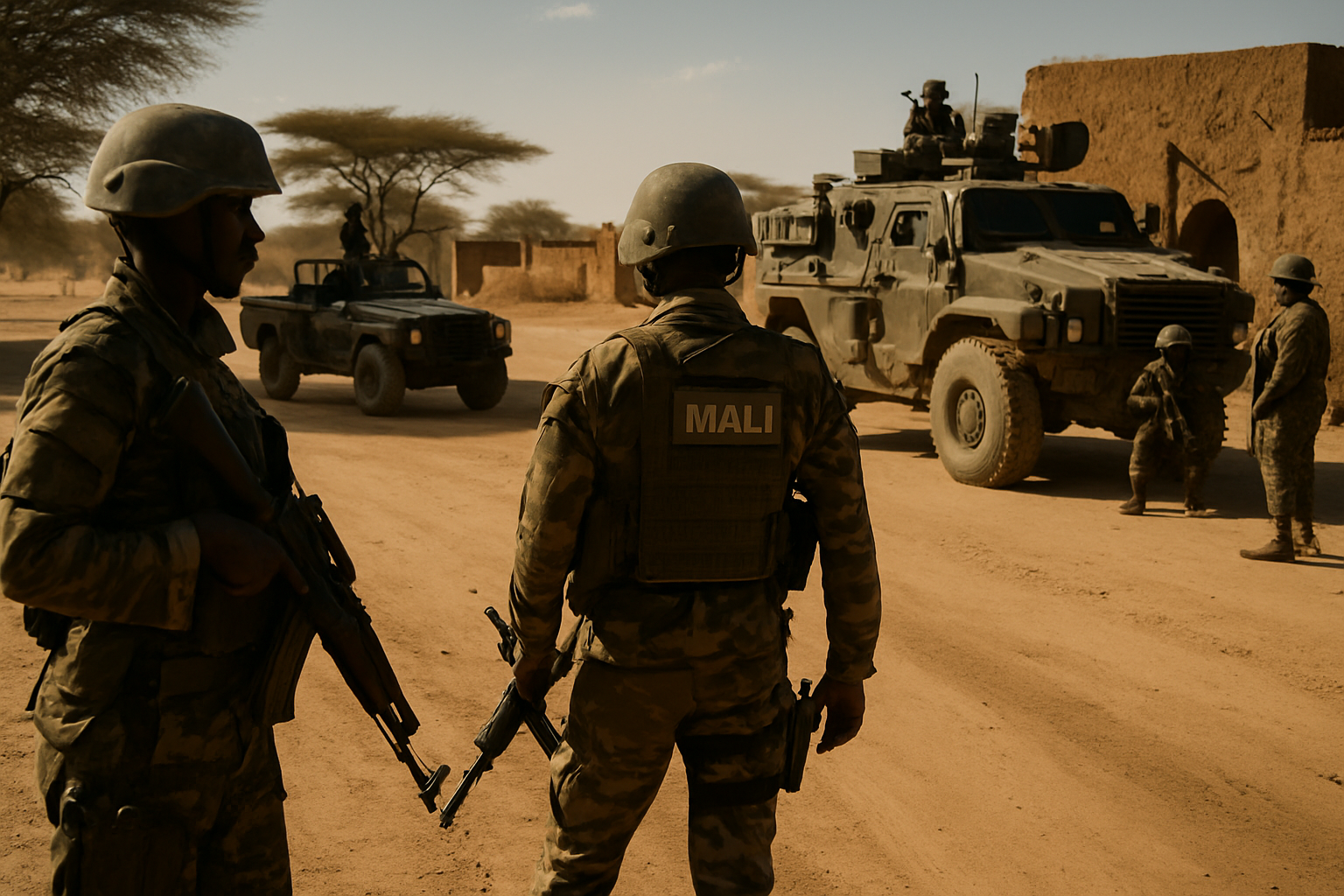
Mali is confronting its most severe security crisis since the 2020 military coup, following coordinated terrorist attacks on April 25, 2026, that killed Defense Minister Sadio Camara and exposed critical vulnerabilities in the country's security apparatus despite ongoing international partnerships.
Prime Minister General Abdoulaye Maïga announced a "total response" after simultaneous attacks by Al-Qaeda affiliate Jama'at Nusrat al-Islam wal Muslimin (JNIM) and Tuareg separatist forces targeted multiple cities including the capital Bamako, the strategic military hub of Kati, and northern strongholds across seven regions beginning at 6:00 AM GMT on April 25.
Unprecedented Coordination Between Hostile Forces
The attacks represented an extraordinary tactical development, with JNIM jihadist forces collaborating with the Azawad Liberation Front (FLA) Tuareg separatists for the first time in a comprehensive assault. This unprecedented coordination combined ideological extremism with ethnic separatist ambitions, creating what security expert Andrew Lebovich of the Clingendael Institute called a "dramatic setback" for both the military government and its Russian security partners.
The assault reached the heart of Mali's military power when a truck bomb penetrated the heavily fortified Kati military complex, located 15 kilometers from Bamako, where the ruling junta leadership resides. The successful breach killed Defense Minister General Sadio Camara and his second wife, representing the highest-profile casualty for Mali's military government since taking power.
"The attacks were aimed at seizing power and dismantling state institutions."
— General Abdoulaye Maïga, Prime Minister of Mali
Strategic Implications and Russian Partnership Questions
The sophisticated nature of the coordinated assault has raised serious questions about the effectiveness of Mali's security partnership with Russia's Africa Corps, the successor to the Wagner Group. Despite ongoing Russian military operations supporting the junta since 2021, the attacks demonstrated that extremist networks retain significant intelligence-gathering and logistical coordination capabilities across Mali's vast 1.24 million square kilometer territory.
According to military sources, government forces "managed to neutralize hundreds of terrorists throughout the country," with General Omar Diarra confirming over 200 militants eliminated in response operations. However, the FLA successfully claimed complete control of the strategic northern city of Kidal, while JNIM forces temporarily threatened the capital before being repelled by evening.
The crisis has exposed what appears to be systematic intelligence failures, with local communities having provided advance warnings about armed groups establishing camps in surrounding areas, yet authorities failed to take effective preventive action. This reactive versus proactive security pattern has become a recurring vulnerability that terrorist groups continue to exploit.
Regional and International Response
The Alliance of Sahel States, comprising Mali, Niger, and Burkina Faso, condemned the attacks through a statement by Captain Ibrahim Traoré, while two days of national mourning were declared across Mali. The Russian embassy in Bamako strongly condemned what it termed "criminal acts" while praising the "firm and coordinated response" of Malian Armed Forces.
Jordan's Foreign Ministry also condemned the terrorist attacks, emphasizing solidarity with Mali in a reflection of growing international concern about Sahel stability. However, the successful penetration of Kidal by separatist forces and the temporary threat to Bamako have highlighted the limitations of current security architectures in addressing complex, multi-front challenges.
Humanitarian and Economic Impact
The security crisis compounds an already dire humanitarian situation in Mali, where the World Health Organization reports that emergency medical oxygen is available in only 23 hospitals, while hundreds of health centers have been forced to close due to security concerns and funding cuts. The World Food Programme indicates that 88 percent of female-headed households in the country are unable to meet minimum living requirements.
The instability threatens Mali's economic foundations, including its record gold production worth over $6 billion in 2025, which represents a crucial revenue source for the government. Mining sector confidence faces new challenges as security deteriorates in key operational areas, while the broader crisis threatens regional economic integration under the African Continental Free Trade Area framework.
Historical Context and Future Implications
The April 25 attacks represent the most serious challenge to Mali's central government since the 2012 rebel offensive that was eventually pushed back by French intervention. The current crisis occurs in a dramatically different context, with France having withdrawn its forces and Russia emerging as the primary international security partner.
The sophisticated coordination demonstrated by the attackers required extensive advance planning, intelligence capabilities, and organizational sophistication that suggests extremist networks have adapted to sustained military pressure while maintaining significant operational capacity. The cooperation between historically rival jihadist and Tuareg groups represents a tactical evolution that could serve as a template for similar operations across the broader Sahel region.
Critical Test for Military Government
For Mali's military junta, led by General Assimi Goita who has remained largely out of public view since the attacks began, the crisis represents a fundamental test of governance capabilities and international partnership effectiveness. The successful defense of the capital while losing control of Kidal demonstrates both the government's resilience and its continued limitations in controlling the entire national territory.
The international community is closely monitoring Mali's response, as the outcome will influence security strategies across West Africa and serve as a template for managing sophisticated extremist networks in the challenging Sahel environment. Success or failure in containing this crisis could determine whether the military government can adapt to new security realities or whether sustained pressure forces fundamental changes in governance approaches.
As Mali enters this critical phase, the government faces fundamental choices about its future amid unprecedented challenges. The crisis tests not only the country's security capabilities but also the effectiveness of international partnerships and the broader viability of military-led governance in addressing 21st-century security challenges across Africa's Sahel region.