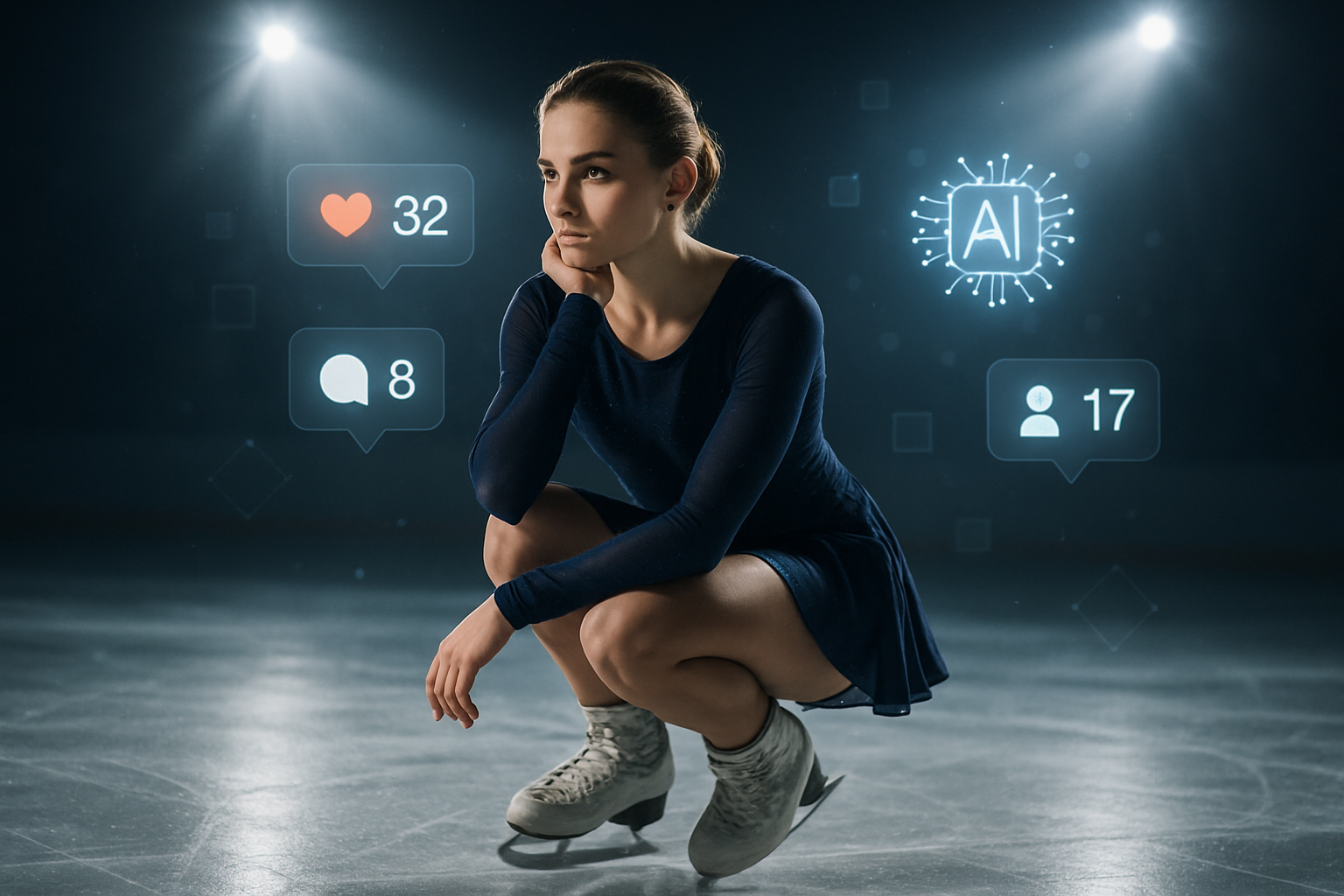
When 17-year-old figure skating champion Ilia Malinin took the ice for his Olympic gala performance at Milano-Cortina 2026, few expected his routine to spark a global conversation about one of the 21st century's most pressing crises: the intersection of artificial intelligence, social media, and youth mental health.
Malinin's emotional performance on February 21, 2026, at Milan Ice Arena transformed what should have been a celebration into a powerful awareness moment that reached millions worldwide. His choreographed routine incorporated elements symbolizing the digital age's impact on mental health—isolation, constant comparison, and the struggle for authenticity in an AI-augmented world.
The Olympic Platform Becomes a Warning Signal
The American figure skater's performance came at a critical juncture. Just months earlier, AI safety concerns had reached unprecedented levels when OpenAI's automated systems flagged Jesse Van Rootselaar's ChatGPT account eight months before the Tumbler Ridge massacre—yet the company determined the concerning messages didn't meet the threshold to alert authorities. The February 10, 2026 tragedy that killed eight people, including a mother, stepbrother, five students, and one educator, exposed critical gaps in AI threat detection systems.
"These platforms are undermining the mental health, dignity, and rights of our children. The state cannot allow this. The impunity of these giants must end."
— Pedro Sánchez, Spanish Prime Minister
Malinin's message resonated particularly powerfully because he himself had experienced the "unforgiving glare of the spotlight" just days earlier during the men's individual competition. Despite being the overwhelming favorite and reigning world champion, he collapsed to eighth place after falling twice in his free skate—a devastating performance that subjected him to intense social media scrutiny.
Global Regulatory Storm Gathering Momentum
The figure skater's advocacy comes amid the most significant wave of social media regulation in internet history. Spain leads the charge with criminal executive liability frameworks that create imprisonment risks for tech executives. The European Commission has found TikTok in breach of Digital Services Act for "addictive design features" including infinite scroll, autoplay, and personalized recommendation systems, with potential penalties reaching billions.
The coordination is unprecedented. Greece stands "very close" to implementing under-15 restrictions via Kids Wallet app enforcement, while France, Denmark, and Austria conduct formal national consultations. Australia has already eliminated 4.7+ million teen accounts, proving technical feasibility of age-based restrictions.

The Science Behind the Crisis
Research underpinning these regulatory efforts reveals alarming statistics: 96% of children aged 10-15 use social media, 70% experience harmful content exposure, and over 50% encounter cyberbullying. Dr. Ran Barzilay's University of Pennsylvania research shows early smartphone exposure causes persistent sleep disorders, cognitive decline, and weight problems. Children spending 4+ hours daily on screens face 61% increased depression risk.
The intersection with AI development creates new complexities. ByteDance's Seedance 2.0 can now generate cinema-quality content from text prompts, while Meta has patented technology enabling AI to mimic human social media activity—even after death. AI-only social networks like Moltbook raise questions about humans being marginalized in an "AI-complete" world.
The AI Governance Challenge
The crisis extends beyond social media into AI development itself. The UN has established an Independent International Scientific Panel with 40 experts led by António Guterres—the first fully independent global AI assessment body. This comes as the industry faces a critical inflection point, transitioning from experimental to essential infrastructure.
OpenAI faces intensifying scrutiny after the Tumbler Ridge case exposed how automated abuse detection systems can flag concerning content but companies may still determine threats don't meet reporting thresholds. With over 800 million weekly ChatGPT users experiencing 10% monthly growth, the stakes couldn't be higher.
"I hope I'm not the last one."
— Jens Lurås Oftebro, Norwegian Olympic Champion, reflecting on potentially being the final Olympic gold medalist in his sport
Success Models and Prevention-First Approaches
Despite the challenges, successful integration models exist. Canadian universities have implemented AI teaching assistants while maintaining critical thinking standards. Malaysia launched the world's first AI-integrated Islamic school combining technology with traditional learning. Singapore's WonderBot 2.0 achieved heritage education success.
The shift toward prevention-first mental healthcare shows promise. Montana achieved 80% reduction in police mental health calls through mobile crisis teams. Countries implementing prevention strategies report improved community resilience and reduced crisis intervention costs.
The Economic Stakes
The financial implications are staggering. The "SaaSpocalypse" has eliminated hundreds of billions in traditional software market cap as AI systems replace conventional solutions. Global memory crisis with sixfold semiconductor price increases affects infrastructure development until 2027. Yet investment continues: Alphabet committed $185 billion to AI infrastructure in 2026, while Amazon plans over $1 trillion in development.
Microsoft's Mustafa Suleyman predicts AI will replace the majority of office workers within two years, lawyers and auditors within 18 months. The employment disruption adds another layer to the mental health crisis as economic anxiety compounds digital-age psychological pressures.
International Cooperation vs. Corporate Resistance
Tech industry resistance remains fierce. Elon Musk characterized Spanish measures as "fascist totalitarian," while Telegram's Pavel Durov sent mass Spanish alerts warning of a "surveillance state." TikTok "categorically" rejected DSA violation findings as "fundamentally flawed."
Yet the momentum appears unstoppable. Spain prosecutors have launched criminal investigations into X, Meta, and TikTok for allegedly spreading AI-generated child sexual abuse material. France conducted cybercrime raids resulting in formal summons for Musk over Grok AI violations. The coordinated approach prevents platform "jurisdictional shopping."
The Olympic Legacy
Malinin's performance will be remembered for its social impact beyond artistic merit, transforming a sporting celebration into a moment of genuine awareness about youth mental health in the digital age. The Milano-Cortina Olympics themselves demonstrated successful technology integration—with Alibaba Qwen AI providing the first Olympic LLM deployment and OMEGA AI revolutionizing figure skating analysis—while maintaining human-centered values.
The Games proved that technology can enhance rather than replace human connections when implemented thoughtfully. The sustainable hosting model, cultural authenticity through bilingual Alto Adige/South Tyrol place names, and Gen Z mascots Milo and Tina showed how innovation can complement tradition.
Critical Juncture for Humanity
February 2026 represents a watershed moment in AI and social media governance. The convergence of Malinin's Olympic platform, regulatory coordination, scientific evidence, and industry resistance creates unprecedented pressure for comprehensive reform.
Success requires balancing innovation acceleration with safety governance, commercial interests with human welfare, and national competitiveness with international cooperation. The decisions made now will determine whether AI achieves its transformative promise or creates systemic risks requiring dramatic corrections.
"This is a historic moment for the entire cryptocurrency market."
— Anonymous market analyst, demonstrating how AI and digital technologies intersect across all sectors
As Malinin's performance demonstrated, athletes have unprecedented power to drive social change through global platforms. His message about social media dangers reached millions precisely through the digital channels he warned against—a powerful irony that underscores the complexity of our technological moment.
The path forward requires unprecedented coordination between governments, technology companies, educational institutions, and civil society. Prevention-first approaches show promise, but implementation must respect cultural values while protecting vulnerable populations. The stakes are clear: get this right, and AI serves humanity; get it wrong, and we face generational consequences for mental health, democratic governance, and human agency itself.
The Olympic champion's courage in using his moment of global attention to highlight these critical issues may prove more historically significant than any athletic achievement. In a world where AI and social media increasingly shape human experience, such advocacy becomes not just admirable, but essential for civilization's future.