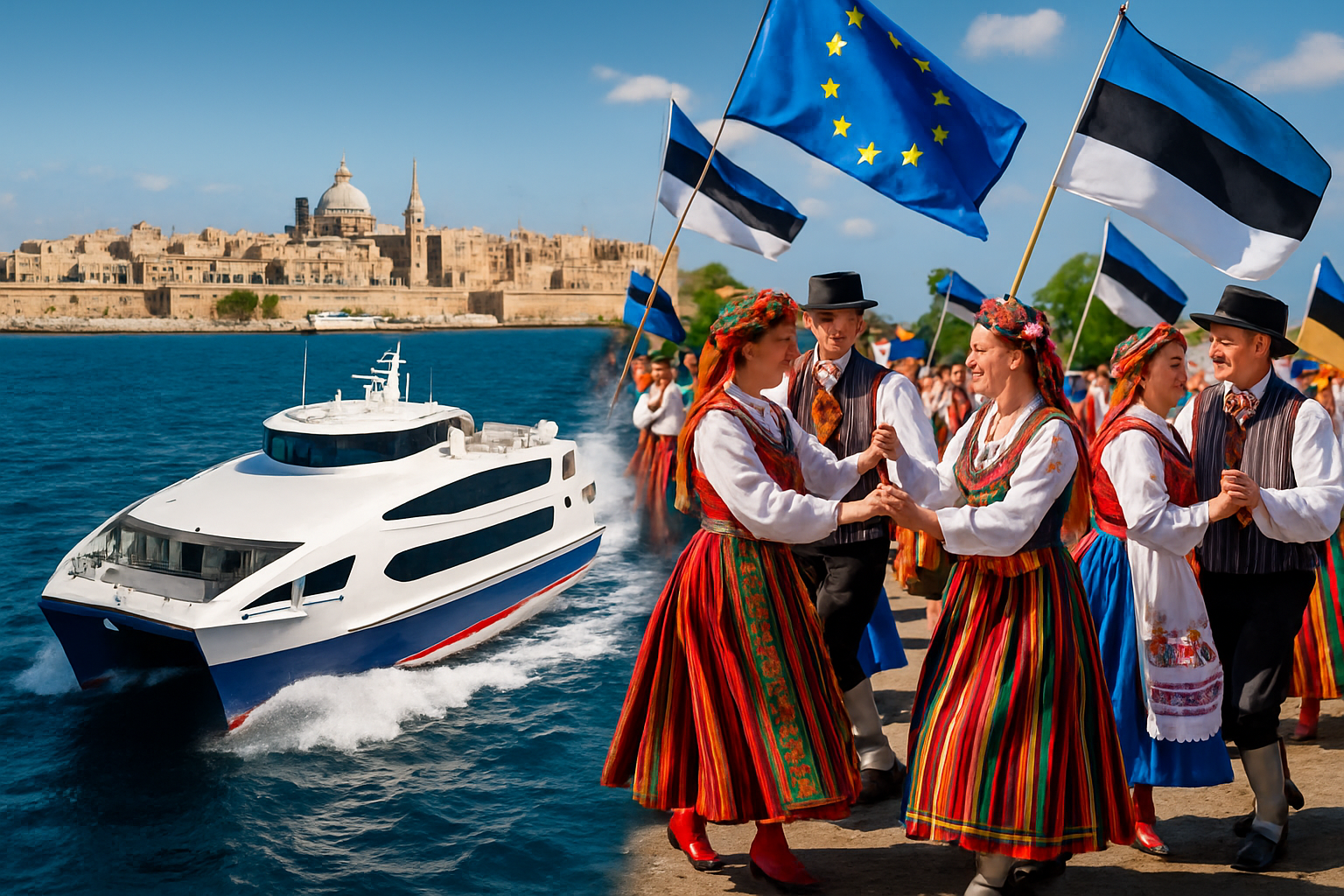
Malta's long-awaited fast ferry service linking Sliema, Bugibba, and Gozo is set to revolutionize Mediterranean island connectivity, while Estonia demonstrates European cultural unity through ambitious Europe Day celebrations featuring free concerts and activities across major cities.
Prime Minister Robert Abela announced during the Labour Party's pre-election congress that ferry operators have successfully completed testing of the quay facilities, with the service expected to commence operations within the coming weeks. This marks a significant milestone in Malta's ongoing efforts to enhance connectivity between the main island and Gozo, addressing long-standing transportation challenges that have affected both residents and tourists.
Malta's Maritime Infrastructure Transformation
The new fast ferry service represents more than just an additional transportation option—it signifies Malta's strategic positioning within the broader European tourism infrastructure renaissance. The route will provide direct connections from Sliema and Bugibba to Gozo, offering tourists and residents alike a more efficient alternative to the traditional Cirkewwa-Mgarr crossing.
This development aligns with Malta's comprehensive approach to tourism infrastructure, which has seen the country deploy 62 tourist medical clinics for the 2026 season—Europe's most extensive seasonal healthcare network according to recent tourism industry analyses. The combination of enhanced connectivity and world-class visitor services positions Malta as a leader in quality-focused tourism development.
"He added that he looked forward to the route entering service shortly, describing it as an important step in improving connectivity between Malta and Gozo," according to the official announcement, reflecting the government's commitment to addressing infrastructure gaps that have historically limited inter-island accessibility.
Estonia's Cultural Diplomacy Through Europe Day
Meanwhile, Estonia is preparing to mark Europe Day on May 9 with an unprecedented week of cultural activities and free concerts spanning Tallinn and the strategically important border city of Narva. This celebration represents more than festive programming—it demonstrates Estonia's sophisticated approach to cultural diplomacy during a period of heightened European unity and regional cooperation.
The choice to include Narva in the celebrations carries particular significance, given the city's position on the Estonian-Russian border and its role in contemporary European geopolitics. By hosting free concerts and cultural activities in both the capital and this border city, Estonia sends a clear message about European values extending to all territories within the EU framework.
Estonia's approach to Europe Day celebrations builds upon the country's established leadership in sustainable development and European integration. With 88% renewable electricity usage, Europe's largest battery storage system serving 90,000 households, and a remarkable 99.25% EU funding absorption rate—the highest among member states—Estonia continues to set standards for effective European cooperation.
The Broader European Tourism Revolution
These developments occur within the context of an unprecedented global tourism infrastructure surge, with over $570 billion invested worldwide in comprehensive visitor services extending far beyond traditional hospitality. European destinations are leading this transformation through quality-focused strategies that prioritize visitor satisfaction, cultural authenticity, and environmental sustainability over simple volume approaches.
The timing proves particularly strategic given the ongoing challenges facing global tourism. With over 18,000 flights cancelled worldwide due to Middle Eastern conflicts and aviation disruptions, European destinations offering reliable, high-quality infrastructure and diverse transportation options are capturing increased market share from traditional hub-dependent routes.
Croatia, for instance, has successfully positioned itself as a safer European alternative while maintaining comprehensive visitor services. Cyprus achieved record tourism performance with 4.5 million visitors generating €3.6 billion revenue through market diversification strategies. These success stories demonstrate how strategic infrastructure investment combined with cultural authenticity creates sustainable competitive advantages.
Technology Integration and Visitor Experience Enhancement
Modern European tourism development increasingly relies on sophisticated technology integration that enhances rather than replaces authentic cultural experiences. The Rome Trevi Fountain managed access system, generating €6 million annually through €2 entry fees, provides a template for sustainable tourism management that balances economic objectives with heritage preservation.
Venice has expanded its pioneering entry fee system to 60 days in 2026, compared to just 29 days in the 2024 pilot phase, demonstrating how digital crowd management can evolve to meet changing visitor patterns while protecting historical sites and local communities.
Malta's new ferry service incorporates similar technological sophistication, with modern vessels equipped with advanced navigation systems, real-time passenger information, and integrated booking platforms that connect seamlessly with the island's broader tourism infrastructure.
Cultural Authenticity and Community Engagement
Estonia's Europe Day programming exemplifies how successful tourism and cultural initiatives require meaningful community involvement and authentic cultural expression. Rather than superficial entertainment, these celebrations showcase Estonia's genuine contribution to European culture while creating economic benefits for local communities.
This approach reflects broader industry evolution toward community-focused development models that serve both visitors and host populations effectively. Generation Z travelers, who represent 50% of those making multiple annual trips of five days or longer, increasingly demand authentic cultural experiences combined with sophisticated infrastructure and environmental responsibility.
The emphasis on free concerts and accessible cultural programming in both Tallinn and Narva demonstrates how public investment in cultural infrastructure creates lasting benefits extending beyond immediate tourism revenue. These events build permanent cultural networks, performance capabilities, and international relationships that support year-round cultural tourism development.
Regional Cooperation and Strategic Positioning
Both Malta's transportation initiative and Estonia's cultural programming reflect the broader trend toward regional cooperation replacing individual destination competition. European countries increasingly recognize that collaborative marketing, shared infrastructure development, and coordinated cultural programming create more robust tourism offerings than isolated efforts.
Malta's enhanced connectivity supports broader Mediterranean tourism integration, making multi-destination experiences more accessible for visitors while reducing transportation-related carbon emissions through efficient maritime connections. Estonia's border city programming demonstrates how cultural tourism can support regional stability and European integration simultaneously.
This cooperative approach proves particularly valuable during periods of global uncertainty. While aviation networks face disruptions from geopolitical tensions, countries with diverse transportation options, strong cultural offerings, and collaborative regional relationships maintain resilient tourism sectors capable of adapting to changing circumstances.
Economic Multiplier Effects and Long-term Benefits
The economic benefits of these infrastructure and cultural investments extend far beyond immediate tourism revenue. Malta's ferry service creates permanent employment in maritime operations, facility management, and related services while reducing travel times and costs for residents accessing education, healthcare, and employment opportunities on different islands.
Estonia's cultural programming supports local artists, event management companies, hospitality providers, and cultural institutions while building international recognition that attracts future investment and collaboration opportunities. These events also strengthen social cohesion and cultural identity, creating intangible benefits that support community resilience during challenging periods.
Modern tourism economic analysis increasingly recognizes these comprehensive multiplier effects, moving beyond simple visitor expenditure calculations to consider infrastructure improvements, cultural industry development, workforce development, and community capacity building as integral components of tourism value creation.
Climate Adaptation and Future Resilience
Both Malta's maritime infrastructure development and Estonia's cultural programming incorporate climate adaptation considerations essential for long-term competitiveness. With January 2026 marking the 18th consecutive month of global temperatures exceeding 1.5°C above pre-industrial levels, tourism infrastructure must anticipate rather than merely respond to changing environmental conditions.
Malta's new ferry service employs vessels designed for increasingly variable weather conditions, with enhanced stability systems and weather monitoring capabilities that ensure reliable operations during Mediterranean storms that have become more frequent and intense. The service also provides redundancy for transportation networks, reducing vulnerability to single-point failures during extreme weather events.
Estonia's emphasis on outdoor cultural programming in multiple cities creates operational flexibility that allows events to continue despite weather variations, while also distributing economic benefits across different communities rather than concentrating them in single locations vulnerable to climate impacts.
Future Implications for European Tourism
The success of these initiatives will influence tourism development strategies across Europe and globally. Malta's ferry service provides a model for island nations seeking to improve connectivity without relying solely on aviation networks increasingly vulnerable to fuel price volatility and operational disruptions.
Estonia's cultural programming demonstrates how smaller European nations can leverage cultural assets and European identity to create distinctive tourism offerings that complement rather than compete directly with larger destinations. The emphasis on free, accessible programming also shows how public investment in cultural infrastructure can generate both economic and social returns.
As the global tourism industry continues evolving toward quality-focused, community-engaged, environmentally responsible development models, these European examples provide practical templates for destinations seeking to balance economic opportunity with cultural preservation and environmental protection.
The convergence of improved transportation infrastructure, authentic cultural programming, technological integration, and environmental consciousness evident in both Malta and Estonia represents the future of European tourism—sophisticated, sustainable, and genuinely beneficial to both visitors and host communities in an increasingly complex global landscape.