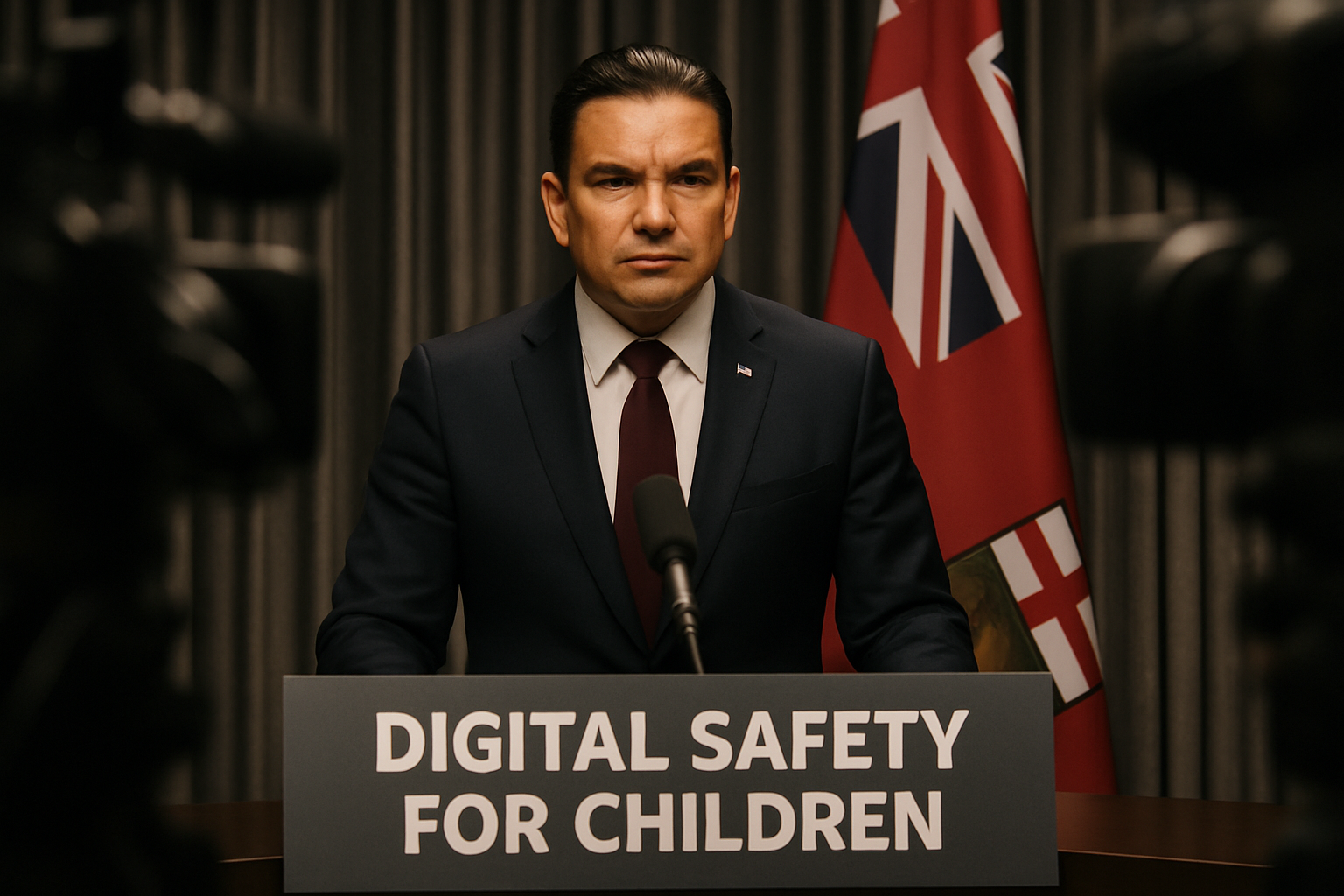
Manitoba Premier Wab Kinew announced that his government is developing comprehensive legislation to ban social media and AI chatbots for youth, making Manitoba the first Canadian province to join an unprecedented global movement aimed at protecting children from documented digital harms.
Speaking to reporters, Premier Kinew emphasized the urgent need for action, stating that social media platforms "contribute to anxiety, depression and are doing 'awful things' to children." The announcement positions Manitoba at the forefront of what experts describe as the most significant social media regulation wave in internet history.
A Global Crisis Demanding Action
The Manitoba initiative comes as alarming new evidence emerges about the scope of digital harm to young people. Research by Dr. Ran Barzilay at the University of Pennsylvania reveals that 96% of children aged 10-15 use social media, with 70% experiencing harmful content exposure and over 50% encountering cyberbullying. Even more concerning, children who use screens for more than four hours daily face a 61% increased risk of depression.
The scientific foundation for action extends beyond mental health statistics. Early smartphone exposure before age 5 causes persistent sleep disorders, cognitive decline, and weight problems that can extend into adulthood. Austrian neuroscience research has identified a "perfect storm" where children's reward systems remain extremely vulnerable to smartphone stimulation while impulse control remains underdeveloped until age 25.
Manitoba Joins International Coordination
Manitoba's decision places Canada within a coordinated international response that has gained extraordinary momentum throughout 2026. Australia's under-16 social media ban, implemented in December 2025, successfully eliminated 4.7 million teen accounts, proving that comprehensive age restrictions are technically feasible when governments demonstrate political will.
The European response has been even more aggressive. Spain has implemented the world's first criminal executive liability framework, creating actual imprisonment risks for technology executives whose platforms harm children. This revolutionary approach is spreading rapidly across Europe, with Greece implementing under-15 restrictions via its "Kids Wallet" system, while France, Denmark, and Austria are conducting formal consultations on similar measures.
"We want technology to humanize humans, not sacrifice our children."
— Meutya Hafid, Indonesian Communications Minister
Indonesia became the first Southeast Asian nation to implement comprehensive under-16 restrictions in March 2026, targeting major platforms including YouTube, TikTok, Facebook, Instagram, and gaming platform Roblox. The coordinated timing across multiple jurisdictions prevents what regulators call "jurisdictional shopping" – the practice of platforms relocating operations to avoid oversight.
The Philippine Connection: Gaming Platforms as Extremist Vectors
Manitoba's inclusion of AI chatbots in its planned restrictions reflects growing concerns highlighted by developments in the Philippines, where authorities discovered extremist recruitment targeting children through gaming platform Roblox. The Philippine National Police Anti-Cybercrime Group linked a series of fatal school shootings and foiled plots to online nihilistic violent extremism allegedly spread through gaming platforms.
These revelations exposed a "scary new frontier in digital harm," as authorities found that traditional safety measures proved inadequate against interactive environments that enable relationship building over time. Foreign individuals were directing Filipino children to acquire weapons and tactical equipment, with devices containing Nazi symbols and detailed attack instructions.
The crisis has prompted Philippine authorities to place Roblox on probation and threaten platform restrictions if adequate safety measures are not implemented. This development underscores why Manitoba's Premier Kinew specifically mentioned AI chatbots alongside social media in his announcement.
Platform Accountability Revolution
The regulatory momentum has coincided with unprecedented legal victories against major technology companies. Meta faces a historic $375 million penalty in New Mexico for child safety violations, representing what courts termed "unconscionable" trade practices exploiting children's vulnerabilities. Internal documents from 2014-2015 revealed explicit company goals to increase user engagement time, contradicting public statements about prioritizing user wellbeing.
Mark Zuckerberg's historic testimony in February 2026 marked the first time a major tech CEO faced questioning in court about platform addiction. Approximately 1,600 similar cases from families and school districts are now pending, representing what legal experts describe as the end of Big Tech's legal immunity era.
Whistleblower Arturo Béjar's revelations proved particularly damaging, demonstrating how algorithms help predators locate children. "If your interest is little girls, they will be very good at connecting you with little girls," Béjar testified, exposing the deadly intersection of engagement optimization and child exploitation.
The Canadian Federal Context
Manitoba's action makes Canada the latest democracy to join the international coordination effort. Federal Culture Minister Marc Miller announced in April 2026 that the Liberal government is "very seriously" considering social media restrictions following a non-binding party resolution supporting youth protection measures.
However, Manitoba's provincial leadership on this issue reflects Premier Kinew's recognition that federal action may be too slow to address the immediate crisis facing young people. The province's approach aligns with the "Therapeutic Revolution of 2026" – a global paradigm shift from crisis-response to prevention-first mental healthcare.
Implementation Challenges and Alternative Approaches
The technical implementation of youth social media bans presents significant challenges. Real age verification requires biometric authentication or identity document validation, raising legitimate surveillance concerns from privacy advocates. The global semiconductor crisis has driven memory chip prices up sixfold, constraining the infrastructure needed for sophisticated verification systems until new manufacturing facilities come online in 2027.
Cross-border enforcement requires unprecedented international cooperation, as demonstrated by the Netherlands' Odijo data breach affecting 6.2 million customers – one-third of the population – which privacy experts describe as a "gold mine for criminals."
Alternative approaches exist. Malaysia emphasizes parental responsibility through comprehensive digital safety campaigns, with Communications Minister Datuk Fahmi Fadzil stressing that parents must control device access rather than using devices as "digital babysitters." Oman has implemented a "Smart tech, safe choices" initiative focusing on conscious digital awareness and teaching children to recognize "digital ambushes."
Economic and Social Benefits of Prevention
Countries implementing prevention-first strategies are documenting superior economic outcomes compared to crisis-management approaches. Montana achieved an 80% reduction in police mental health calls through proactive mobile crisis teams. Finland maintains its position as the world's happiest country for the ninth consecutive year through educational reforms that balance academic achievement with psychological wellbeing.
The economic benefits extend beyond immediate cost savings. Prevention-focused strategies demonstrate measurable returns through decreased crisis interventions, improved community resilience, enhanced workplace productivity, and reduced social service demands. Mental wellness is increasingly viewed as essential community infrastructure rather than individual pathology.
Industry Resistance and Market Impact
The technology industry's resistance to these measures has been fierce and coordinated. Elon Musk has characterized regulatory measures as "fascist totalitarian" overreach, while Telegram founder Pavel Durov has sent mass alerts to users warning of "surveillance state" implications. However, government officials are using this coordinated opposition as evidence supporting the regulatory necessity.
The "SaaSpocalypse" of February 2026 eliminated hundreds of billions in technology market capitalization amid regulatory uncertainty. Yet platforms are demonstrating that compliance is achievable when faced with determined government action – TikTok and X both reportedly complied with Indonesia's restrictions despite broader industry resistance.
The Stakes for Canadian Youth
For Manitoba's young people, Premier Kinew's announcement represents recognition that current trends are unsustainable. The emergence of the "digital ghosts" movement – millions of young people consuming social media content without sharing personal information as a form of digital self-care – indicates widespread generational digital fatigue.
Young Australians are increasingly blaming Big Tech for their psychological distress, with many expressing that they "sometimes wish social media didn't exist." This sentiment captures a generation caught between the social connectivity that platforms provide and the documented psychological harm they inflict.
A Critical Juncture for Democratic Governance
Manitoba's entry into the global youth protection movement represents what experts describe as a "critical juncture" for democratic governance in the digital age. Parliamentary approval is required across participating European nations throughout 2026 for coordinated year-end implementation of criminal liability frameworks.
Success in establishing these precedents could trigger worldwide adoption of executive accountability and age restrictions, fundamentally altering the relationship between technology companies and democratic governments. Failure might strengthen anti-regulation arguments and consolidate platform power beyond governmental authority.
The fundamental question remains whether social media companies designed to maximize engagement can coexist with the healthy development of young minds. Decisions made in 2026 will echo through decades of human development, determining whether technology serves human flourishing or becomes an exploitation tool beyond democratic accountability.
As Premier Kinew noted, platforms are currently "doing awful things to children." Manitoba's leadership in addressing this crisis positions the province at the forefront of determining how democratic societies will organize around child protection in the digital age – a test that will define the relationship between technology and human welfare for generations to come.