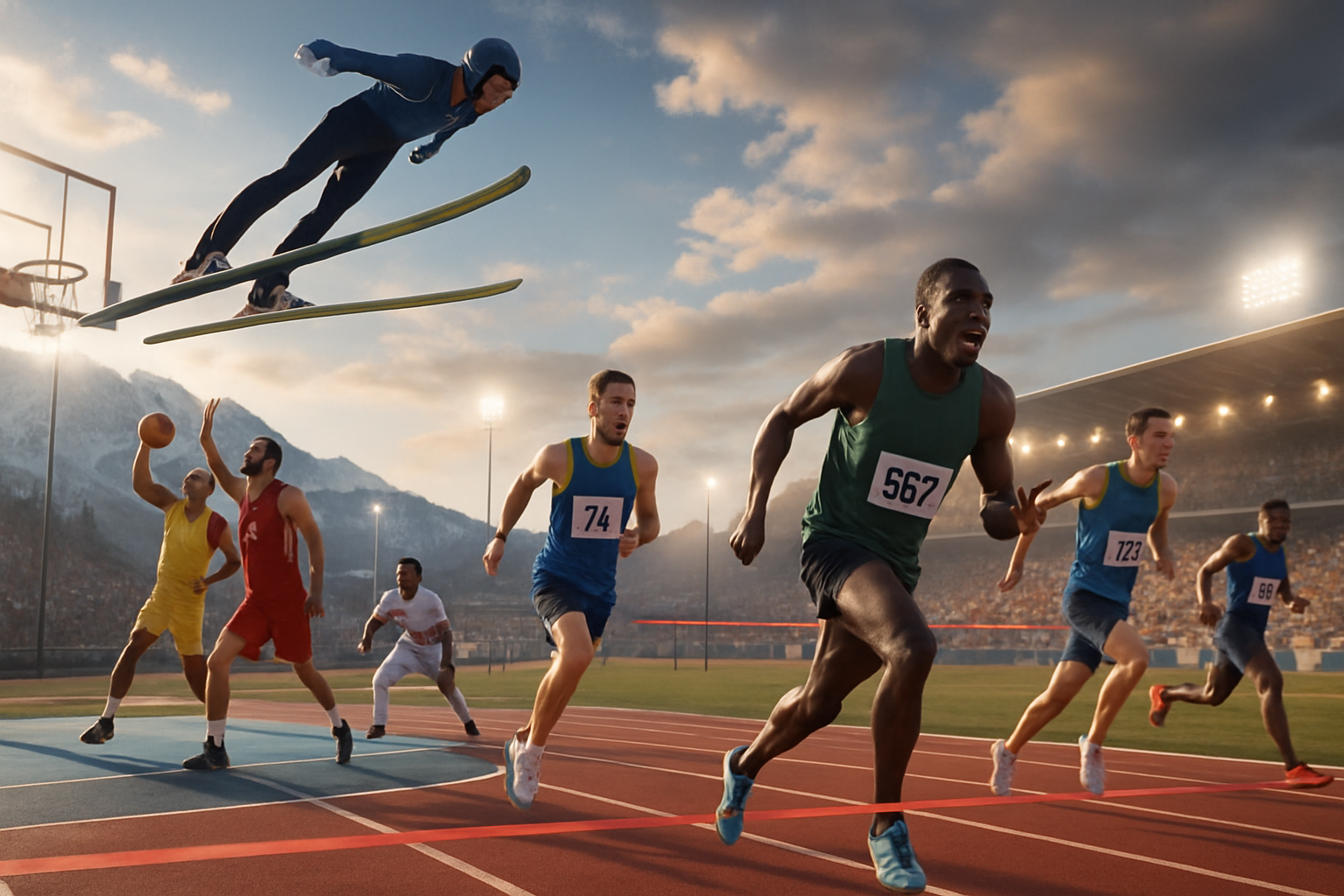
March 2026 has witnessed a remarkable convergence of international sporting excellence, with athletes from across six continents redefining competitive boundaries and establishing new benchmarks in global championships.
The World Athletics Indoor Championships in Toruń, Poland, emerged as the centerpiece of this athletic renaissance, with performances that demonstrated the continuing evolution of human achievement in sport. The championships saw breakthrough performances from athletes representing the increasingly diverse landscape of international athletics.
World Athletics Indoor Championships: Global Breakthrough
Ireland's Mark English delivered one of the tournament's standout performances, safely advancing to the 800m semi-finals with a controlled 1:46.42 victory in his heat. The Finn Valley AC runner's tactical excellence was evident as he held off Poland's Filip Ostrowski, who finished second in 1:46.61, while bronze medallist from the 2025 World Indoors, Josué Canales of Spain, was eliminated after finishing fifth.
"I was looking around a little bit on the final lap, but I knew there was a few guys in the race," English reflected after his heat victory. "I'm happy to get through safely and look forward to Saturday's semi-finals."
Jamaica's veteran Natoya Goule-Toppin continued her impressive indoor season, progressing to the women's 800m semi-finals after placing second in her heat with 2:01.32. The experienced athlete led most of her race before being overtaken by Norway's Pernille Karlsen Antonsen, who set a national record of 2:00.77. Unfortunately, Jamaica's Kelly-Ann Beckford was unable to advance after finishing fifth in her heat with a time of 2:04.09.
Algeria's Suleiman Moulaye also secured his place in the 800m semi-finals, finishing third in his heat with 1:46.13. His qualification came through fastest losers after failing to secure direct advancement, demonstrating the competitive depth of the event.
Biathlon World Cup Dominance
Norway's Sturla Holm Lægreid continued his exceptional season with another commanding victory, this time claiming the sprint cup in dramatic fashion. The Norwegian athlete has been virtually unstoppable in 2026, with his latest triumph marking his sixth consecutive victory in the discipline.
Sweden's Sebastian Samuelsson provided the closest challenge to Lægreid's dominance, finishing level on points but losing the sprint cup due to having fewer individual victories. "Det är surt som fan faktiskt" (It's damn bitter actually), Samuelsson told SVT Sport after the results were confirmed.
The biathlon season has showcased the incredible depth of Scandinavian winter sports, building on the momentum from the Milano-Cortina 2026 Winter Olympics where Norwegian athletes achieved unprecedented success with 18 gold medals.
Swimming World Records Redefined
Australian swimmer Cameron McEvoy delivered one of the most significant performances in international swimming by breaking the 50m freestyle world record at the China Open. The Olympic champion surpassed Brazilian César Cielo's long-standing mark, which had stood for over 16 years, representing a monumental achievement in sprint swimming.
McEvoy's record demonstrates the continued evolution of swimming technique and training methods, with Australian swimming programs producing consistently world-class results across multiple disciplines. The achievement adds to Australia's remarkable year in international sports, following their breakthrough Winter Olympic performances.
Cultural and Artistic Excellence
Estonia's University of Tartu Chamber Choir provided a different dimension to international competition, winning two gold diplomas and a special award at the Cantaquera Festival Coral Internacional in Antequera, Spain. This achievement highlights how competitive excellence extends beyond traditional athletics into cultural and artistic domains.
Rugby League and Professional Sports
New Zealand's Warriors have made their statistically best-ever start to an NRL season, though with only two games completed, the achievement provides hope rather than certainty. The team's early-season performance has generated optimism among supporters who have endured decades of near-misses and disappointment.
"Maybe it is their year?" has become the cautious refrain among Warriors fans, recognizing that while the sample size is minimal, the quality of performances suggests genuine improvement in the franchise's competitive capability.
Emerging Global Competition
The Cyprus Grand Slam in Tbilisi saw promising performances from local athletes, with P. Christodoulidis narrowly missing a medal position. While full details remain limited, the event demonstrated the continued expansion of international judo competition into traditionally underrepresented regions.
These championships collectively represent a watershed moment in international sport, where traditional powerhouses face increasing challenges from emerging nations that have invested systematically in athletic development and coaching infrastructure.
Technology and Innovation Impact
The 2026 championships have benefited significantly from technological advances pioneered during the Milano-Cortina Winter Olympics, including AI-powered analysis systems and enhanced broadcasting capabilities. These innovations have improved both athlete performance analysis and spectator engagement, setting new standards for international sporting events.
The integration of advanced timing systems, real-time performance analytics, and global broadcasting has created unprecedented opportunities for athletes to showcase their talents to worldwide audiences, contributing to the democratization of international sport.
Future Implications
The performances across these March 2026 championships suggest that international sport has entered a new era of global competitiveness. The success of athletes from diverse geographical and economic backgrounds demonstrates that traditional barriers to elite athletic achievement are increasingly surmountable through strategic investment in coaching, facilities, and systematic development programs.
As these championships conclude, the sporting world looks ahead to upcoming major events with heightened expectations for breakthrough performances and continued expansion of global competitive excellence. The template established by successful programs across multiple continents provides a roadmap for nations seeking to develop their athletic capabilities and compete at the highest international levels.
The convergence of record-breaking individual achievements, team successes, and cultural celebrations in March 2026 represents more than isolated sporting moments – it demonstrates sport's capacity to unite diverse communities while celebrating human potential across all its magnificent forms.