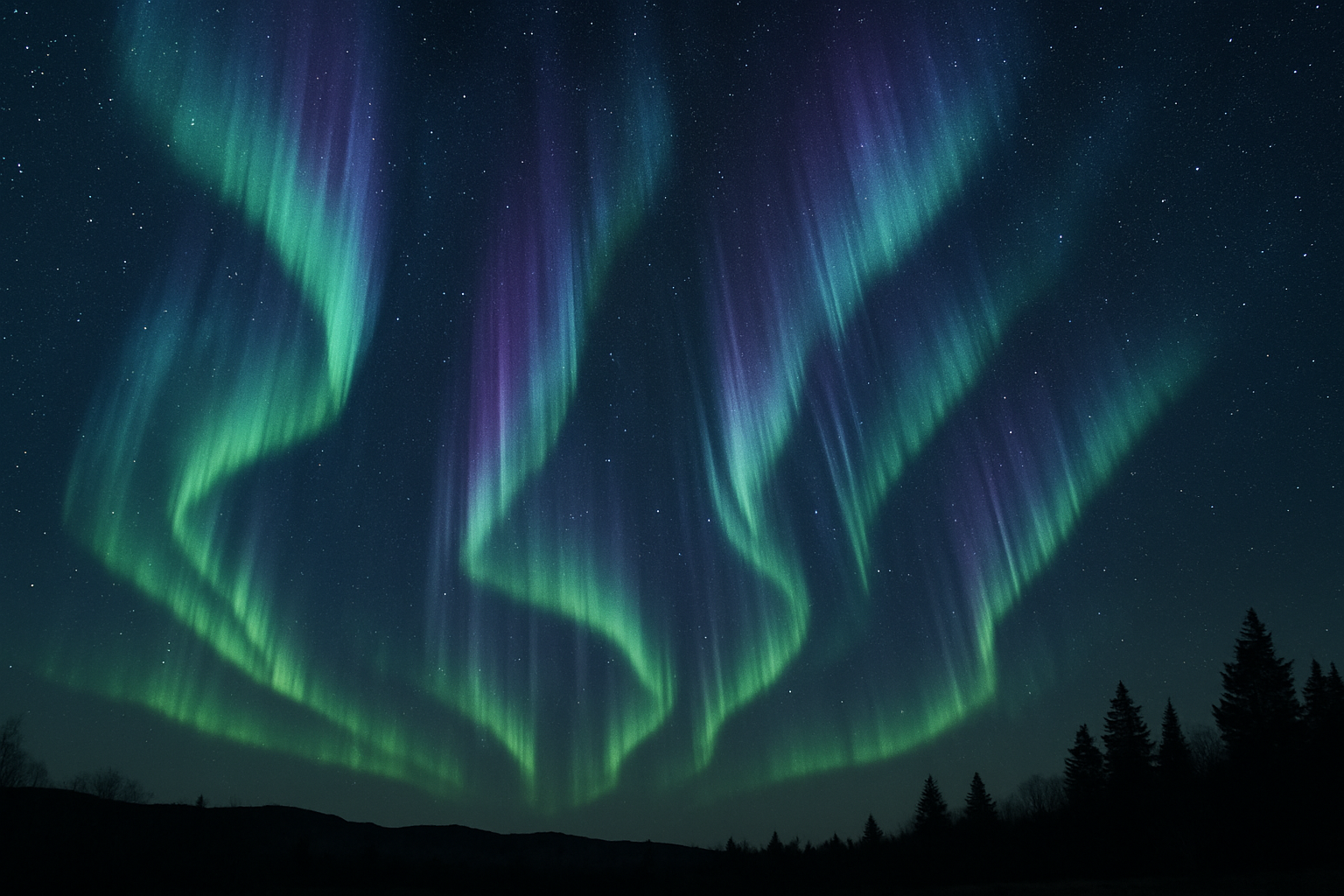
March 2026 is set to deliver one of the most spectacular aurora displays in years, with astronomers predicting a rare "sky in flames" phenomenon that will make the northern lights visible far beyond their usual polar boundaries.
The extraordinary celestial event, being tracked by observatories across Europe and North America, promises to open what scientists are calling a "cosmic gateway" above viewers' heads. Unlike typical aurora displays confined to high-latitude regions, this March phenomenon is expected to paint the night sky in brilliant colors across much of the Northern Hemisphere.
A Golden Age of Astronomical Discovery
This March aurora event occurs during what researchers have dubbed the "golden age of astronomical observation," following an unprecedented series of celestial phenomena throughout early 2026. The year has already delivered remarkable cosmic spectacles, including February's six-planet alignment featuring Mercury, Venus, Mars, Jupiter, Saturn, and Uranus, and the total lunar eclipse on March 3 that captivated millions worldwide.
The aurora forecast builds on a year of extraordinary space weather activity, with NASA's revolutionary DAGGER AI system now providing 30-minute geomagnetic storm predictions with unprecedented accuracy. This breakthrough technology has transformed space weather monitoring, allowing both professional astronomers and citizen observers to prepare for optimal viewing conditions.
"We're witnessing a convergence of solar activity and technological capability that's creating unique opportunities for aurora observation," explains Dr. Maria Santos, a space physicist at the European Space Agency. "The March phenomenon represents the kind of display that typically occurs once every several years."
— Dr. Maria Santos, ESA Space Physicist
The Science Behind the Spectacle
Aurora displays result from the interaction between charged particles from the Sun and Earth's magnetic field. When these solar particles collide with atmospheric gases, they create the characteristic dancing lights that have fascinated humanity for millennia. The March 2026 event is expected to be particularly intense due to enhanced solar wind conditions coinciding with optimal magnetic field alignment.
Recent advances in space weather prediction, including the deployment of sophisticated monitoring satellites and AI-powered forecasting systems, have allowed scientists to anticipate this display with remarkable precision. The International Space Station's Crew-12 mission, featuring French astronaut Sophie Adenot on her record eight-month stay, has been conducting crucial atmospheric research that contributes to understanding these phenomena.
Global Viewing Opportunities
Unlike many astronomical events that require expensive travel to remote locations, the March aurora display promises accessibility to millions of observers. Preliminary forecasts suggest the phenomenon will be visible across northern Europe, Canada, Alaska, and potentially as far south as the northern United States and southern Scandinavia.
The timing couldn't be better for public engagement, as the display is expected during optimal viewing hours for populated regions. Modern smartphone technology, recently certified by NASA for space photography applications, will allow widespread documentation of the event, potentially creating the most extensively photographed aurora display in history.
Technology Meets Ancient Wonder
The March 2026 aurora represents a fascinating intersection of cutting-edge technology with one of nature's oldest spectacles. Advanced prediction systems now allow forecasters to provide precise timing and intensity estimates, while social media platforms enable real-time sharing of observations across continents.
This technological integration enhances rather than diminishes the natural wonder of aurora displays. Mobile applications provide location-specific viewing guidance, while improved camera technology makes aurora photography accessible to amateur photographers worldwide. The democratization of both prediction and documentation tools means this March event could engage the largest aurora-observing audience in history.
Economic and Educational Impact
Aurora tourism has become increasingly significant for northern regions, with specialized viewing tours generating substantial economic activity. The March 2026 phenomenon is expected to boost tourism across traditional aurora-viewing destinations while creating new opportunities in regions that rarely experience such displays.
Educational institutions worldwide are preparing special curricula around the event, using it as a gateway to teaching space science, atmospheric physics, and Earth's magnetic field dynamics. Astronomy clubs report unprecedented enrollment as public interest in celestial phenomena reaches new heights during this remarkable year of cosmic activity.
Connection to Broader Space Developments
The March aurora spectacle occurs during a transformative period for space science and exploration. The ongoing transition from what researchers call the "AI revolution" to the "space economy golden age" has created unprecedented capabilities for monitoring and predicting space weather phenomena.
International cooperation continues to drive these advances, with coordinated observation networks spanning multiple countries and continents. The recent success of missions like NASA's Artemis program preparations, China's lunar exploration advances, and the European Space Agency's continued innovation all contribute to humanity's growing understanding of space weather and its effects on Earth.
Preparing for the Display
Optimal aurora viewing requires minimal light pollution and clear skies. Observers are advised to seek locations away from urban areas, dress warmly for extended outdoor viewing, and allow their eyes time to adjust to darkness. While auroras can appear at any time during dark hours, the most intense displays typically occur between 10 PM and 2 AM local time.
Photography enthusiasts should prepare for long-exposure techniques, with tripods essential for capturing the full beauty of the dancing lights. The phenomenon's intensity and duration will vary by location, making real-time aurora forecast apps invaluable for timing viewing sessions.
A Rare Celestial Gift
The March 2026 aurora phenomenon represents more than just a beautiful sky display—it symbolizes humanity's growing capability to understand and predict cosmic events while maintaining our sense of wonder at the universe's natural beauty. As millions prepare to look skyward this March, they'll witness both an ancient cosmic dance and a testament to modern scientific achievement.
This rare convergence of solar activity, technological capability, and public accessibility makes the March 2026 aurora display a truly special event. For those who witness it, the "sky in flames" will provide memories of cosmic beauty that connect us to both the vastness of space and the remarkable planet we call home.