European researchers are pioneering revolutionary marine cleanup technology while Romania achieves record-breaking freshwater restoration, demonstrating unprecedented environmental conservation momentum during the 19th consecutive month of global temperatures exceeding 1.5°C pre-industrial levels.
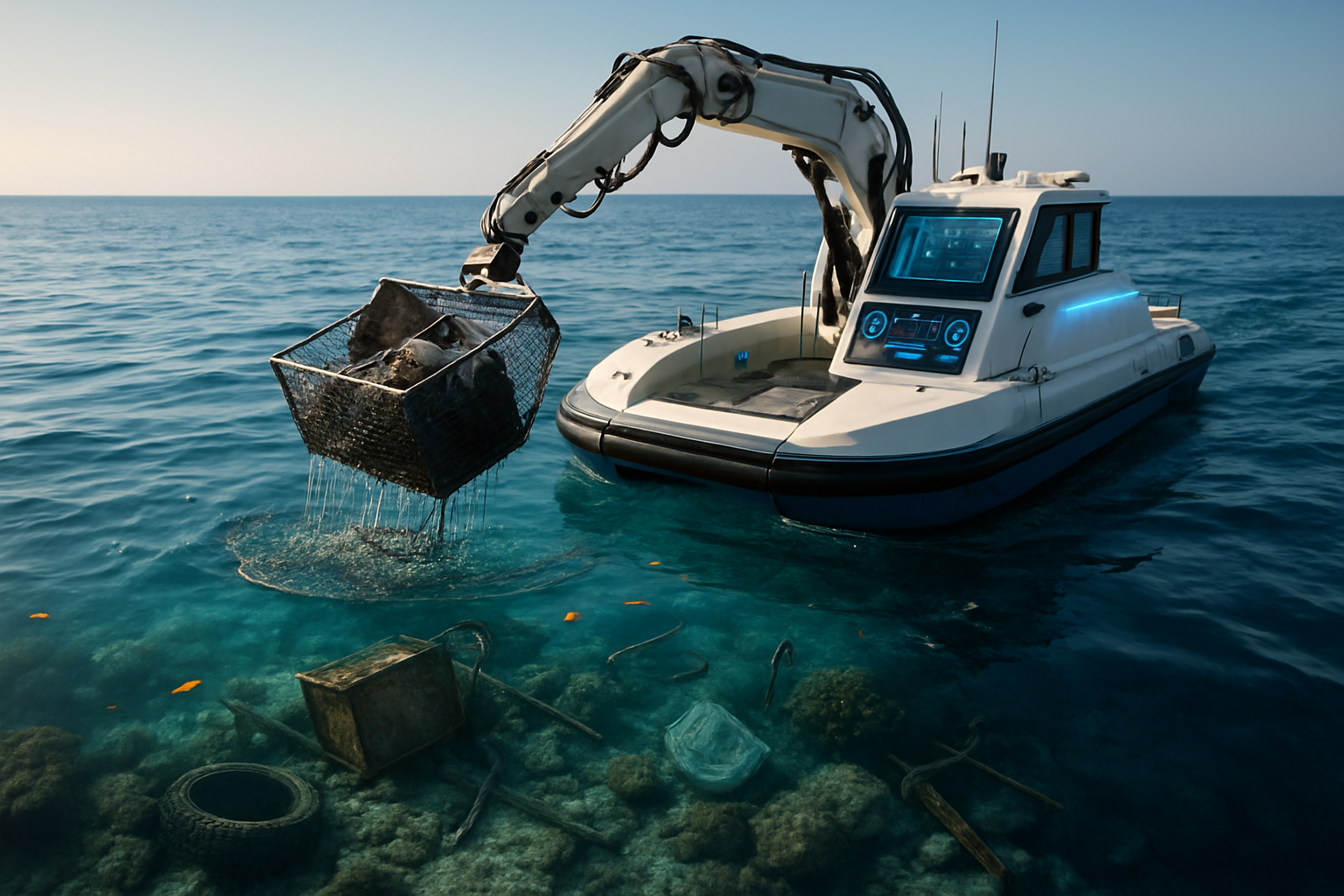
At the forefront of marine conservation innovation, the EU-funded SeaClear2.0 initiative has deployed autonomous robotic fleets capable of independently identifying and removing marine litter from the Mediterranean seafloor. Operating from a marina in Marseille, France, these AI-guided systems represent a fundamental transformation in how humanity approaches ocean cleanup operations.
Autonomous Marine Recovery Revolution
The SeaClear2.0 demonstration revealed remarkable capabilities, with cranes hauling rubber tires covered in algae, rusted metal ship parts, fences, and heavy machinery from beneath the Mediterranean waves. The entire operation proceeds without human crews aboard, relying entirely on autonomous systems developed by European scientists and companies.
"There is no crew on board, and the entire system operates autonomously," explains the project documentation. The initiative represents evolution from SeaClear's predecessor program, with researchers developing drone fleets that can independently locate, identify, and retrieve marine debris using advanced artificial intelligence.
This technological breakthrough addresses the dangerous, dirty work of seafloor cleanup through sophisticated robotic systems equipped with IoT and 5G connectivity. The drones demonstrate unprecedented precision in collecting both visible marine waste and microscopic plastic particles that traditional cleanup methods cannot address, offering billions in export revenue potential and high-tech manufacturing employment opportunities.
Romania's Rapid Ecosystem Restoration Success
Simultaneously, Romania achieved a remarkable environmental victory with the rapid restoration of the Călimănești reservoir lake. Environment Minister Diana Buzoianu announced the complete removal of tons of waste from the water body within just six days of filing a complaint with the National Administration "Romanian Waters" (ANAR).
The swift government response demonstrates how effective coordination between environmental authorities and rapid-response protocols can achieve dramatic ecosystem improvements. Minister Buzoianu's announcement on social media highlighted the transformation from a waste-polluted water body to restored aquatic habitat in less than a week.
This success represents broader Romanian environmental leadership, including recent airport solar expansion projects and strengthened coastal development enforcement along the Black Sea. The country's comprehensive approach positions environmental protection as economic development strategy rather than regulatory burden.
Global Conservation Renaissance Context
These breakthroughs emerge during what environmental scientists describe as an unprecedented global conservation renaissance, occurring against the backdrop of critical climate challenges. January 2026 marked the hottest month in recorded history, extending an unprecedented 19-month streak of temperatures exceeding the critical 1.5°C threshold above pre-industrial levels.
The sustained warming overrides natural climate variability, including La Niña cooling effects, demonstrating that human-induced climate change has fundamentally altered Earth's atmospheric systems beyond natural recovery mechanisms. This context makes conservation victories particularly significant, showing adaptive capacity for protecting essential environmental systems.
"The challenge for 2026 is not to identify the problem, but to assume responsibility for solving it."
— Environmental Policy Analysis, 2026
Technology-Tradition Integration Success
Both the marine cleanup technology and Romanian lake restoration demonstrate sophisticated integration of cutting-edge technology with traditional ecological knowledge and community-based management. The Mediterranean cleanup combines advanced robotics with local maritime expertise, while Romanian efforts build on decades of freshwater management experience enhanced by modern environmental science.
This synthesis represents fundamental environmental protection methodology evolution, moving beyond purely technological solutions to comprehensive frameworks that incorporate cultural sensitivity and community engagement. The approach recognizes that technology alone remains insufficient without community participation and traditional environmental knowledge systems.
Economic and Strategic Implications
Modern environmental conservation increasingly functions as an economic development engine rather than regulatory burden. The marine cleanup technology sector represents substantial export revenue potential and high-tech manufacturing employment across participating European nations. Romania's rapid lake restoration protects tourism assets while demonstrating governmental environmental responsiveness that attracts sustainable investment.
Countries implementing comprehensive environmental protection consistently demonstrate greater economic resilience and attract sustainable development investment across sectors from green technology manufacturing to eco-tourism and environmental services. The economic multiplier effects include reduced healthcare costs from pollution, preserved agricultural productivity, and enhanced international competitiveness through environmental credentials.
International Cooperation Templates
The success of both initiatives highlights the critical importance of unprecedented international cooperation in addressing transnational environmental challenges. Ocean currents carry pollution across continental boundaries, making unilateral cleanup efforts insufficient for long-term ecosystem health.
The EU's SeaClear2.0 program demonstrates how coordinated policy frameworks, shared monitoring systems, and collaborative technology development can achieve remarkable results. Romania's rapid response provides templates for emergency environmental action that other nations can adapt to their specific contexts while maintaining effectiveness.
This diversity of approaches offers resilience against single-solution dependencies, providing multiple adaptation pathways for addressing complex environmental challenges that span biological, physical, and human systems.
Implementation Challenges and Solutions
Despite remarkable successes, both initiatives face common implementation challenges that characterize environmental protection efforts globally. Funding sustainability remains particularly critical for developing nations, where immediate economic pressures often override long-term environmental considerations.
Technical capacity building requires sustained investment in education, training, and institutional development. Climate change continually disrupts project timelines, requiring adaptive management capabilities for rapidly changing environmental conditions. However, the diversity of successful approaches provides crucial lessons for scaling protection efforts worldwide.
Success factors consistently include community ownership and engagement, transparent governance frameworks, economic incentives that make protection financially viable, and integration of traditional ecological knowledge with modern conservation science.
Critical Action Window and Future Implications
March 2026 represents a critical juncture for global environmental protection, with the choice between reactive crisis management and proactive ecosystem service management potentially determining whether conservation efforts can keep pace with accelerating environmental change during this decisive climate action decade.
The environmental action window continues narrowing as ecological systems approach critical thresholds that could trigger irreversible changes. However, the demonstrated success of both marine cleanup technology and rapid freshwater restoration provides grounds for optimism about humanity's adaptive capacity.
Tools, knowledge, and cooperation frameworks clearly exist for comprehensive environmental protection, as demonstrated by these diverse international initiatives. Success depends on rapid scaling through enhanced international cooperation, sustained financial commitments, and recognition of environmental protection as essential infrastructure for human prosperity and planetary sustainability.
Global Scaling Potential
The Mediterranean marine cleanup and Romanian lake restoration provide practical templates for scaling environmental protection globally through coordinated approaches that address multiple challenges while building local capacity and fostering international cooperation.
These initiatives demonstrate that effective conservation requires sophisticated synthesis of scientific knowledge, community engagement, technological innovation, and international cooperation through locally-appropriate combinations rather than isolated approaches. The conservation renaissance emerging in 2026 may prove decisive in determining humanity's relationship with the natural world and providing foundations for a sustainable future.
As environmental challenges continue accelerating, the coordination demonstrated across marine and freshwater ecosystem restoration offers crucial lessons for scaling protection efforts worldwide. The window for effective environmental action may be narrowing, but these remarkable achievements show that comprehensive environmental protection remains achievable through maximum urgency and coordinated international response.