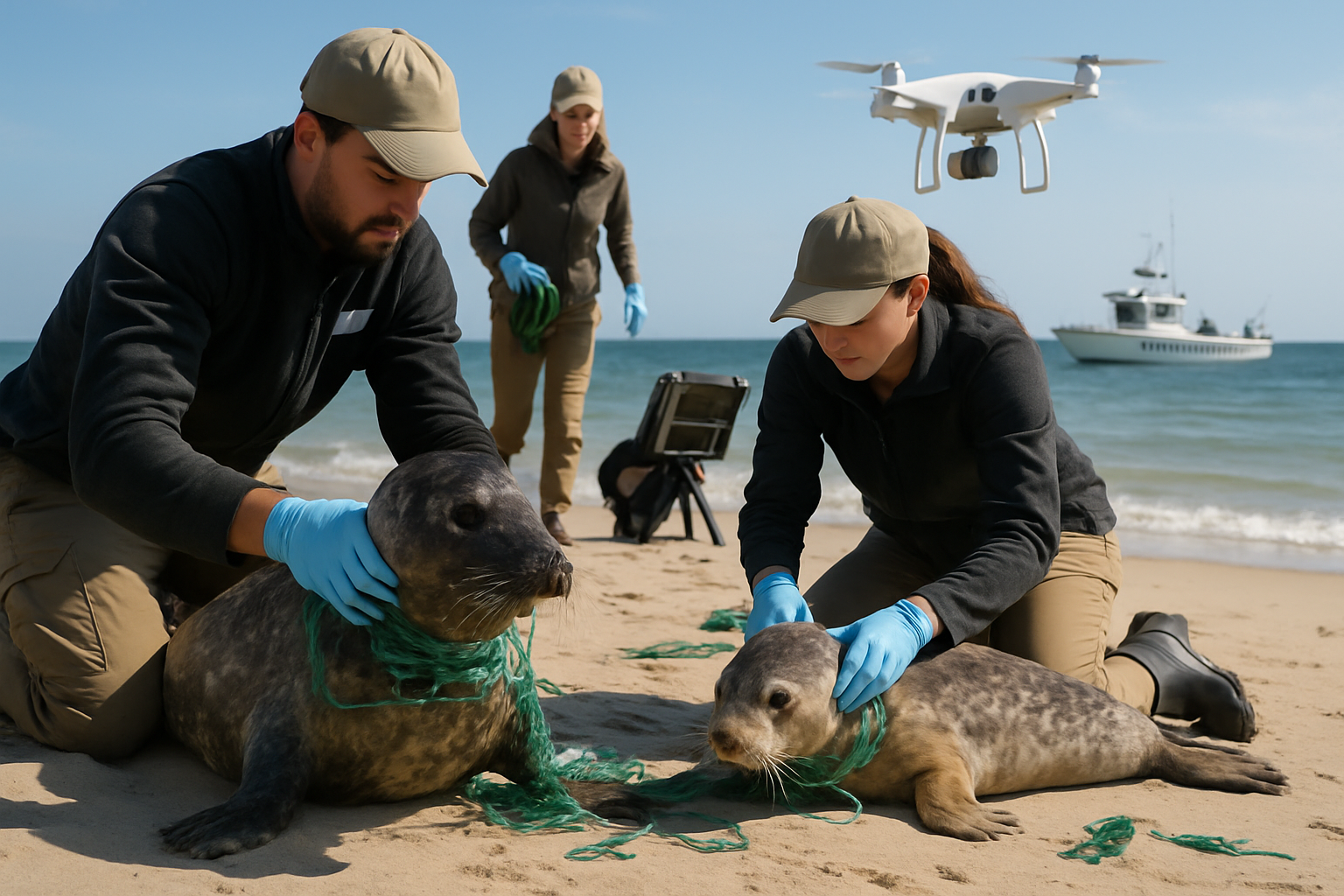
Groundbreaking conservation initiatives are revolutionizing marine wildlife protection across multiple continents, with advanced rescue operations helping animals escape plastic pollution while addressing unprecedented environmental challenges during Earth's 19th consecutive month of temperatures exceeding 1.5°C above pre-industrial levels.
From Australia's pioneering use of aerial surveillance to spot injured fur seals in vast colonies to cutting-edge technology preventing diseased wildlife populations, conservation efforts are evolving rapidly to meet the accelerating pace of environmental threats. These initiatives represent a fundamental shift from reactive crisis management to proactive ecosystem service management, combining cutting-edge technology with traditional ecological knowledge.
Australia's Aerial Rescue Revolution
Australian researchers have deployed sophisticated "eyes in the skies" technology that can identify individual injured animals within colonies of hundreds, enabling targeted rescues with unprecedented precision. This breakthrough in wildlife monitoring allows conservation teams to conduct surgical interventions in massive fur seal populations, where a single injured animal might otherwise be impossible to locate.
The technology represents a quantum leap in conservation efficiency, transforming how researchers approach large-scale wildlife management. Teams can now monitor vast coastal areas and respond rapidly to animals in distress, particularly those entangled in plastic waste or suffering from pollution-related injuries.
"Eyes in the skies can pick out an injured animal easily, even in a colony of hundreds, allowing researchers to conduct targeted rescues."
— Conservation Research Team, Sydney Morning Herald
European Wildlife Health Crisis Management
Across Europe, conservation authorities are grappling with complex wildlife health emergencies that highlight the interconnected nature of environmental and animal welfare challenges. In Latvia's Ķemeru National Park, environmental inspectors discovered multiple animal deaths in the Dunduru meadows, prompting immediate investigation by the Nature Conservation Management Authority.
Meanwhile, Cyprus has implemented precautionary closures of moufflon enclosures in Platania and Stavros tis Psokas to prevent the spread of foot-and-mouth disease. The forestry department's swift action demonstrates the sophisticated disease management protocols now essential for wildlife conservation amid increasing pathogen pressures linked to climate change.
These measures reflect the evolution of conservation from traditional habitat protection to comprehensive biosecurity management, recognizing that wildlife health and ecosystem integrity are inseparable components of effective environmental stewardship.
Mediterranean Marine Tragedy Reveals Broader Crisis
The discovery of a whale carcass in a bay near Comino, Malta, has prompted immediate investigation by the Environment and Resources Authority (ERA), highlighting the ongoing threats facing marine megafauna in one of Europe's most biodiverse marine regions.
Authorities responded within hours of the discovery, with ERA teams conducting comprehensive assessments to determine the cause of death and potential environmental implications. The incident underscores the vulnerability of marine ecosystems to multiple stressors including shipping traffic, pollution, and climate-related habitat changes.
Malta's response demonstrates the sophisticated monitoring and rapid-response capabilities now essential for marine conservation, with authorities maintaining constant surveillance of critically important marine sanctuaries that serve as refuges for endangered species.
Technology-Tradition Integration: The New Conservation Paradigm
Modern conservation success increasingly depends on sophisticated integration of cutting-edge technology with traditional ecological knowledge and community-based management approaches. Australian aerial surveillance systems combine advanced imaging with decades of field research experience, while European disease management protocols integrate veterinary science with traditional animal husbandry practices.
This technological evolution includes satellite monitoring, environmental DNA sampling, AI-powered threat detection systems, and real-time data transmission capabilities that enable rapid response to environmental emergencies. However, the most successful programs consistently demonstrate that technology alone is insufficient without community engagement and traditional knowledge integration.
Climate Change: The Accelerating Threat Multiplier
These conservation efforts are occurring against the backdrop of unprecedented global warming, with January 2026 confirmed as the hottest month in recorded history, marking the 19th consecutive month of temperatures exceeding the critical 1.5°C threshold above pre-industrial levels. This sustained warming is overriding natural climate variability, including La Niña cooling effects that typically moderate global temperatures.
The climate crisis is creating cascading environmental effects that compound traditional conservation challenges. Rising ocean temperatures are altering marine food webs, changing migration patterns, and increasing the frequency of extreme weather events that stress wildlife populations. Plastic pollution becomes more dangerous as warmer waters accelerate chemical breakdown and increase toxicity.
Economic Dimensions of Modern Conservation
Contemporary conservation demonstrates that environmental protection functions as an economic development strategy rather than a regulatory burden. Australia's innovative monitoring systems support a thriving eco-tourism sector worth hundreds of millions annually, while also attracting international research partnerships and sustainable investment.
European countries implementing comprehensive wildlife protection measures consistently show greater economic resilience and attract sustainable development investment across green technology manufacturing, environmental services, and nature-based tourism sectors. The economic multiplier effects extend far beyond direct conservation activities to encompass public health improvements, enhanced agricultural productivity through ecosystem services, and reduced infrastructure costs through natural disaster prevention.
International Cooperation: The Imperative for Success
The transnational nature of environmental challenges demands unprecedented international cooperation, as ocean currents, atmospheric systems, and species migrations cross political boundaries, making unilateral conservation efforts insufficient. Australia's marine rescue innovations inform protection strategies globally, while European disease management protocols provide templates for wildlife health surveillance worldwide.
Success requires coordinated policy frameworks, shared monitoring systems, collaborative enforcement mechanisms, and innovative financing that recognizes the economic value of ecosystem services. The diversity of conservation approaches provides resilience against single-solution dependencies, offering multiple adaptation pathways for addressing complex environmental challenges.
Implementation Challenges and Opportunities
Despite remarkable advances, conservation efforts face persistent challenges, particularly regarding funding sustainability for developing nations, where immediate economic pressures often override long-term environmental considerations. Technical capacity building requires sustained investment in education, training, and institutional development, while climate change continues to disrupt project timelines, demanding adaptive management approaches.
However, the diversity of conservation approaches demonstrated across continents provides hope and practical guidance for scaling protection efforts globally. International partnerships are accelerating technology transfer, while South-South cooperation enables knowledge sharing that maintains local autonomy and cultural sensitivity.
The Critical Action Window
March 2026 represents a critical juncture in global environmental protection, with the choice between reactive crisis management and proactive ecosystem service management potentially determining whether conservation efforts can keep pace with accelerating environmental change during this decisive climate action decade.
The environmental action window is narrowing rapidly as ecological systems approach critical thresholds that could trigger irreversible changes affecting global food security, climate stability, and human settlement patterns. However, the tools, knowledge, and cooperation frameworks exist for comprehensive environmental protection if implemented with sufficient speed and coordination.
"The measure aims to safeguard animal health and limit the spread of foot-and-mouth disease. The department said following such preventive measures helps protect animals and preserve Cyprus' biodiversity."
— Cyprus Forestry Department
Future Implications and Strategic Significance
The conservation initiatives documented across Australia, Europe, and the Mediterranean provide templates for scaling environmental protection globally through coordinated approaches that address multiple challenges while building local capacity and fostering international cooperation.
Success depends on sustained international cooperation, enhanced multi-sector coordination, and increased financial commitments that recognize environmental protection as essential infrastructure for human prosperity and planetary sustainability. The conservation renaissance emerging in 2026 may prove decisive in determining the trajectory of global environmental protection for decades ahead.
These developments demonstrate that effective conservation requires a sophisticated synthesis of scientific knowledge, community engagement, technological innovation, and international cooperation through locally-appropriate combinations rather than isolated approaches. The window for effective environmental action is narrowing, but the convergence of innovation, cooperation, and commitment offers hope for maintaining planetary habitability for future generations.