Chinese shipyards are experiencing an unprecedented surge in orders for massive oil tankers as global energy markets grapple with the ongoing Strait of Hormuz crisis, while an international maritime coalition of over 40 countries mobilizes to secure critical shipping lanes. This development represents a fundamental shift in global maritime dynamics amid the most severe shipping crisis since World War II.
According to the South China Morning Post, Chinese shipbuilders have emerged as primary beneficiaries from the US-Israeli war on Iran, securing substantial new orders as crude transport bottlenecks worsen and global demand for very large crude carriers (VLCCs) capable of transporting about 2 million barrels of oil surges dramatically.
China's Strategic Shipbuilding Advantage
The crisis has created an unprecedented opportunity for China's shipbuilding industry, which has rapidly expanded capacity to meet surging global demand for oil tankers. With Iran's Revolutionary Guard maintaining effective control over the Strait of Hormuz—a 21-mile waterway handling 40% of global seaborne oil transit—shipping companies are racing to expand their fleets with vessels capable of alternative routing.
"Chinese shipyards have the production capacity and competitive pricing that makes them attractive during this supply crunch," explains maritime industry analyst Samuel Ciszuk, who has described the current situation as "the most severe energy security crisis in decades with single-chokepoint vulnerabilities exposed."
The strategic implications extend beyond immediate commercial benefits. China's shipbuilding surge positions the nation to potentially dominate global maritime transport infrastructure at a time when energy security has become paramount for nations worldwide.
International Maritime Coalition Response
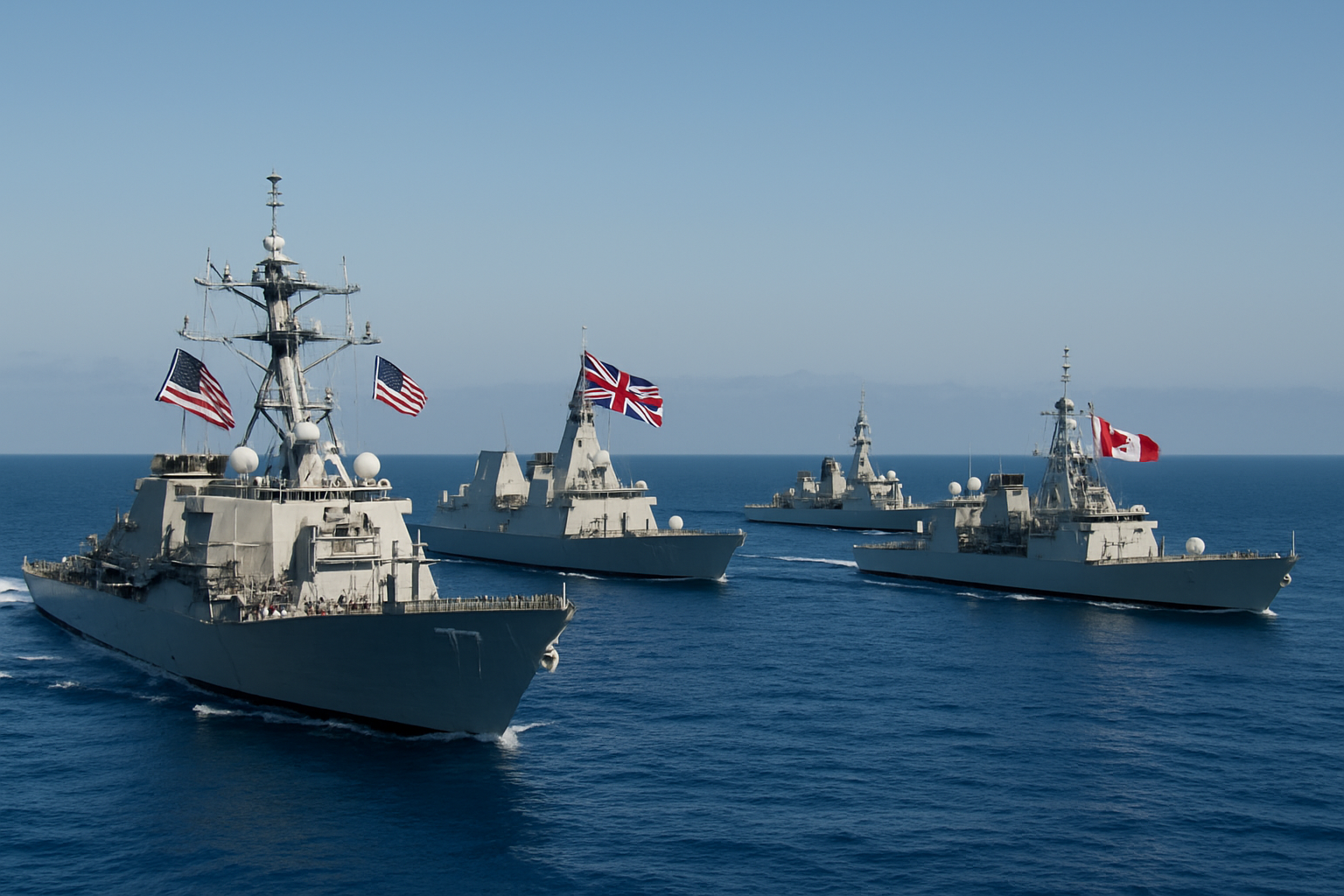
Meanwhile, reports from the Philippines indicate that allied naval forces from Canada, Australia, and the United States have conducted joint maneuvers and exchanges in the South China Sea, demonstrating coordinated international efforts to maintain maritime security during the current crisis.
The formation of an unprecedented 40-country coalition, led by British Foreign Secretary Yvette Cooper, represents the largest maritime security coordination since World War II. The coalition aims to secure free passage through critical shipping lanes and counter what Cooper described as Iran's attempt to "hijack international shipping routes to hold the global economy hostage."
"Only joint action by nations can yield results in reopening critical maritime corridors."
— Ukrainian President Volodymyr Zelensky, offering assistance
Portuguese and European Maritime Enforcement
European nations have intensified their maritime enforcement efforts, with Portuguese and other EU forces recently apprehending a sanctioned oil tanker in the Indian Ocean for smuggling Iranian crude, according to Pentagon reports. This action reflects the broader international effort to maintain sanctions pressure on Iran while protecting legitimate maritime commerce.
The detention represents part of a systematic campaign to disrupt what analysts estimate to be a 600-vessel Russian "shadow fleet" operating with false documentation and concealed ownership to circumvent international sanctions. The EU's 20th sanctions package has imposed comprehensive maritime services bans, including insurance, maintenance, port access, and technical support restrictions.
Global Economic and Security Implications
The maritime crisis has triggered the largest strategic petroleum reserve release in 50-year history, with the International Energy Agency coordinating deployment of 400 million barrels from 32 countries. Oil prices reached historic peaks of $119.50 for Brent crude and $108.15 for WTI, representing the largest single-day jump on record.
The aviation industry has faced parallel disruptions, with over 18,000 flights cancelled—the most extensive cancellations since COVID-19. Eight Middle Eastern countries have closed their airspace simultaneously, creating what analysts describe as an "aviation black hole" for Europe-Asia corridors.

Supply Chain Transformation
The crisis has exposed dangerous vulnerabilities in global supply chain architecture, with the 21-mile Strait of Hormuz representing a single-point failure for modern logistics. Over 150 oil and LNG tankers worth billions in cargo remain stranded in the Persian Gulf, while major shipping companies Maersk and MSC have suspended operations indefinitely.
Manufacturing sectors dependent on Gulf logistics—including automotive, electronics, and textiles—face severe disruptions. Singapore has reported 30% increases in logistics costs, while China has suspended refined fuel exports to prioritize domestic needs.
Qatar Energy Minister Saad Al Kaabi has warned that Gulf states may declare force majeure "within weeks," potentially driving oil prices toward $150 per barrel in what he described as a scenario that could "bring down economies of the world."
Consumer and Economic Impact
The crisis has triggered unprecedented government emergency measures worldwide:
- Bangladesh has implemented fuel rationing for 170 million people
- Pakistan faces wartime austerity with the highest fuel prices in South Asia
- Sweden reports electricity increases of 10-20 öre and gasoline increases of 1-2 kronor
- Ireland faces heating oil approaching €2 per liter in what officials call "brazen rip-offs"
- Multiple European nations have abandoned free-market principles to implement emergency price controls
Nuclear Diplomacy Context
The maritime crisis emerged from the complete breakdown of US-Iran nuclear negotiations, despite what had been characterized as a "broad agreement on guiding principles" breakthrough—the most progress since the 2018 JCPOA collapse. The failure to reach agreement has led to the largest US-Israeli military operation since 2003, followed by Iranian retaliation targeting regional coalition territories.
The breakdown occurs amid broader nuclear governance challenges, with the New START treaty having expired in February 2026, marking the first 50-year gap without US-Russia nuclear constraints. Iran continues 60% uranium enrichment with over 400kg of weapons-grade material sufficient for multiple nuclear weapons.
UN Secretary-General António Guterres has described nuclear risks as being at their "highest in decades," calling the situation "the greatest test of multilateral cooperation in the modern era."
Long-term Maritime Security Architecture
Industry experts emphasize that the crisis represents a watershed moment requiring fundamental transformation of global energy security architecture. The dangerous over-dependence on strategic chokepoints necessitates restructuring to reduce geopolitical volatility.
The International Maritime Organization has called for establishing "safe corridors" for merchant vessel evacuation, with representatives from six nations—the UK, France, Germany, Italy, Japan, and the Netherlands—pledging support for securing shipping routes.
"This crisis has exposed the most severe energy security vulnerabilities in decades through single-chokepoint dependencies."
— Samuel Ciszuk, Energy Security Analyst
Technology and Innovation Response
The crisis has accelerated technological innovation in maritime security, with enhanced satellite tracking, AI-powered monitoring, and real-time analytics improving surveillance capabilities. China has mobilized its maritime technology sector, including shipbuilding giant CATL's battery manufacturers, to support electric shipping fleet development aligned with carbon neutrality goals for 2030-2060.
Digital transformation extends beyond security to comprehensive operational optimization, with port automation, predictive maintenance, and digital monitoring becoming industry standards worldwide.
Regional Impact and Adaptation
Regional maritime industries demonstrate varying adaptation strategies. Greek maritime companies show strategic agility, with Atlas Maritime pivoting from automotive carriers to crude oil transportation in response to market shifts. The Pure Car Truck Carrier (PCTC) market faces transformation due to automotive regionalization and electric vehicle adoption.
Southeast Asian ports continue infrastructure development despite global disruptions. Malaysia's Kuching Port Authority announced major expansion projects for 2026-2028, including a 220-meter wharf extension to accommodate larger vessels as part of regional maritime hub strategies.
Future Implications
The April 2026 maritime crisis represents the most dangerous international situation since the Cold War end, with implications extending decades beyond current events. Recovery timelines remain uncertain, dependent on military and diplomatic resolution rather than predictable weather or technical disruptions.
Success in containing the escalation could provide a framework for nuclear crisis resolution, strengthening diplomatic precedents for 21st-century conflict management. Failure risks accelerating military solutions, potentially reshaping Middle Eastern geopolitics for decades while encouraging nuclear proliferation globally and undermining diplomatic credibility worldwide.
As maritime security becomes increasingly central to global stability, the current crisis may well determine whether international cooperation or military confrontation becomes the template for managing future territorial and nuclear disputes in an interconnected world.