At least 10 seafarers have been killed in 29 attacks on vessels in the Persian Gulf since the beginning of the US-Israel conflict with Iran, with the International Maritime Organisation highlighting the deteriorating plight of crews trapped in increasingly dangerous waters.
International Maritime Organisation Secretary General Arsenio Domínguez has raised urgent concerns about the weeks-long closure of the Strait of Hormuz, stating the situation is taking "a high toll on the crews" and creating an unprecedented humanitarian crisis at sea. Several vessels have been seized and detained in what maritime experts are calling the most severe threat to global shipping security since World War II.
Escalating Violence Against Commercial Vessels
The maritime crisis has intensified dramatically with the recent shooting of a container ship 15 nautical miles northwest of the Oman coast. Iranian Revolutionary Guard vessels opened fire on the vessel, causing major bridge damage but no casualties among the 24 crew members. The attack occurred at 12:10 AM local time, with fires extinguished by 4:26 AM Kuwait time.
According to UK Maritime Trade Operations (UKMTO), the container ship had ignored "repeated warnings" from Iranian military forces before the attack, according to Greek sources. This latest incident represents a dangerous escalation in the systematic targeting of commercial vessels that has characterized the ongoing conflict.
"This represents the latest escalation affecting 40% of global seaborne oil transit through the strategic 21-mile waterway."
— UKMTO Crisis Center
Humanitarian Impact on Seafarers
The human cost of the maritime crisis extends far beyond property damage. Over 20,000 seafarers have been stranded on approximately 3,200 vessels during the peak of the crisis, representing the most severe maritime humanitarian emergency in decades.
The Cyprus-based Maritime Labour Organization has confirmed that seafarers have fundamental rights in war zones. Charalampos Avgousti, Secretary-General of OMEPEGE-SEK, stated that "from the moment a zone is designated a warlike zone, sailors have the right not to be on a ship that will pass through it."
Fortunately, no Cypriot sailors were reported trapped in the Hormuz strait, though some crew members were aboard vessels when attacked, with all reported safe following rescue operations.
Global Supply Chain Disruption
The Persian Gulf maritime crisis has exposed critical vulnerabilities in global supply chains that extend far beyond energy transportation. The region serves as a vital trade hub affecting consumer goods, industrial materials, and manufacturing networks worldwide.
Major shipping companies Maersk and MSC have completely suspended operations in the Persian Gulf, with over 150 oil and LNG tankers worth billions stranded. The 21-mile Strait of Hormuz has proven to be a dangerous single-point failure in modern logistics, with no realistic alternatives for the massive volumes of cargo normally transiting the waterway.

Economic Ramifications
The maritime crisis has triggered severe economic consequences across multiple sectors:
- Oil Markets: Prices reached historic peaks with Brent crude at $119.50 and WTI at $108.15, representing an 18.98% record single-day jump
- Aviation Industry: Over 18,000 flights cancelled, the most extensive disruption since COVID-19
- Natural Gas: Prices surged 24% in Europe and 78% in the US, reaching €47.32/MWh
- Financial Markets: Pakistan's KSE-100 suffered its largest decline in history at -8.97%
International Response and Naval Coalition
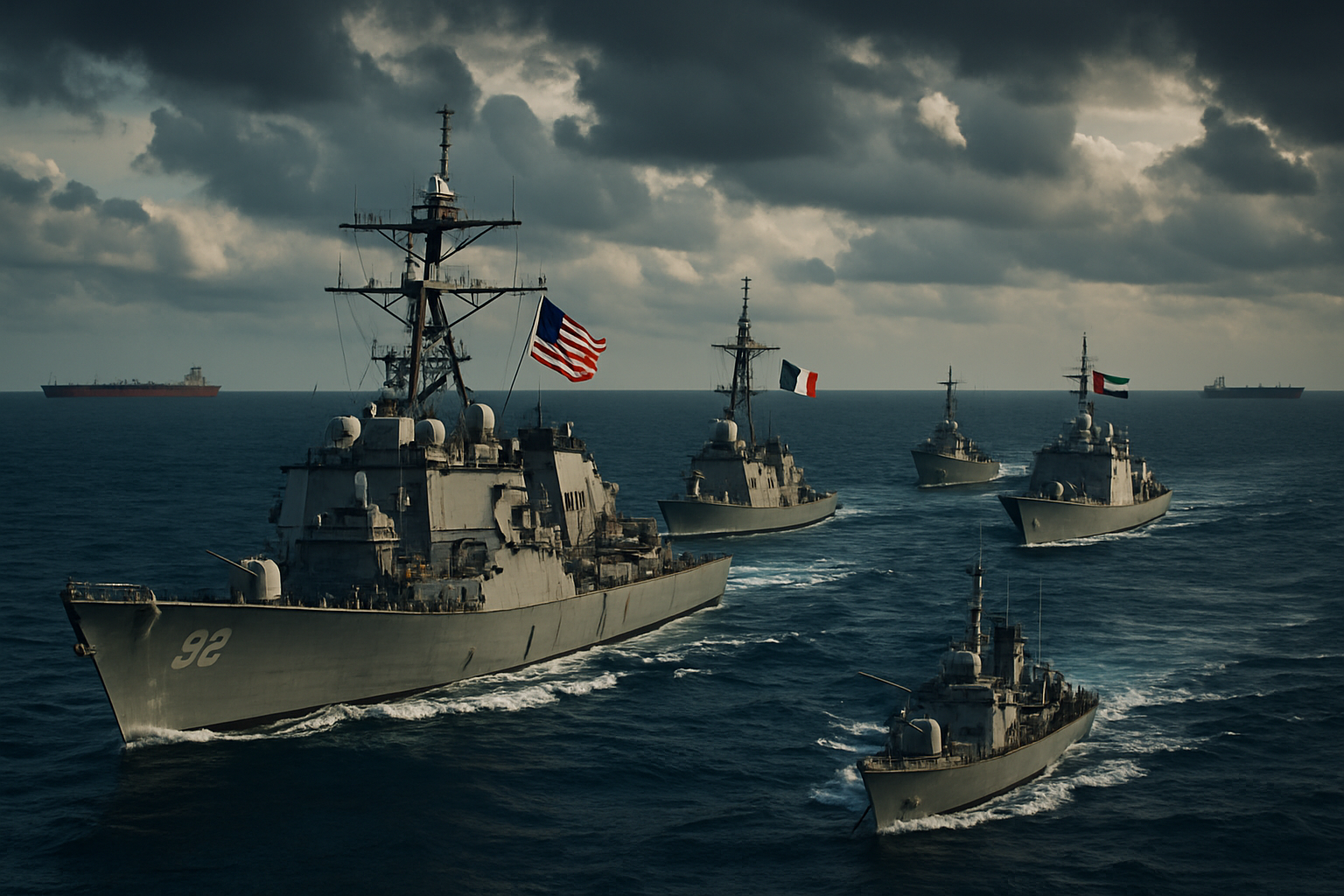
The international community has mobilized an unprecedented maritime security response. Over 40 countries have formed a coalition led by British Foreign Secretary Yvette Cooper to secure critical shipping lanes, representing the largest maritime security coordination since World War II.
Naval forces from multiple nations, including HMS Dragon from the UK, Spanish and Italian frigates, and vessels from France, the Netherlands, and Greece, have been deployed to protect commercial shipping. This coalition represents a new template for international maritime security cooperation in an era of increasing geopolitical tensions.
Emergency Reserves Deployment
The International Energy Agency (IEA) has deployed the largest strategic petroleum reserve release in its 50-year history, coordinating the release of 400 million barrels from 32 member countries. This represents more than double the reserves released during the 2022 Ukraine crisis.
Japan has released 80 million barrels for the first time since the 2011 Fukushima disaster, highlighting the vulnerability of nations heavily dependent on Middle Eastern energy imports. Germany has confirmed participation, with the US expected to be the largest contributor to the emergency reserves deployment.
Environmental and Safety Concerns
Beyond the immediate security threats, the maritime crisis has raised significant environmental concerns. Iranian strikes on vessels carrying millions of barrels of oil pose catastrophic environmental risks. The Kuwait-flagged Al Salmi tanker, carrying approximately 2 million barrels, was struck near Dubai, highlighting the potential for massive environmental disasters.
UKMTO has documented 24 incidents between February and March across the Arabian Gulf, with 16 confirmed attacks on commercial vessels. The systematic nature of these attacks has fundamentally altered maritime safety calculations for the region.
Looking Forward: Maritime Security Architecture
The current crisis has exposed fundamental weaknesses in global maritime security architecture that require comprehensive reform. The over-dependence on strategic chokepoints like the Strait of Hormuz has proven to be a critical vulnerability in an interconnected world.
Maritime security experts are calling for a fundamental transformation of global shipping routes and emergency response protocols. This includes developing alternative shipping corridors, enhancing international naval cooperation, and establishing rapid-response mechanisms for maritime emergencies.
"The situation demonstrates the urgent need for fundamental energy architecture transformation to reduce dependence on strategic chokepoints."
— Samuel Ciszuk, Energy Security Analyst
Long-term Implications
The Persian Gulf maritime crisis represents a template-setting moment for 21st-century international relations. The success or failure of the international response will influence how future maritime security challenges are addressed and may determine whether diplomatic or military solutions become the preferred approach to resolving international disputes.
Recovery timelines remain uncertain and depend on both military and diplomatic resolutions rather than predictable economic factors. Traditional monetary policy has proven to have limited effectiveness in addressing structural geopolitical disruptions of this magnitude.
Conclusion
The ongoing maritime security crisis in the Persian Gulf represents the most dangerous international situation since the end of the Cold War, with implications extending decades beyond current events. The crisis affects regional war prevention, global energy security, nuclear governance credibility, and international law enforcement simultaneously.
As the international community works to address immediate humanitarian needs and restore maritime security, the crisis serves as a stark reminder of the vulnerabilities inherent in our interconnected global economy. The template established by this crisis will likely influence international approaches to conflict resolution, energy security planning, and maritime cooperation for generations to come.