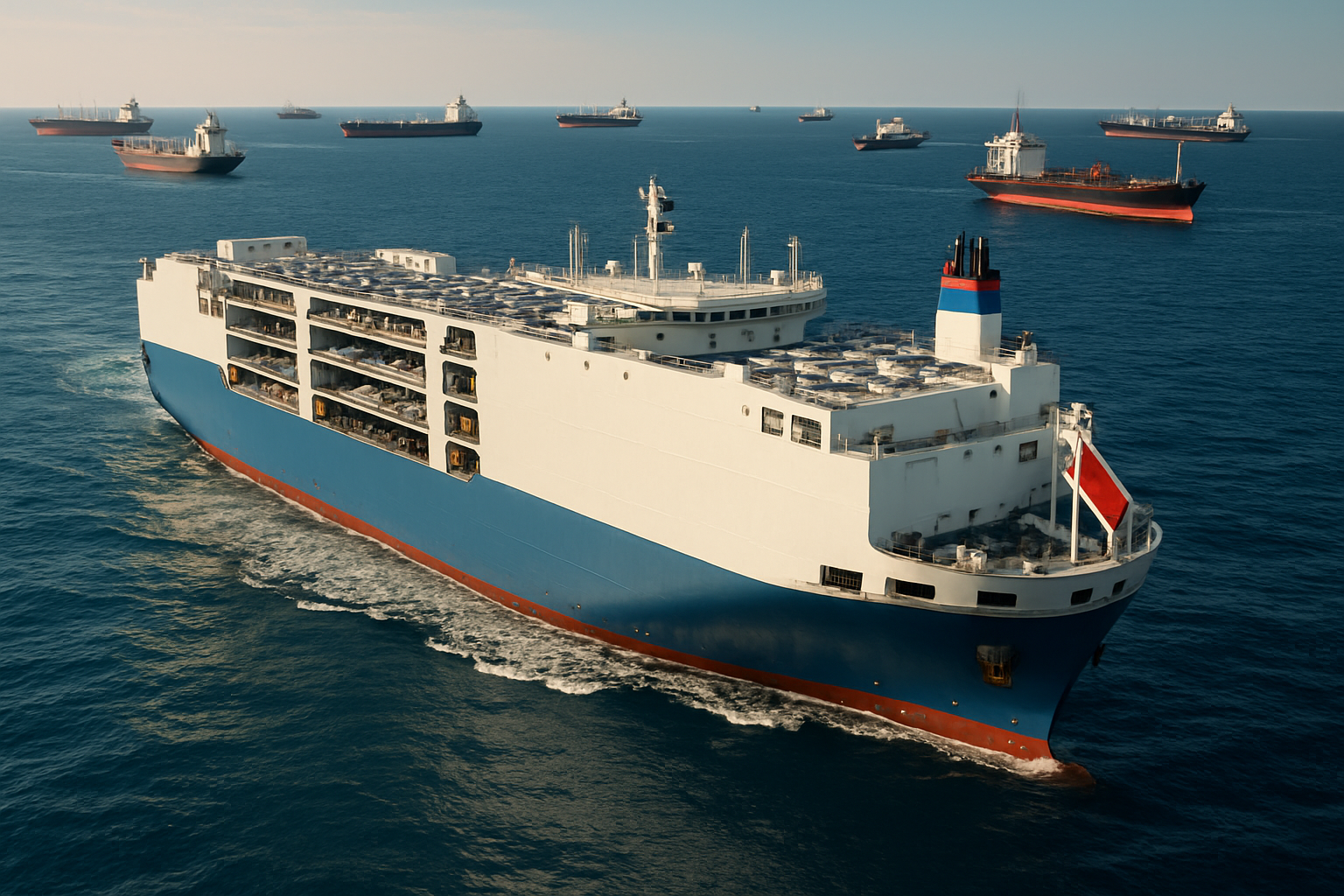
The global maritime shipping industry is experiencing a pivotal transformation as Pure Car Truck Carrier (PCTC) vessels flood the market with accelerating deliveries, while new shipbuilding orders remain conspicuously subdued, creating unprecedented challenges for global automotive trade networks.
The PCTC market has reached what industry analysts describe as a critical turning point following an extraordinary four-year period from 2021-2024 that witnessed more than 280 new vessel orders. However, 2025 marked a dramatic shift, with new orders declining substantially while delivery schedules accelerated, fundamentally altering the competitive landscape for automotive shipping worldwide.
Market Transformation and Delivery Acceleration
The automotive shipping sector is grappling with the consequences of unprecedented ordering activity during the 2021-2024 period, when supply chain disruptions and pent-up demand drove aggressive fleet expansion strategies. The current wave of deliveries represents the materialization of those historic orders, flooding the market with new capacity precisely when demand patterns are shifting.
This delivery surge coincides with a marked reluctance among shipowners to commit to additional newbuilding contracts, reflecting growing uncertainty about future automotive trade volumes and evolving cargo patterns. The automotive industry's transition toward electric vehicles, changing consumer preferences, and geopolitical trade tensions are fundamentally reshaping shipping requirements.
Greek Maritime Leadership in Challenging Times
Against this backdrop of industry uncertainty, Greek maritime companies are pursuing distinct strategies to navigate the turbulent waters. Atlas Maritime, owned by Leo Patitsas, is making a bold return to the Suezmax tanker market, ordering two newbuilding vessels from South Korea's DH Shipbuilding with options for two additional units.
This strategic pivot toward crude oil transportation reflects broader industry diversification strategies as traditional cargo segments face pressure. The Suezmax segment offers exposure to energy markets while providing operational flexibility that automotive carriers cannot match.
"Atlas Maritime's dynamic return to Suezmax represents strategic positioning for volatile market conditions where operational flexibility becomes paramount for survival."
— Industry Maritime Analysis
Meanwhile, Safety Management Overseas S.A. and Safe Bulkers Management Ltd., interests of Polys V. Hadjioannou, have received significant recognition through publication in the 6th edition of industry performance rankings, demonstrating that operational excellence remains achievable despite challenging market conditions.
Broader Industry Implications and Regional Impact
The PCTC market's current dynamics reflect broader transformations affecting the entire maritime sector. The automotive shipping segment's challenges are interconnected with global supply chain realignments, changing trade patterns, and evolving regulatory frameworks governing emissions and environmental performance.
European Union sanctions targeting maritime services for Russian energy exports have further complicated shipping market dynamics, while geopolitical tensions continue to disrupt traditional trade routes. The maritime services ban affecting Russian crude oil exports represents a dramatic expansion of sanctions beyond previous import restrictions, creating additional uncertainty for vessel deployment strategies.
Technology and Environmental Pressures
The shipping industry faces mounting pressure to invest in cleaner technologies and more efficient vessels, adding complexity to newbuilding decisions. Environmental regulations are driving demand for next-generation ships equipped with advanced propulsion systems and emission reduction technologies, making older vessel designs less attractive for long-term investments.
These technological requirements are contributing to higher newbuilding costs and extended delivery schedules, further complicating capacity planning for automotive shipping companies. The intersection of environmental compliance, technological advancement, and market uncertainty is creating unprecedented decision-making challenges for maritime executives.
Strategic Responses and Market Adaptation
Industry leaders are adopting diverse strategies to navigate the current environment. Some companies are focusing on operational efficiency improvements and route optimization to maximize utilization of existing capacity. Others are pursuing diversification strategies, moving beyond traditional automotive cargo to handle multiple vessel types and cargo categories.
The recognition achieved by Safe Bulkers' management companies highlights how operational excellence and safety performance remain critical differentiators in competitive markets. Companies that maintain superior operational standards are better positioned to secure premium contracts and weather market downturns.
Financial Market Response
Financial markets are closely monitoring shipping companies' strategic responses to current challenges. Atlas Maritime's return to the tanker market represents the type of strategic pivot that investors are evaluating for long-term viability. The energy transportation sector offers different risk-reward profiles compared to automotive shipping, potentially providing more stable revenue streams amid automotive market volatility.
Global Trade Pattern Evolution
The current maritime industry transformation reflects broader changes in global trade patterns. Automotive manufacturers are increasingly regionalizing production to reduce supply chain risks, potentially reducing demand for long-distance shipping services. Simultaneously, the growth of electric vehicle manufacturing is changing the geographical distribution of automotive production and component sourcing.
These structural shifts are forcing shipping companies to reconsider traditional business models and explore new market opportunities. The companies that successfully adapt to these evolving patterns will emerge stronger, while those that fail to adjust face potential consolidation or market exit.
Future Outlook and Strategic Considerations
The maritime industry's current challenges require sophisticated strategic responses that balance capacity management, technological investment, and market positioning. The PCTC delivery surge will likely continue through 2026 and beyond, requiring companies to optimize utilization while managing competitive pressures.
Success in this environment will depend on operational excellence, strategic flexibility, and the ability to identify emerging opportunities in evolving cargo markets. Companies like Atlas Maritime that demonstrate strategic agility through market diversification may outperform those that remain focused solely on traditional automotive shipping.
The recognition achieved by Safe Bulkers' management companies demonstrates that excellence in traditional shipping operations remains valuable, even as market conditions evolve. Companies that maintain high operational standards while adapting to new market realities are best positioned for long-term success.
Regional Maritime Hub Development
The current market dynamics are also influencing regional maritime hub development strategies. Ports and shipping companies are investing in infrastructure improvements to handle diverse cargo types and provide enhanced services to shipping lines navigating volatile markets.
These infrastructure investments, combined with strategic vessel deployment and operational excellence, will determine which maritime companies successfully navigate the current transformation and emerge as leaders in the evolved global shipping landscape.
The maritime industry's current period of transformation presents both significant challenges and strategic opportunities. Companies that demonstrate adaptability, operational excellence, and strategic vision will be best positioned to capitalize on emerging opportunities while navigating the complex dynamics reshaping global shipping markets.