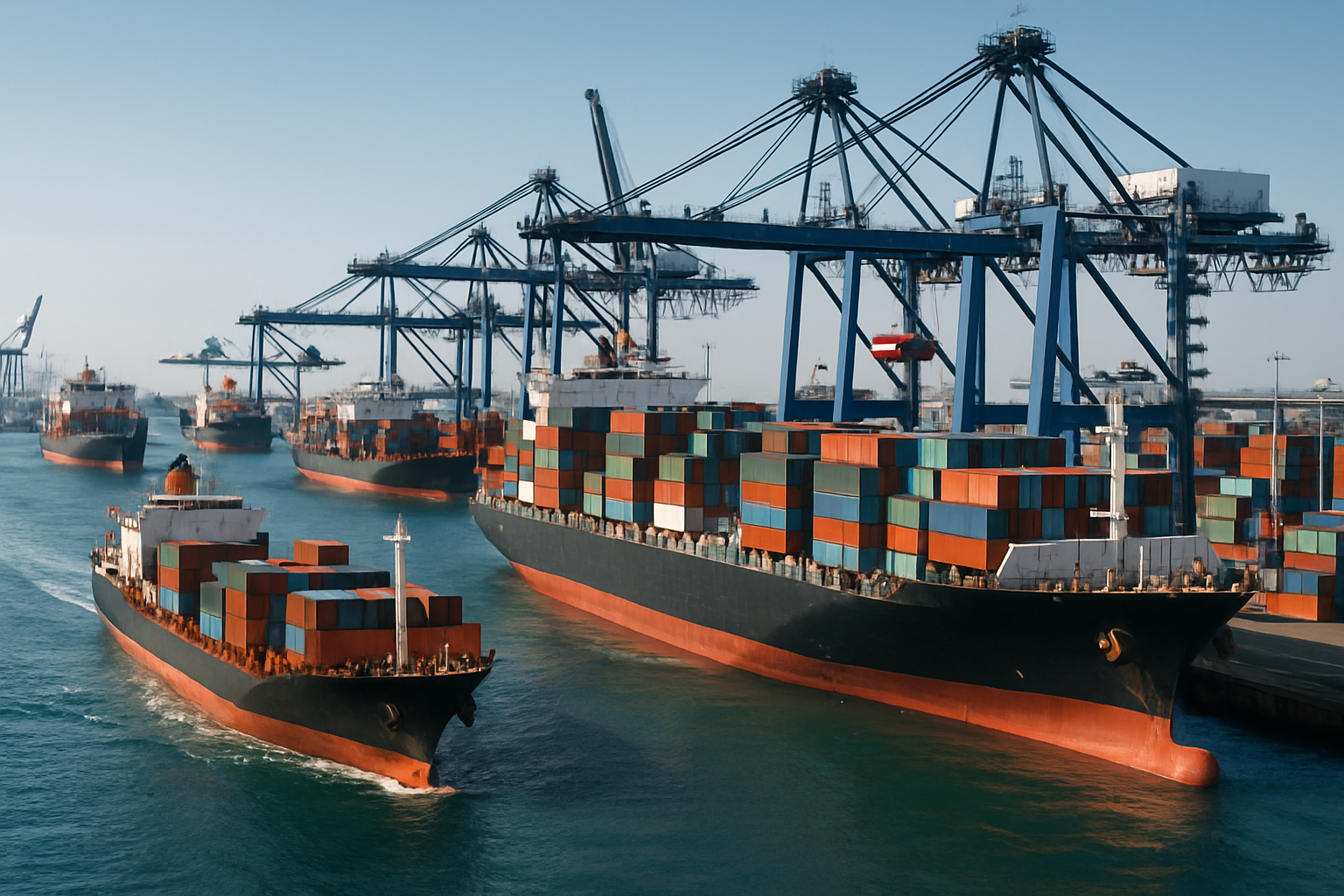
The maritime and shipping industry confronts a complex landscape of opportunities and challenges as geopolitical tensions reshape global trade routes, security concerns mount in critical waterways, and individual ports demonstrate remarkable resilience amid unprecedented disruptions.
Port Operations Show Mixed Performance
The Port of Kribi in Cameroon has emerged as a standout success story in the global maritime sector, demonstrating exceptional growth despite broader industry challenges. Container traffic at the port experienced remarkable expansion, surging from 135,820 TEU (Twenty-foot Equivalent Units) in 2018 to 555,398 TEU in 2025, representing a spectacular 308.9% increase over seven years.
This growth trajectory reflects an average annual growth rate of 22.3%, positioning Kribi as a major player in Central Africa's logistics landscape. The port's expansion comes at a critical time when global shipping faces unprecedented pressures from geopolitical tensions and supply chain disruptions.
Meanwhile, the Port of Limassol in Cyprus continues normal operations despite regional tensions. Yiannis Tsouloftas, president of Limassol district local government organisation, visited DP World facilities at the port and confirmed that all activities continue without disruption. Simon Pitout, CEO of DP World Cyprus, briefed officials on the current operational status, emphasizing the port's strategic importance as one of Cyprus' most critical logistics hubs.
Major Shipping Lines Face Operational Challenges
The global shipping industry has experienced significant disruptions, with major carriers making difficult operational decisions. Chinese shipping giant COSCO Shipping Lines announced the suspension of its services at Panama's Port of Balboa, located at the Pacific entrance to the Panama Canal. The decision, communicated on March 10, affects all departures and arrivals at the strategically important Pacific coast facility.
According to COSCO Shipping Lines (Panama) Inc., all confirmed bookings will be cancelled, requiring companies and customers to contact sales representatives for alternative arrangements. However, the company assured that import releases will continue as normal, minimizing disruption to cargo removal processes for shipments that have already arrived.
This development highlights the complex decision-making processes shipping companies face when balancing operational efficiency with regional stability concerns. The Panama Canal remains one of the world's most critical maritime chokepoints, handling approximately 6% of global trade.
Maritime Security Concerns Escalate
Security incidents in key shipping lanes have raised alarm throughout the industry. The UK Maritime Commercial Operations (UKMTO) reported that the Panama-flagged container ship MSC Ela was struck by an unidentified projectile while transiting near the Strait of Hormuz. The incident occurred approximately 25 nautical miles northwest of Ras Al Khaimah, within the Persian Gulf but close to the strategically vital Hormuz passage.
The vessel's captain confirmed that all crew members remain safe following the incident, though the ship sustained damage from the projectile. This attack represents part of a broader pattern of maritime security challenges, with UKMTO recording fourteen separate incidents affecting ships in the Persian Gulf, Strait of Hormuz, and Gulf of Oman region since late February.
These security concerns have prompted widespread industry response, with major shipping companies implementing enhanced security protocols and route diversification strategies. The incidents underscore the vulnerability of global trade to geopolitical tensions in critical maritime passages.
"The safety of our crews and vessels remains our absolute priority as we navigate these challenging operational conditions."
— Industry Executive, speaking on condition of anonymity
Economic Impact and Industry Adaptation
The maritime industry's challenges have had cascading effects throughout global supply chains. With approximately 40% of the world's seaborne oil trade typically transiting through the Strait of Hormuz, any disruption to this critical waterway creates immediate ripple effects across energy markets and shipping costs.
Industry analysts report that alternative routing around the Arabian Peninsula adds significant time and costs to shipping schedules, forcing companies to recalculate operational efficiency and pricing structures. These adjustments affect everything from consumer goods pricing to just-in-time manufacturing processes that depend on predictable shipping schedules.
The situation has accelerated discussions about supply chain resilience and the risks of over-dependence on specific geographical chokepoints. Maritime industry experts emphasize the need for diversified routing strategies and enhanced contingency planning to manage future disruptions.
Technological Innovation and Future Outlook
Despite current challenges, the maritime sector continues to embrace technological innovations designed to improve operational efficiency and safety. Advanced tracking systems, satellite-based navigation, and enhanced communication technologies are becoming standard across modern fleets.
Port operations are increasingly incorporating automated cargo handling systems, predictive maintenance technologies, and digital monitoring platforms to optimize throughput and reduce operational risks. These technological advances have proven particularly valuable during periods of heightened security concerns and operational uncertainty.
The success of ports like Kribi demonstrates that strategic investment in infrastructure and technology can yield substantial returns even during challenging global conditions. The port's growth trajectory suggests that well-positioned facilities can capitalize on shifting trade patterns and regional economic development.
Regional Maritime Cooperation
The current environment has highlighted the importance of international maritime cooperation and coordination. Naval forces from multiple nations are working to ensure safe passage through critical shipping lanes, while industry organizations coordinate on security protocols and best practices.
Cyprus's strategic location in the Eastern Mediterranean has proven advantageous, with facilities like Limassol Port maintaining operational continuity through enhanced security measures and international cooperation frameworks. This stability provides a crucial link in regional supply chains during periods of uncertainty elsewhere.
Long-Term Industry Transformation
The maritime industry is undergoing fundamental changes driven by both immediate security concerns and longer-term strategic considerations. Shipping companies are investing heavily in route diversification, enhanced security capabilities, and improved risk assessment methodologies.
These developments are reshaping traditional trade patterns and forcing a reevaluation of logistics strategies that have dominated global commerce for decades. The industry's adaptation to current challenges may well define its structure and operational approaches for years to come.
As the maritime sector navigates these unprecedented challenges, the resilience and adaptability demonstrated by successful ports and shipping companies provide valuable models for industry-wide transformation. The coming months will likely prove crucial in determining how effectively the global maritime system can adapt to an increasingly complex operating environment.