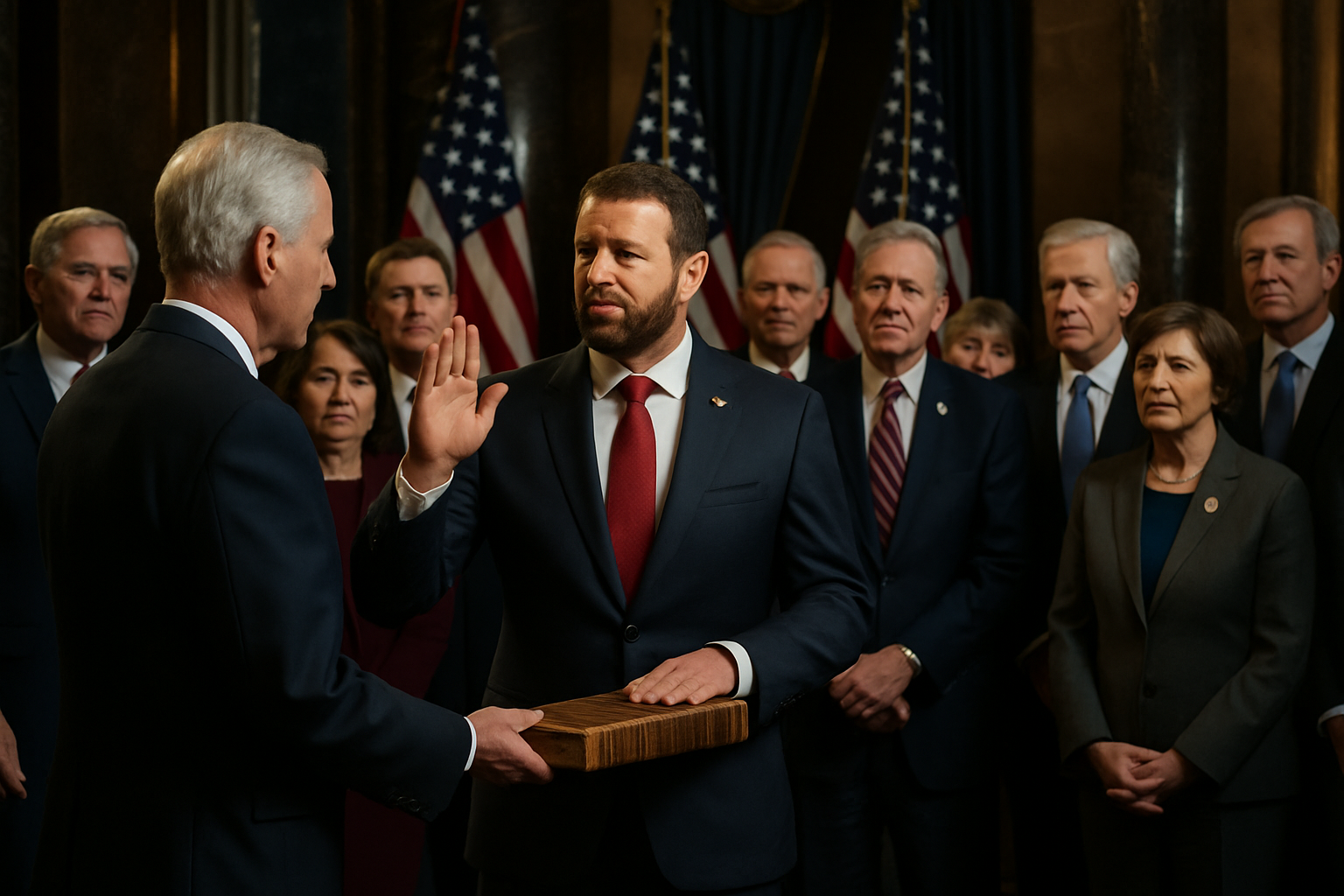
The U.S. Senate confirmed Oklahoma Senator Markwayne Mullin as the new Secretary of Homeland Security late Monday, approving President Donald Trump's nominee to take over the embattled department after the firing of Kristi Noem in March.
Mullin, a Republican senator and former Mixed Martial Arts fighter, received 54 of 100 votes in the Senate, marking the end of a contentious confirmation process amid ongoing crises within the Department of Homeland Security. The confirmation makes him the latest appointment in what has been a tumultuous period for the Trump administration's second term.
From the Octagon to the Senate Chamber
Markwayne Mullin brings an unconventional background to the role of Homeland Security Secretary. The 48-year-old Oklahoma native first gained public attention as a professional MMA fighter before transitioning into politics. A member of the Cherokee Nation, Mullin served in the House of Representatives before being elected to the Senate.
Trump praised Mullin's television appearances defending the administration during his nomination announcement. "Markwayne has been a tremendous advocate for our policies and has shown real leadership in defending America's interests," Trump stated when announcing the nomination.
"I'm ready to restore credibility to this department and ensure it serves the American people effectively."
— Markwayne Mullin, incoming Homeland Security Secretary
Inheriting a Crisis-Ridden Department
Mullin takes control of a department facing unprecedented challenges. The DHS has been operating without a valid budget, creating what Swiss media described as "a whole series of problems," including long queues at major American airports due to staffing shortages.
The confirmation comes after Kristi Noem was dismissed as the first Cabinet member fired in Trump's second term. Noem's tenure was marked by controversy, particularly following fatal Minneapolis shootings by ICE agents that resulted in the deaths of Alex Pretti and Renee Nicole Good in January 2026. The incidents triggered widespread criticism and led to the implementation of mandatory body cameras for ICE agents.
According to U.S. sources, the Oklahoma Republican is inheriting a department where approximately 100,000 of the more than quarter-million employees are currently working without pay due to the ongoing government shutdown situation.
Immigration Enforcement Under Scrutiny
One of Mullin's most immediate challenges will be addressing immigration enforcement practices that have come under intense scrutiny. During his confirmation hearings, Mullin portrayed himself as an experienced lawmaker ready to restore the department's credibility following what The Washington Post described as "a surge in immigration enforcement that resulted in the killing of two U.S. citizens."
The new secretary will need to navigate the fallout from Operation Metro Surge, which resulted in over 4,000 arrests but also led to civilian casualties and a government shutdown. Congressional Democrats have demanded comprehensive reforms to ICE operations, while two-thirds of Americans polled believe ICE has "gone too far" in its enforcement efforts.
French media reports indicate that Mullin's department will need to address broader policy tensions, noting that he arrives "at the head of a department that is in a situation of budgetary paralysis" and must work to "reduce pressure around immigration police operations."
International Dimensions and Border Security
Mullin's appointment occurs within the context of broader international security initiatives. His nomination coincides with the launch of the "Shield of the Americas" program, a 17-nation anti-cartel coalition that represents a significant expansion of U.S. security cooperation in the Western Hemisphere.
The new secretary will oversee border security operations that have taken on increased complexity, particularly following successful operations such as the March 13 capture of Uruguayan drug kingpin Sebastian Marset in Bolivia, which demonstrated the effectiveness of international intelligence cooperation.
Congressional Oversight and Reform Demands
The Senate confirmation process revealed deep concerns about DHS operations among lawmakers from both parties. Congressional hearings this year have shown bipartisan opposition to previous leadership approaches, with demands for enhanced accountability measures and transparency in immigration enforcement.
House Speaker Mike Johnson has scheduled ICE reform debates, reflecting broader congressional interest in oversight of federal law enforcement operations. The confirmation process occurred against the backdrop of federal courts increasingly requiring ICE to obtain warrants for operations, signaling a shift toward greater judicial oversight.
Operational Challenges Ahead
Mullin faces immediate operational challenges that extend beyond immigration policy. The department's current budget paralysis has created cascading effects throughout the federal government, affecting everything from airport security to disaster response capabilities.
According to Norwegian media, the former MMA fighter received his confirmation amid reports that deportations have quadrupled in the first nine months of Trump's second term. This operational tempo has strained department resources and highlighted the need for sustainable approaches to immigration enforcement.
The new secretary will also need to address technology and infrastructure needs. Previous reporting has shown that Google employees have demanded their company sever ties with DHS contracts, citing concerns about the use of technology in immigration enforcement operations.
A Test of Institutional Reform
Mullin's confirmation represents more than a personnel change—it signals the administration's need to balance security priorities with constitutional protections and public accountability. His unique background as both a Cherokee Nation member and former MMA fighter brings a different perspective to a department that has faced criticism for its enforcement methods.
The transition occurs during what experts describe as the most serious executive-judicial confrontation since Watergate, with federal courts mounting systematic resistance to various administration policies. Mullin will need to navigate these constitutional tensions while maintaining department operations.
"This represents a critical opportunity for the department to reset its approach while maintaining our core security mission."
— Congressional source familiar with confirmation process
Looking Forward: March 31 Transition
Mullin officially assumes his role on March 31, 2026, providing time for a comprehensive policy review and the development of new operational frameworks. His confirmation allows the Trump administration to address mounting international and domestic pressures regarding immigration enforcement while maintaining security priorities.
The appointment comes at a time when international cooperation on security issues has proven crucial, as demonstrated by recent successes in anti-cartel operations across Latin America. Mullin's role will be central to maintaining these partnerships while addressing domestic concerns about enforcement practices.
As the department faces ongoing legal challenges, budget constraints, and public scrutiny, Mullin's leadership will be crucial in determining whether DHS can successfully balance security imperatives with constitutional protections and democratic accountability. His confirmation marks a potential turning point for an agency that has been at the center of some of the most contentious policy debates of the Trump administration's second term.