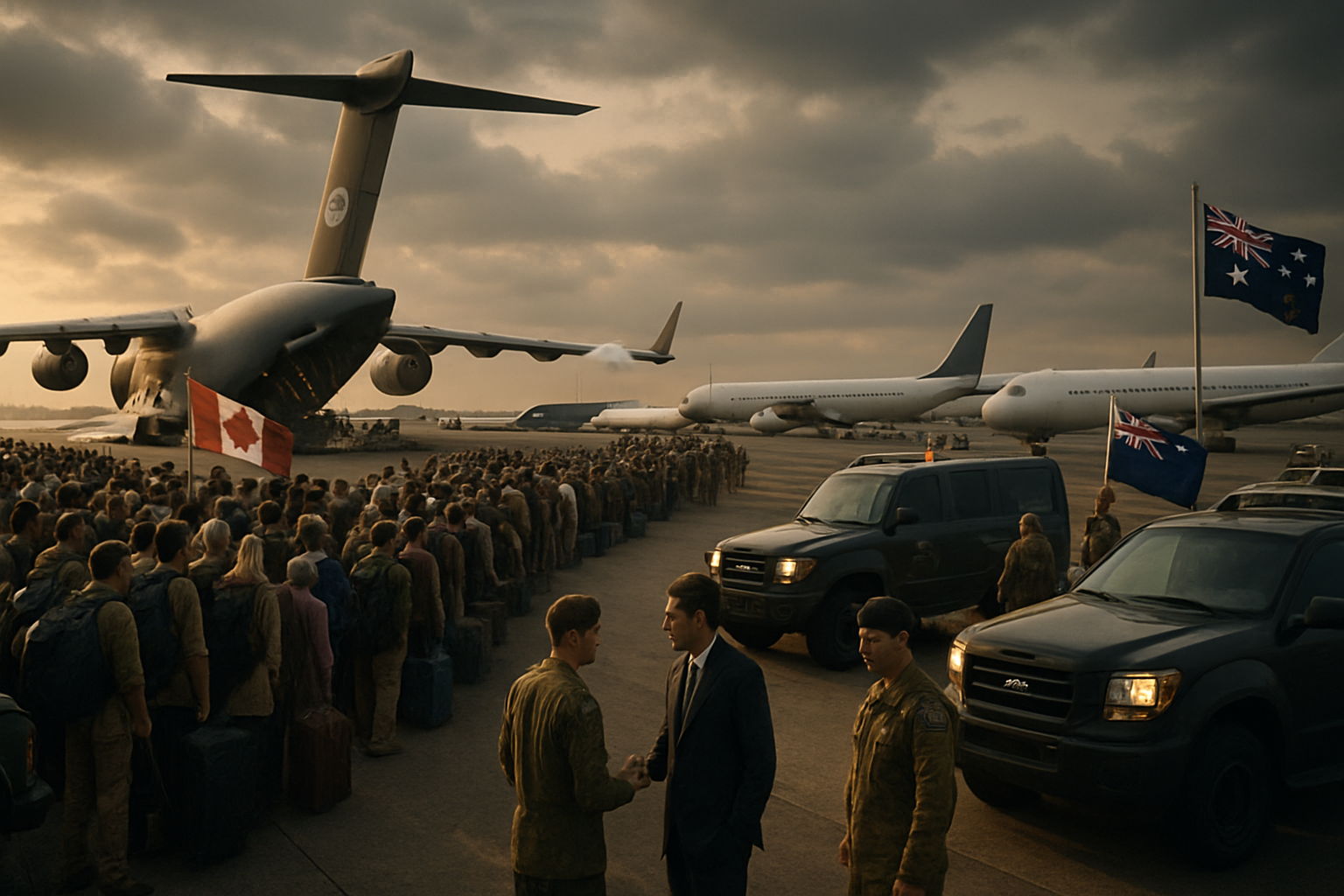
More than 500,000 citizens are being evacuated from Middle East conflict zones in the largest coordinated international rescue operation since the Arab Spring of 2011, as governments worldwide mobilize unprecedented resources to extract their nationals from the escalating crisis.
The massive evacuation effort, spanning from Australia's 115,000 trapped nationals to Germany's 30,000 stranded tourists, represents a historic test of international crisis management capabilities. Multiple nations have activated emergency protocols simultaneously as the Middle East conflict continues to escalate following the confirmed death of Iran's Supreme Leader Ali Khamenei on March 1, 2026.
Unprecedented Scale of Operations
Australia leads the evacuation numbers with 115,000 nationals requiring assistance, prompting the Department of Foreign Affairs and Trade (DFAT) to launch innovative shuttle bus services from Qatar to Saudi Arabia. "We're starting bus transit services from Qatar to the Saudi Arabian capital, in a bid to help Australians desperate to leave the war-torn Middle East," confirmed Foreign Affairs Assistant Minister Matt Thistlethwaite.
From Riyadh, Australians can access commercial flights out of the region, representing a creative solution to the aviation crisis that has seen Dubai International Airport - the world's busiest with 86 million passengers annually - completely shut down due to missile damage.
New Zealand has deployed a Defence Force plane to the Middle East, with Defence Minister Judith Collins stating that "the government's immediate priority is supporting New Zealanders in the Middle East." The coordinated response demonstrates the unprecedented nature of this crisis, requiring nations to activate evacuation protocols across multiple Middle Eastern countries simultaneously.
European Coordination Sets New Standard
The European Union has activated unprecedented coordination mechanisms, with Cyprus implementing its ESTIA evacuation plan for the first time in history. This landmark operation is coordinating the evacuation of over 2,000 European and third-country nationals from the UAE, setting a template for future crisis management.
Norway has organized special flights prioritizing families, pregnant women, and those with medical needs, demonstrating the humanitarian complexity of these operations. The Norwegian government is charging evacuees NOK 12,500 (approximately $1,200) to partially offset costs, reflecting the massive financial commitment required for such operations.
Germany, with 30,000 tourists stranded in the region, has launched specialized charter flights from Oman. Meanwhile, multiple European nations have coordinated their evacuation schedules and shared resources, representing a new level of European crisis management capability.
Asia-Pacific Nations Respond
South Korea has successfully evacuated 140 nationals from Iran and Israel, with a chartered plane scheduled to bring home South Koreans from the UAE. The Korean Foreign Ministry has confirmed that "South Korean nationals stranded across the Middle East" are receiving embassy assistance amid the regional crisis.
The coordinated Asian response highlights the global nature of this evacuation effort, with nations from across continents simultaneously activating emergency protocols to protect their citizens.
Aviation Crisis Compounds Challenges
The evacuation operations are taking place against the backdrop of the most extensive aviation disruption since the COVID-19 pandemic. Over 18,000 flights have been cancelled worldwide as eight countries - Iran, Iraq, Israel, UAE, Qatar, Syria, Kuwait, and Bahrain - have simultaneously closed their airspace.
Major carriers including Emirates, Air France-KLM, Wizz Air, and Bulgaria Air have suspended operations indefinitely, affecting hundreds of thousands of passengers globally. The closure of Dubai International Airport, a critical Europe-Asia hub, has forced airlines to implement complex rerouting through alternative corridors.
This aviation crisis has exposed the vulnerability of modern transportation networks to geopolitical instability, particularly the over-reliance on Middle Eastern hubs for global connectivity. With Russian and Ukrainian airspace already closed due to ongoing conflict, airlines face unprecedented routing challenges.
Energy Security Implications
Parallel to the human evacuation crisis, Iran's closure of the Strait of Hormuz - through which 40% of global seaborne oil transits - has created severe energy market disruptions. Oil prices have surged 10% past $80 per barrel, while natural gas prices have increased 24% in Europe and 78% in the United States.
Major shipping companies Maersk and MSC have suspended Persian Gulf operations, with over 150 tankers stranded and billions of dollars worth of cargo affected. Qatar has halted LNG production, impacting global energy supplies and demonstrating how regional conflicts can instantly affect worldwide markets.
Individual Stories of Resilience
Behind the massive numbers are individual stories of citizens caught in an unprecedented crisis. Americans like travel blogger Alyssa Ramos have described desperate, self-organized escapes spanning multiple continents over 48 hours, with many reporting minimal government assistance.
"They keep going on the news and saying they're doing everything they can to get Americans out," Ramos said after landing in Miami. "I know for a fact they're not."
— Alyssa Ramos, American Travel Blogger
The crisis has also highlighted disparities in evacuation capabilities, with some nations providing comprehensive support while others leave citizens to navigate complex escape routes independently. The situation has become so dire that private jets are offering expensive escape routes from the Gulf as commercial flights remain largely unavailable.
Government Responses and Coordination
Trinidad and Tobago has established communication channels for its 324 nationals residing in the Middle East, while also facing pressure to provide more active evacuation assistance. Attorney General John Jeremie confirmed that facilities have been established to help nationals communicate with the government during this crisis.
Pakistan's coverage has highlighted how "major carriers divert or turn back due to missile fire fears," with many stranded as major hubs like Dubai operate below capacity. European countries have begun repatriation flights amid extended high-risk regional warnings.
The crisis has revealed both strengths and limitations in international coordination frameworks. While individual nations have demonstrated rapid emergency response capabilities, the lack of unified coordination mechanisms for mass civilian protection during regional conflicts has become apparent.
Historical Significance and Future Implications
This evacuation operation represents the most significant international civilian protection effort since the Arab Spring of 2011, demonstrating how regional conflicts in today's interconnected world can instantly affect hundreds of thousands of civilians globally.
The scale rivals the Arab Spring evacuations but occurs in a more complex environment with extensive aviation networks and energy dependencies that amplify the global impact. The successful multilateral coordination, despite the challenges, could provide a framework for future international crises.
However, the crisis has also exposed vulnerabilities in modern transportation systems and the need for enhanced contingency planning to address geopolitical instability in strategic regions. Airlines are now accelerating discussions about route diversification to reduce over-dependence on Middle Eastern hubs.
Recovery Timeline Remains Uncertain
Unlike weather-related disruptions that have predictable recovery timelines, this crisis depends entirely on the resolution of military operations and the normalization of diplomatic tensions. Aviation industry experts note that even when operations resume, clearing the passenger backlog could take weeks.
The crisis is forcing a fundamental reconsideration of route planning, risk assessment procedures, and international cooperation frameworks for managing geopolitical travel disruptions. This represents a template-setting moment for 21st-century aviation crisis management during regional conflicts.
The success of current evacuation efforts will likely influence how the international community approaches similar crises in the future, potentially reshaping approaches to civilian protection mechanisms in an increasingly volatile multipolar world.
Template for Future Crisis Management
The ongoing evacuation operations demonstrate both the capacity for rapid international mobilization and the critical importance of pre-existing diplomatic relationships and coordination mechanisms. Cyprus's successful implementation of the ESTIA plan, for instance, shows how prepared frameworks can be activated effectively during crises.
The crisis management lessons emerging from this operation will likely influence international emergency response protocols for years to come. The coordination between EU nations, the innovative solutions developed by countries like Australia, and the rapid response capabilities demonstrated by various governments provide valuable templates for future emergencies.
As operations continue, the international community faces a critical test of its capacity to protect civilians caught in rapidly evolving conflicts while managing the complex logistical, diplomatic, and economic challenges that such crises present in our interconnected world.