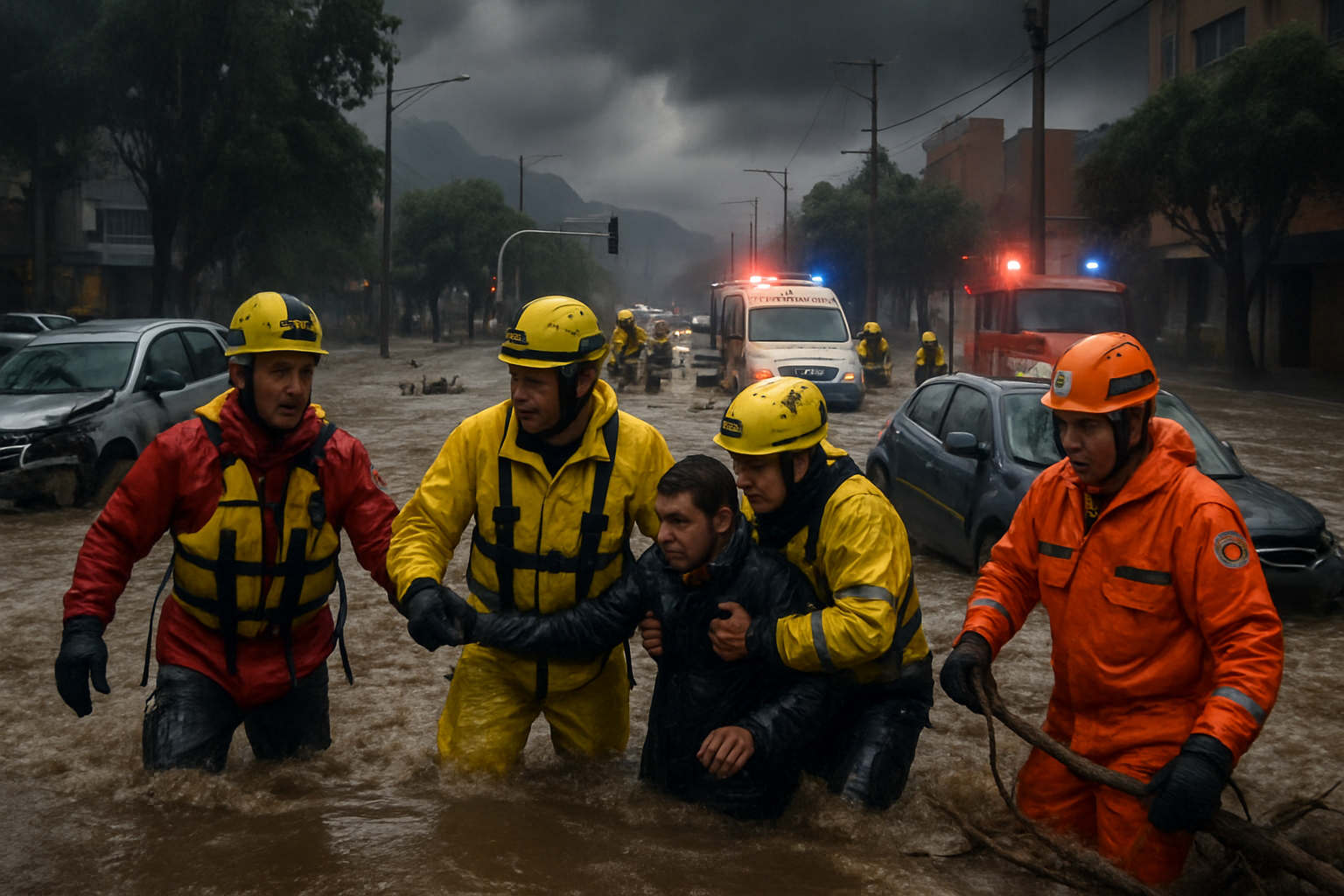
A five-year-old child has died and widespread emergency conditions have been declared across Medellín, Colombia, after torrential rainfall on Good Friday triggered deadly flooding and stream overflows throughout the Valle de Aburrá metropolitan area.
The child's death occurred during severe flooding caused by overflowing quebradas (streams) that overwhelmed drainage systems across Colombia's second-largest city. Mayor Federico Gutiérrez expressed condolences to the family, stating "Toda mi solidaridad y acompañamiento a su familia en este doloroso momento" (All my solidarity and support to the family in this painful moment).
Emergency responders documented cars swept away by flood currents, fallen trees blocking major thoroughfares, and significant infrastructure damage across Medellín and surrounding municipalities in the southern Valle de Aburrá. The severe weather event has forced widespread road closures and disrupted transportation networks throughout the metropolitan region.
Emergency Response and Infrastructure Impact
Municipal authorities activated comprehensive emergency protocols as the intensity of Friday's rainfall exceeded the capacity of urban drainage systems designed for historical precipitation patterns. Emergency services reported multiple incidents of vehicles being carried away by flood waters, while crews worked to clear fallen trees from critical transportation routes.
The flooding particularly affected lower-lying areas of the city where quebradas converge with the Medellín River system. These natural watercourses, which run through urban areas, became torrential streams that overwhelmed containment infrastructure and flooded adjacent neighborhoods.
Transportation authorities implemented emergency road closures across multiple access points to the city, with particular impacts on routes connecting Medellín to municipalities in the southern Valle de Aburrá region. The disruptions affected both private vehicle traffic and public transportation systems during the Easter weekend.
Broader Regional Weather Patterns
The Medellín emergency represents part of a broader pattern of extreme weather affecting Colombia throughout 2026. Earlier this year, the Caribbean coast region experienced devastating flooding that killed 14 people and affected over 50,000 families across Córdoba and Sucre departments, prompting the government to consider formal emergency declarations.
In February 2026, Colombia faced dual weather crises: landslides in Nariño department claiming seven lives, while Caribbean coast flooding destroyed approximately 9,000 homes and displaced tens of thousands of residents. These events occurred during what climatologists identified as unprecedented dry season rainfall that defied traditional seasonal patterns.
The recurring severe weather events highlight vulnerabilities in Colombia's urban infrastructure, particularly drainage systems and flood defenses that were designed for historical rainfall patterns rather than the increasingly intense precipitation events characteristic of current climate conditions.
Global Climate Context
The Medellín flooding occurs during what meteorologists have identified as an extraordinary period of global climate volatility. January 2026 was confirmed as the hottest month in recorded history, marking the 22nd consecutive month that global temperatures exceeded 1.5°C above pre-industrial levels – the longest sustained extreme warming period in human history.
This unprecedented warming streak has contributed to what climate scientists term a "climate volatility paradox," where sustained global warming enables both record heat and devastating regional extreme weather events through disrupted atmospheric circulation patterns and altered precipitation cycles.
The World Meteorological Organization has indicated a 50-60% probability of El Niño conditions developing between July and September 2026, which could drive global temperatures to unprecedented levels by combining baseline warming with natural climate cycle amplification.
Infrastructure Adaptation Challenges
Urban planning experts emphasize that Medellín's flooding exposes critical gaps between existing infrastructure capacity and current weather realities. The city's drainage systems, like those throughout Colombia, were designed for historical precipitation patterns that no longer accurately predict rainfall intensity and frequency.
Emergency management officials note that traditional seasonal weather patterns, which guided infrastructure design and emergency preparedness for centuries, have become unreliable planning frameworks. The timing of intense rainfall during what should be a transitional weather period between dry and wet seasons exemplifies this breakdown of predictable patterns.
The concept of "building back better" with climate-resilient infrastructure has evolved from an optional enhancement to what experts describe as an essential survival strategy for Colombian municipalities facing increasingly volatile weather conditions.
Emergency Response Capabilities
The rapid response to Medellín's flooding demonstrates enhanced emergency coordination capabilities developed following previous weather disasters across Colombia. Emergency services coordinated rescue operations, evacuation procedures, and infrastructure assessment protocols that have been refined through repeated activation during 2026's series of extreme weather events.
However, the frequency and intensity of weather emergencies are testing the limits of municipal and regional response systems. Emergency services designed for occasional severe weather events are now operating in an environment of near-continuous climate-related incidents across multiple Colombian regions.
The Medellín emergency occurs within a global context where traditional mutual aid mechanisms – where stable regions assist disaster-affected areas – are being strained by the simultaneity of extreme weather events affecting multiple countries and regions concurrently.
Community Impact and Recovery
The death of the five-year-old child underscores the human cost of increasingly severe weather events affecting vulnerable populations. Families throughout the affected areas faced property damage, business disruption, and the psychological trauma of repeated exposure to extreme weather events throughout the year.
Local communities demonstrated resilience through neighbor assistance networks and volunteer mobilization during the emergency response. These community-based support systems have become increasingly important as formal emergency services manage elevated demand from more frequent weather incidents.
Mental health services report increased demand for support related to climate anxiety and repeated extreme weather trauma, as families face the possibility of losing homes and livelihoods multiple times within short periods.
Looking Forward: Adaptation Imperatives
The April 2026 Medellín emergency represents what climate adaptation experts describe as a watershed moment for urban preparedness in Colombia. The choice between reactive crisis management and transformative infrastructure adaptation has become increasingly critical as extreme weather events exceed the adaptive capacity of existing systems.
Current conditions across Colombia are considered a preview of routine weather patterns expected in the 2030s without significant climate adaptation investment. This reality demands fundamental reassessment of infrastructure design standards, emergency response capabilities, and urban planning frameworks.
The window for effective climate action continues to narrow as ecological systems approach critical thresholds that could trigger irreversible changes in global food security, climate stability, and human settlement patterns. Colombia's experience with recurring severe weather provides lessons for nations worldwide facing similar challenges from permanent climate volatility.
Recovery efforts in Medellín will emphasize climate-resilient reconstruction approaches, enhanced drainage capacity, and improved early warning systems. The goal is moving beyond emergency response to proactive adaptation strategies that protect communities from the increasing frequency and intensity of extreme weather events that have become the new normal for Colombian cities.