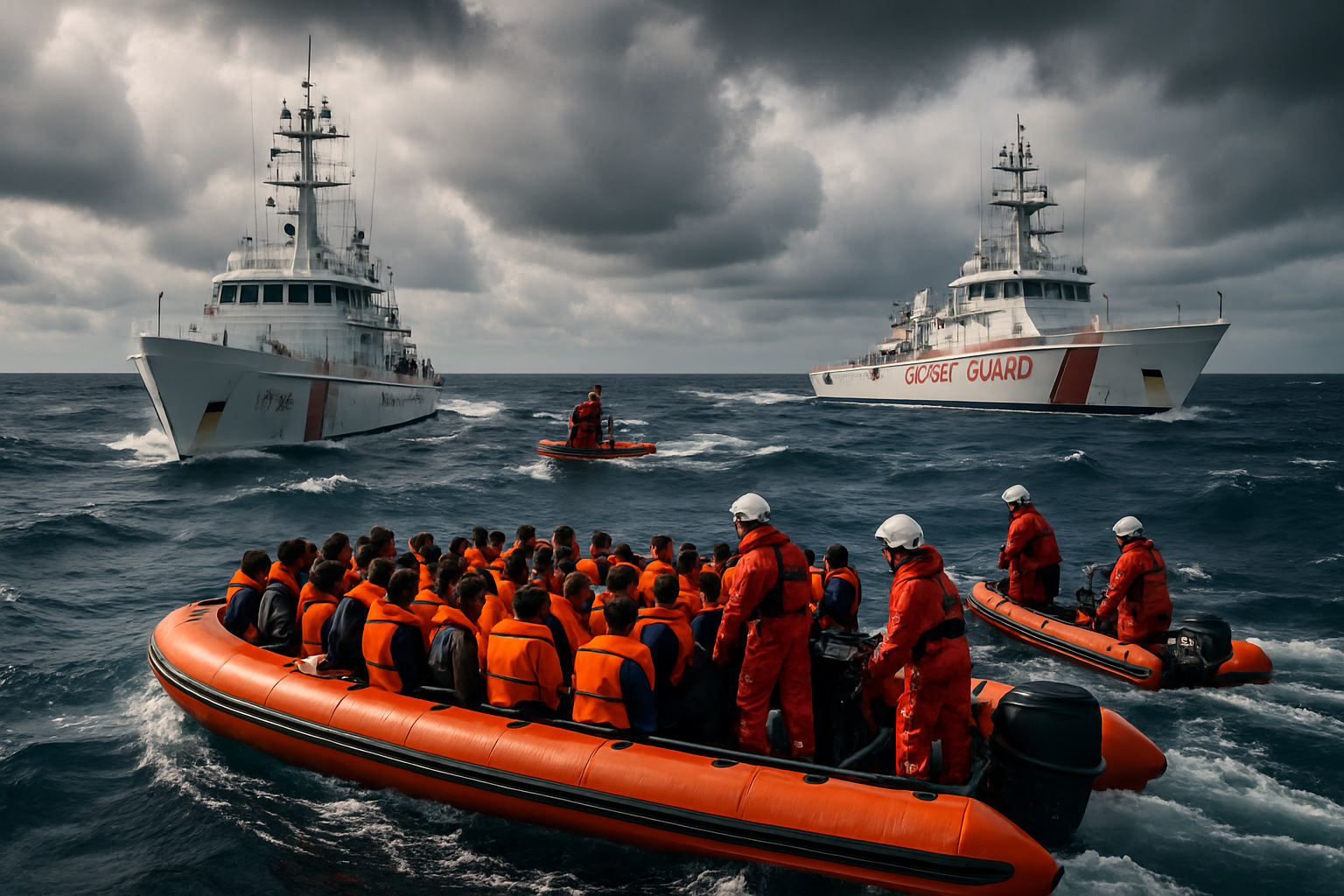
At least 71 migrants are presumed dead after a boat carrying 105 people capsized in the central Mediterranean Sea near Libya on Saturday afternoon, according to rescue organizations, marking another devastating tragedy along one of the world's most dangerous migration routes.
The vessel departed from Libya with women, men, and children aboard, according to NGOs Mediterranea Saving Humans and Sea-Watch, who coordinated the rescue operation. Thirty-two survivors were rescued by commercial vessels and transported to the Italian island of Lampedusa, while two bodies were recovered from the water.
Aerial video footage released by Sea-Watch from their surveillance aircraft Sea-Bird 2 showed survivors clinging desperately to the overturned hull of the capsized boat before rescue ships arrived. The tragic incident occurred in waters under Libyan search and rescue jurisdiction, highlighting the ongoing challenges of coordinated rescue operations in the region.
Escalating Death Toll Amid Policy Changes
This latest tragedy brings the total number of Mediterranean migrant deaths in 2026 to 683, according to the International Organization for Migration (IOM) – more than double the figures recorded for the same period in 2025. The dramatic increase comes as European nations have implemented unprecedented policy changes aimed at deterring irregular migration.
In February 2026, the European Parliament approved historic asylum procedure changes allowing member states to deport asylum seekers to "safe" third countries, regardless of personal connections to those nations. The legislation, passed through an alliance between center-right and far-right parties, represents the most significant shift in European migration policy since the 2015-2016 refugee crisis.
"This is a tragic Easter shipwreck. 32 survivors, 2 bodies recovered, and 71 people missing. The consequence of policies by European institutions that continue to choose to look the other way."
— Mediterranea Saving Humans, statement on social media
External Processing Centers and Deterrence Strategy
Greece is leading a coalition with Germany, Netherlands, Austria, and Denmark to establish migrant "return centers" in Africa for rejected asylum seekers whose countries of origin refuse to take them back. This external processing model builds on Italy's Albanian processing facilities, which have served as a template for broader European external processing strategies.
The enhanced cooperation mechanisms enable smaller groups of member states to advance policies without requiring unanimous EU consent, effectively bypassing traditional humanitarian safeguards that have historically protected asylum seekers. This represents a fundamental transformation from protection-based principles to deterrence-focused strategies.
Human rights organizations are preparing legal challenges over potential violations of the non-refoulement principle, which prohibits returning individuals to countries where they may face persecution. Constitutional challenges are expected across multiple jurisdictions as the new policies are implemented.
Climate Displacement Pressures
The tragedy occurs during an unprecedented period of global warming, with March 2026 marking the 19th consecutive month that global temperatures have exceeded 1.5°C above pre-industrial levels. Environmental migration experts warn that current asylum categories are inadequate for addressing climate-induced displacement, adding new complexity to already strained migration systems.
Despite a 19% decline in EU asylum applications in 2025 to 669,400, death tolls on dangerous routes continue to rise, suggesting that deterrent policies may be redirecting migrants to more perilous journeys rather than reducing overall migration pressure.
Recent Pattern of Deadly Crossings
This latest tragedy is part of a disturbing pattern of deadly Mediterranean crossings in 2026. On April 1, at least 38 migrants died in multiple boat disasters across Mediterranean routes within 24 hours, including incidents near Bodrum, Turkey, and off Lampedusa, Italy. In March, 22 migrants died after being adrift at sea for six days before being rescued by Greek coast guards.
The frequency and scale of these tragedies have intensified since the beginning of 2026, coinciding with the implementation of stricter European migration policies and enhanced border enforcement measures.
EU Technology and Enforcement
The European Union's new Entry/Exit System has detected more than 4,000 overstayers in its first four months of operation, exceeding expectations but also creating processing delays that have required partial suspensions during peak travel periods. The biometric system represents the largest advancement in border control technology in decades.
However, critics argue that enhanced technological enforcement, combined with external processing centers and restricted legal pathways, is pushing migrants toward increasingly dangerous routes across the Mediterranean.
Public Opinion and Political Response
Recent Eurobarometer polling shows that 89% of Europeans demand greater EU unity on migration issues, while 72% express concerns about border security. These figures have provided political backing for the controversial policy shifts, despite mounting humanitarian concerns.
The policy changes require formal ratification by all 27 EU governments before full implementation, and complex negotiations with third countries will be necessary to establish the proposed external processing facilities.
Economic Contradictions
The restrictive migration approach comes amid significant labor shortages across European sectors including healthcare, agriculture, and construction. Germany's Bertelsmann Foundation estimates the country needs 288,000 foreign workers annually to prevent a 10% workforce contraction by 2040, highlighting tensions between demographic needs and political pressures for restriction.
In contrast, Albania has successfully integrated 27,000 foreign nationals from countries including India, Nepal, and the Philippines, addressing workforce gaps in fishing, construction, manufacturing, and tourism sectors.
International Implications
International observers are closely monitoring the European approach to external processing as a potential template for other developed democracies managing complex migration flows in the 21st century. The success or failure of these policies will likely influence international migration management strategies for decades to come.
The developments represent a critical test of whether democratic institutions can maintain humanitarian commitments while adapting to contemporary migration realities driven by climate change, conflicts, and economic disparities.
As rescue operations continue in the central Mediterranean and survivors receive medical attention in Lampedusa, the latest tragedy underscores the human cost of policies that prioritize deterrence over protection, raising fundamental questions about Europe's commitment to humanitarian principles in an era of increasing global displacement.