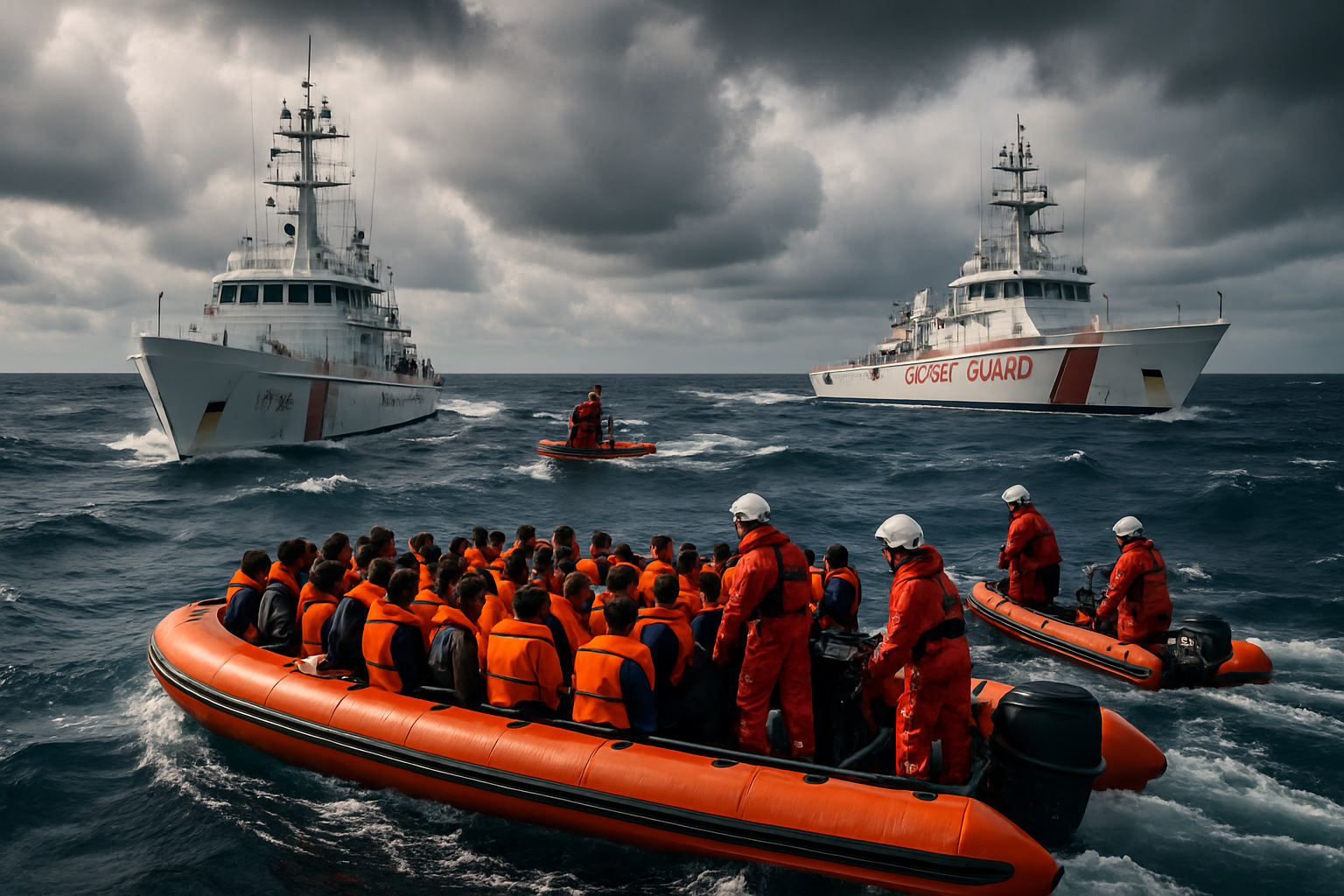
More than 70 migrants are dead or missing after a wooden boat carrying 105 people capsized in the central Mediterranean Sea on Sunday, marking another tragic chapter in what has become the deadliest year for migrants attempting to reach Europe since 2015.
The vessel, which departed from Libya the previous day with 105 women, men, and children aboard, was reported missing by two humanitarian organizations operating in the region. According to the NGOs Mediterranea Saving Humans and Sea-Watch, 32 people were rescued from the waters while two confirmed deaths were recovered. The remaining 71 passengers are presumed dead or missing.
This latest tragedy brings the total number of migrants who have died or gone missing in the central Mediterranean to 683 since the beginning of 2026, according to the International Organization for Migration (IOM) – a figure that represents more than double the casualties recorded during the same period in 2025.
A Route Marked by Death
The central Mediterranean crossing from Libya to Italy has long been recognized as one of the world's most dangerous migration routes. Despite this, thousands continue to attempt the perilous journey, driven by conflict, persecution, and economic desperation in their home countries, as well as increasingly restrictive policies that have eliminated most legal pathways to European protection.
The wooden boat that capsized Sunday represents the typical vessel used by smugglers – overcrowded, unseaworthy craft that are never intended to complete the full journey to European shores. Instead, they serve merely as a means to reach international waters where migrants hope to be rescued by commercial vessels or humanitarian organizations.
German media outlet Tagesschau described the central Mediterranean route as "one of the most dangerous escape routes worldwide," noting that the area has become a graveyard for those seeking better lives in Europe. The description is tragically accurate – since 2014, more than 25,000 people have died or disappeared while attempting this crossing.
Europe's Policy Transformation
The Sunday tragedy occurs against the backdrop of a fundamental transformation in European migration policy. In February 2026, the European Parliament approved historic changes to asylum procedures through an unprecedented alliance between center-right and far-right parties. These reforms allow for the deportation of asylum seekers to "safe" third countries and represent what experts describe as a shift from protection-based to deterrence-focused principles.
Greece is now leading a coalition with Germany, the Netherlands, Austria, and Denmark to establish external processing centers in Africa for rejected asylum seekers whose home countries refuse to readmit them. This approach builds on Italy's Albanian processing model and utilizes enhanced cooperation mechanisms that enable smaller groups of member states to advance policies without unanimous EU consent.
The policy changes have coincided with a 19% decline in first-time asylum applications across the EU in 2025, falling to 669,400 from 912,400 the previous year – the steepest decline since the 2015 refugee crisis. However, rather than reducing dangerous crossings, critics argue that restrictive policies have simply redirected migrants to increasingly perilous routes.
"These deaths are not inevitable tragedies but the direct consequence of political choices that prioritize deterrence over human life."
— Humanitarian organization spokesperson
Climate and Conflict Driving Displacement
The ongoing migration crisis is being exacerbated by unprecedented environmental and political pressures. March 2026 marked the 19th consecutive month that global temperatures exceeded 1.5°C above pre-industrial levels – the longest sustained warming streak in recorded history. Climate experts warn that environmental displacement will only intensify in the coming years.
Simultaneously, conflicts in regions including the Sahel, Horn of Africa, and Middle East continue to generate massive displacement. The UN has warned of potentially "unprecedented" refugee flows if instability in Iran, with its population of 84 million, escalates further.
Yet current European asylum categories remain inadequate to address climate-induced displacement, creating a growing gap between the scale of global displacement pressures and available legal pathways for protection.
The Human Cost of Deterrence
Sunday's tragedy follows a pattern of deadly incidents that have marked 2026 as particularly lethal for Mediterranean migrants. In April alone, multiple boat disasters across Mediterranean routes killed more than 40 people within a 24-hour period. Earlier incidents in March saw 22 migrants die during a six-day ordeal at sea, with survivors reporting that traffickers ordered bodies to be thrown overboard.
The implementation of new EU biometric systems has had mixed results. The Entry/Exit System has successfully detected more than 4,000 overstayers in its first four months of operation, exceeding expectations. However, processing delays have created significant bottlenecks, with airlines warning of four-hour queues during summer 2026.
Meanwhile, enhanced enforcement has led to numerous successful operations against "shadow fleet" vessels and smuggling networks, but these victories have done little to address the root causes driving migration or provide safe alternatives for those seeking protection.
Voices from the Frontlines
Rescue organizations operating in the Mediterranean have documented increasingly desperate conditions as European policies limit search and rescue operations. The two NGOs that reported Sunday's tragedy – Mediterranea Saving Humans and Sea-Watch – are among the few remaining humanitarian organizations still conducting rescue operations in the central Mediterranean.
These organizations face constant legal and political pressure, with some European governments attempting to restrict their activities through port closures, vessel seizures, and criminalization of rescue activities. Critics argue that such restrictions effectively weaponize the Mediterranean Sea against migrants.
Economic Contradictions
The restrictive approach to migration comes despite significant labor shortages across Europe in sectors including healthcare, agriculture, and construction. Countries like Albania have successfully integrated 27,000 foreign nationals to address workforce gaps, while Germany's Bertelsmann Foundation estimates the country needs 288,000 foreign workers annually to prevent a 10% workforce contraction by 2040.
The economic contradictions are stark: as European nations spend billions on border enforcement and external processing centers, they simultaneously face aging populations and skills shortages that immigration could help address. Meanwhile, the human capital lost through migrant deaths represents an immeasurable economic and social cost.
International Implications
The European approach to migration is being closely watched by other developed nations as a potential template for 21st-century migration management. The success or failure of external processing centers, enhanced cooperation mechanisms, and deterrence-focused policies will likely influence international migration governance for decades to come.
Human rights organizations are preparing legal challenges to external processing arrangements, citing violations of the non-refoulement principle and international humanitarian law. Constitutional challenges are expected in multiple jurisdictions, testing the balance between sovereign border control and humanitarian obligations.
A Critical Juncture
As rescue operations continued Sunday evening for any possible survivors from the capsized vessel, the broader questions surrounding European migration policy remained unanswered. The tragedy highlighted the fundamental tension between the political imperative to control borders and the humanitarian imperative to protect human life.
With climate displacement expected to intensify and global conflicts showing no signs of abating, Europe's approach to migration policy is being tested at a critical juncture. The choices made in 2026 will likely determine whether the continent can maintain its humanitarian values while adapting to 21st-century migration realities.
For the families of those lost in Sunday's tragedy, these policy debates offer cold comfort. Each statistic represents a life cut short, a family destroyed, and dreams that will never be fulfilled. As European leaders gather to discuss migration policy, the Mediterranean continues to claim lives at an unconscionable rate, marking 2026 as one of the deadliest years on record for those seeking safety and opportunity across its waters.