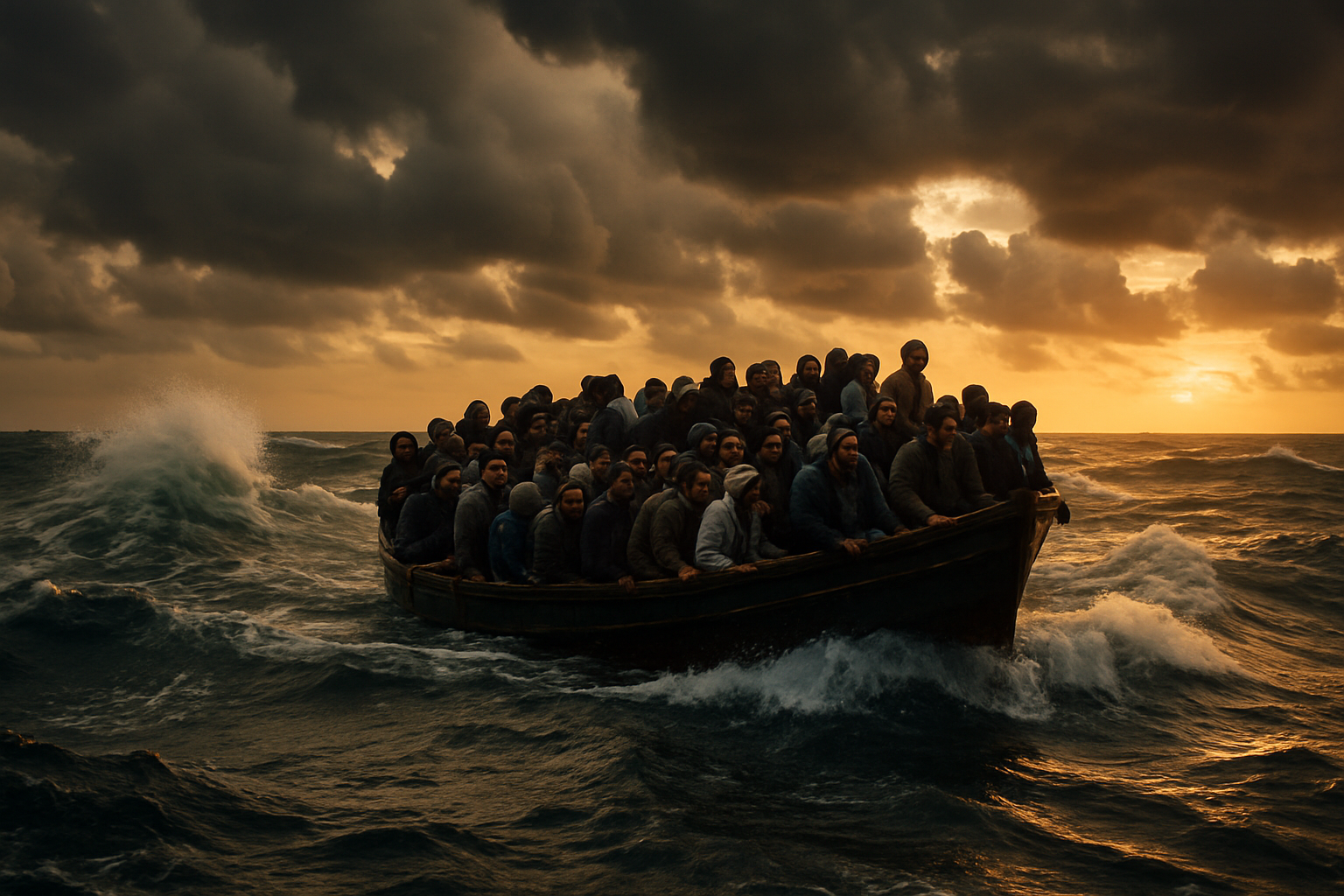
At least 40 migrants died in multiple boat disasters across Mediterranean and Aegean Sea routes within a devastating 24-hour period on April 1, 2026, underscoring the continuing humanitarian crisis as Europe implements its most restrictive migration policies in decades.
The tragedies unfolded simultaneously across three major migration routes, with rescue operations struggling against rough seas and challenging weather conditions that have made the Mediterranean routes increasingly treacherous during what authorities describe as one of the deadliest start to a year on record.
Aegean Sea Disaster Claims 19 Afghan Lives
The deadliest single incident occurred off Turkey's coastal city of Bodrum, where 19 Afghan nationals, including an infant, perished when their speedboat capsized in rough Aegean Sea conditions. Turkish officials report the vessel was attempting to reach nearby Greek islands when it encountered difficulties early Wednesday morning.
Turkish Coast Guard operations successfully rescued 20 survivors from the churning waters, though one additional person died later in hospital, bringing the confirmed death toll to 19. The victims were part of a group fleeing Afghanistan, where 88% of female-headed households now live below minimum subsistence levels under Taliban rule.
"This represents one of the latest deadly tragedies along Europe's dangerous migrant routes, highlighting the desperate conditions driving people to risk everything for safety and opportunity."
— Turkish Coast Guard Official
Mediterranean Route Tragedy South of Lampedusa
Simultaneously, Italian authorities discovered 19 migrants dead aboard a vessel found in Libyan search and rescue waters south of Lampedusa. The deceased, including two children, were discovered by rescue teams who also saved 58 survivors from the same boat.
Seven people remained in critical condition and were airlifted to medical facilities for emergency treatment. German media reports suggested the victims likely died from hypothermia during their attempted crossing from North Africa to European shores.
The discovery came during what Italian authorities describe as intensified patrols as part of the expanded Albanian processing model, which serves as a template for external migration centers being established across Europe.
Channel Crossing Deaths Mark Grim Milestone
Adding to the day's toll, two migrants died and another went missing while attempting to cross the English Channel from France to the UK. The fatalities marked the first deaths in the Channel during 2026, occurring just hours after Britain and France agreed to a £16.2 million "stop the boats" deal.
The timing proved particularly stark, with the deaths coming as enhanced cooperation between French and British authorities was being celebrated as a model for European border security coordination.
Policy Context: Europe's Deterrence Shift
These tragedies unfold against the backdrop of historic changes in European migration policy. In February 2026, the European Parliament approved controversial asylum procedure reforms allowing deportation to "safe" third countries through an unprecedented center-right and far-right political alliance.
Greece now leads a coalition with Germany, Netherlands, Austria, and Denmark to establish African "return centers" for rejected asylum seekers whose home countries refuse readmission. The enhanced cooperation mechanism enables smaller member state groups to advance restrictive policies without requiring unanimous EU consent, fundamentally bypassing traditional humanitarian safeguards.
The policy transformation represents the most significant shift in European migration management since the 2015-2016 refugee crisis, moving from protection-based principles toward deterrence-focused strategies.
Death Toll Doubles in 2026
Mediterranean migration deaths have more than doubled in the first two months of 2026 compared to the previous year, according to rescue organizations and government statistics. The increase coincides with the implementation of more restrictive European policies that advocates argue are pushing migrants toward increasingly dangerous routes.
Despite a 19% decline in overall EU asylum applications during 2025, the death toll continues rising as migrants seek alternative pathways when legal channels become restricted. The phenomenon reflects what migration experts describe as "route diversification" - where enforcement in one area redirects rather than reduces dangerous journeys.
"We're seeing the human cost of policies that prioritize deterrence over protection. When legal pathways are closed, people don't stop moving - they take greater risks."
— European Migration Observatory Researcher
International Response and Rescue Operations
The simultaneous tragedies triggered large-scale international rescue coordination involving Turkish Coast Guard vessels, Italian naval units, Greek patrol boats, and French maritime authorities. Helicopter operations transported the most critically injured survivors to specialized medical facilities across the region.
European Union Entry/Exit System technology, which has detected over 4,000 overstayers in its first four months of operation, demonstrates enhanced border monitoring capabilities. However, critics argue the focus on enforcement technology has not been matched by equivalent investment in search and rescue capacity.
Climate and Geopolitical Pressures
The April 1 disasters occurred during the 19th consecutive month of global temperatures exceeding 1.5°C above pre-industrial levels - the longest sustained warming streak in recorded history. Climate displacement experts warn that current asylum categories remain inadequate for handling climate-induced migration, which is expected to intensify significantly.
Additional pressure comes from ongoing conflicts in Afghanistan, Myanmar, Sudan, and other regions, combined with economic instability that continues driving migration despite increasingly restrictive European policies.
Iran's ongoing crisis, with a population of 84 million, has European officials warning of potential "refugee flows without precedent" should the situation deteriorate further.
Economic and Social Contradictions
The restrictive migration policies contrast sharply with demographic realities across Europe. Germany requires 288,000 foreign workers annually to prevent a 10% workforce contraction by 2040, according to the Bertelsmann Foundation. Similar labor shortages exist across healthcare, agriculture, and construction sectors throughout the EU.
Countries like Albania have successfully integrated 27,000 foreign nationals to address workforce gaps, demonstrating the economic benefits of managed migration. Yet European policy continues prioritizing enforcement over economic integration, creating what economists describe as counterproductive contradictions.
Humanitarian Organizations Prepare Legal Challenges
Human rights organizations are preparing comprehensive legal challenges to the new European asylum procedures, citing violations of the non-refoulement principle and international humanitarian law. The European Court of Justice is expected to review several aspects of the external processing framework.
The legal challenges focus on whether the enhanced cooperation mechanisms can legitimately circumvent traditional asylum protections and whether external processing arrangements violate fundamental European values regarding human dignity and protection.
Looking Forward: A Critical Juncture
The April 1 tragedies represent more than individual disasters - they mark a critical juncture in 21st-century migration governance. European approaches are being closely monitored internationally as potential templates for other democratic societies managing complex migration flows.
The success or failure of Europe's deterrence-focused policies will influence global migration management strategies for decades. Early indicators suggest that restrictive approaches may be redirecting rather than reducing dangerous journeys, with potentially catastrophic humanitarian consequences.
As rescue operations concluded and families across Afghanistan, Libya, and other regions await news of missing loved ones, the April 1 disasters serve as a stark reminder of the human costs of migration policies that prioritize enforcement over protection.
The challenge facing European leaders is whether democratic institutions can maintain humanitarian commitments while managing complex migration flows driven by climate change, conflict, and economic disparity - a test that will define migration governance for generations to come.