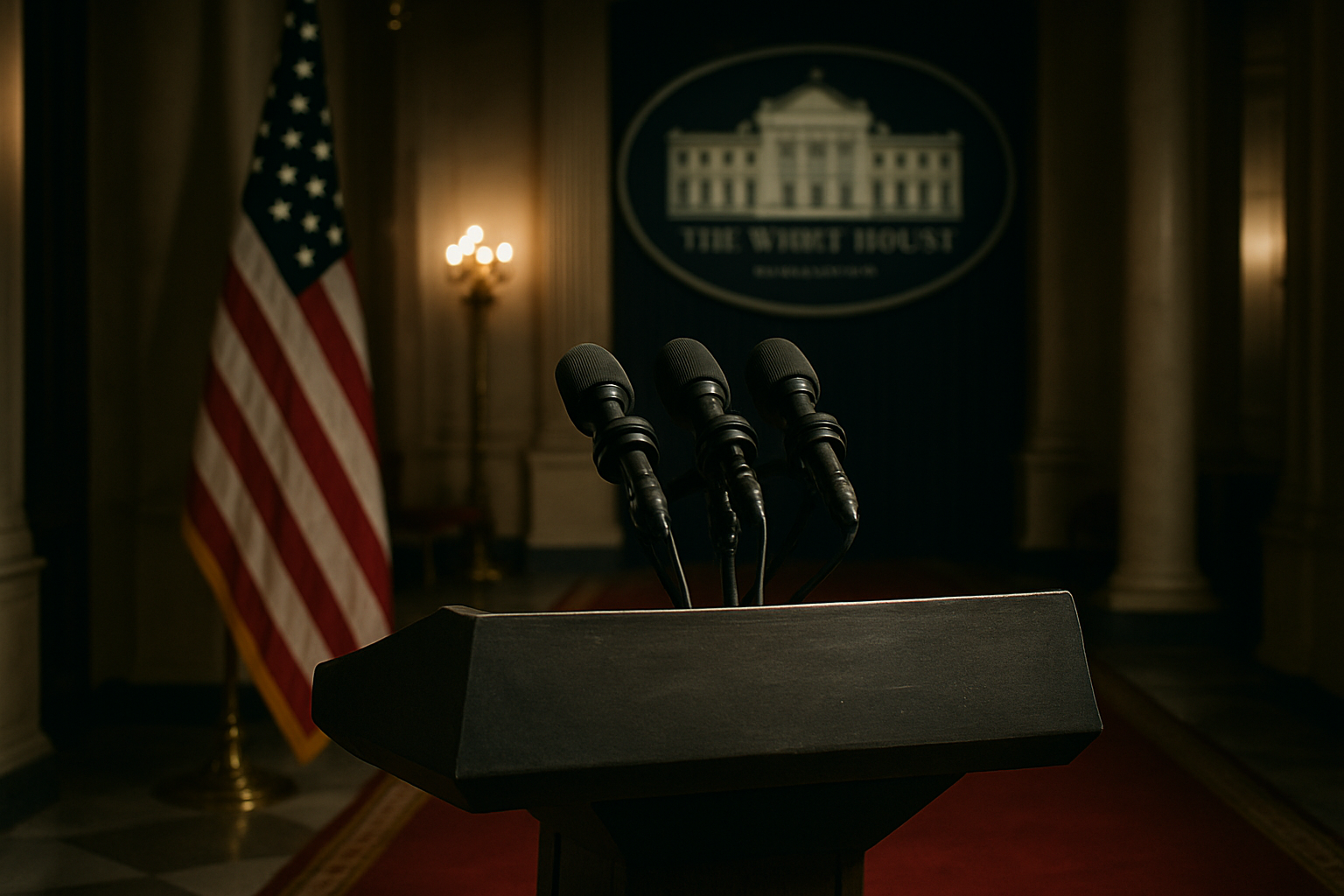
In an unprecedented break from White House protocol, First Lady Melania Trump delivered a rare public statement from the Grand Foyer categorically denying any connection to Jeffrey Epstein while calling for congressional hearings to give survivors a voice, leaving observers questioning the timing and motivations behind her unexpected intervention.
The First Lady's statement, delivered Thursday from the White House, marked a dramatic departure from her traditionally private approach to controversial matters. "I was never friends with Jeffrey Epstein," Trump declared emphatically, adding "I am not Epstein's victim" and "Epstein did not introduce me to Donald Trump." The comments represent only her eighth public speech during her husband's presidency, compared to Michelle Obama's 74 in her first year alone.
Perhaps most significantly, Trump positioned herself as an advocate for Epstein survivors, stating: "These women deserve to be heard, and their stories must be told." She called for congressional hearings to provide a platform for survivors' testimonies, a move that caught many by surprise given the administration's previous reluctance to engage with Epstein-related matters.
Presidential Surprise and Administrative Discord
Sources close to the administration revealed that President Trump was "completely surprised" by his wife's statement and was not informed in advance of her decision to address the scandal publicly. This suggests the First Lady acted independently, contradicting typical White House coordination protocols for such sensitive matters.
The timing of her intervention comes amid mounting international pressure from what European law enforcement has described as "the largest international elite criminal network exposure in recent memory." Active investigations span six countries, with unprecedented coordination between authorities examining connections that reach the highest levels of government and business.
Trump characterized critics' allegations against her as "completely baseless lies" and described those making them as "financially and politically motivated" and "devoid of ethical standards." Her forceful denial appears calculated to control the narrative amid escalating scrutiny of the Trump administration's handling of Epstein-related matters.
Context of International Investigations
The First Lady's statement occurs against the backdrop of explosive revelations affecting multiple countries. Norwegian Crown Princess Mette-Marit faces potential criminal proceedings after being mentioned over 1,000 times in released documents. Major corporate resignations have rocked Wall Street, with Goldman Sachs' top lawyer Kathy Ruemmler stepping down over "big brother" emails with Epstein, and DP World CEO Sultan Ahmed bin Sulayem being forced out after extensive document mentions.
Baltic states are coordinating trafficking investigations, with Latvia's human trafficking probe of the "Natalie" modeling agency declared a national priority. Poland has confirmed recruitment evidence involving "women, possibly minors," while Estonian authorities examine operations spanning three Baltic countries. The systematic Eastern European recruitment patterns suggest sophisticated international exploitation networks.
Recent NPR investigations revealed that the Department of Justice allegedly withheld 53 pages of Trump-related Epstein materials, including FBI interviews containing sexual assault allegations involving a minor. Representative Robert Garcia has characterized this as "the largest government cover-up in modern history," intensifying calls for transparency and accountability.
Survivor Reactions and Advocacy Community Response
Epstein survivors have expressed mixed reactions to the First Lady's unexpected advocacy. Marina Lacerda, speaking to The Guardian, suggested that Trump's statement shifts responsibility away from authorities who have failed to act despite overwhelming evidence. "We got the transparency law passed, we got the files released, we have names in the files, nobody has done anything," Lacerda stated.
The Department of Justice faces mounting criticism for prosecution failures despite possessing over 3 million pages of evidence. Deputy Attorney General Todd Blanche has confirmed no new federal prosecutions are planned, citing "technical and human errors." Most damaging has been the catastrophic victim protection failure that exposed approximately 100 survivor identities, including 31 minors, through inadequate document redaction.
Some survivors have praised Trump's call for congressional hearings as "bold," while others question whether additional testimony without prosecutorial action provides meaningful support for victims seeking justice.
Breaking White House Protocol
The First Lady's decision to address the Epstein scandal directly represents a significant departure from established White House protocol. Traditionally, First Ladies have avoided direct engagement with criminal investigations or controversial matters that could implicate their spouses' administrations.
Her statement acknowledges the gravity of Epstein's crimes while firmly rejecting suggestions of involvement. This strategic positioning allows her to express sympathy for survivors while protecting her family's reputation amid ongoing international scrutiny.
The timing coincides with multiple administration crises, including the Iran conflict that has cost over $27 billion with only 25% American public support, and strained relationships with European allies who have rejected participation in military coalitions. This has led to speculation about whether the statement serves broader narrative control purposes during a period of intense political pressure.
International Implications and Precedents
Trump's intervention occurs as international cooperation reaches unprecedented levels in addressing transnational elite criminal networks. The Council of Europe stripped former Secretary-General Thorbjørn Jagland of diplomatic immunity—a historic first—while French authorities have opened criminal investigations into high-profile figures including former Culture Minister Jack Lang.
The case has established several precedents for 21st-century international justice cooperation. Bill Clinton became the first former U.S. president compelled to testify in an Epstein investigation, while Prince Andrew was arrested—the first British royal detention since King Charles I in 1647. These developments demonstrate that traditional diplomatic protections are being challenged by the scope and gravity of the allegations.
Enhanced coordination between six countries has created new frameworks for addressing sophisticated criminal networks that transcend national boundaries. The success or failure of these investigations will establish crucial precedents for democratic accountability mechanisms in an era of globalized elite networks.
Questions of Timing and Motivation
Political analysts are questioning why the First Lady chose this moment to break her silence. Her statement comes amid a period when the Trump administration faces multiple international crises and domestic challenges. The Iran conflict has significantly damaged the administration's approval ratings, while European allies have demonstrated unprecedented independence by rejecting American military requests.
Critics suggest the timing may be designed to deflect attention from other investigations or to preemptively address potential revelations. However, supporters argue that the statement demonstrates genuine concern for survivors and a commitment to transparency that transcends political considerations.
The strategic nature of the intervention is evident in its careful messaging—acknowledging victim suffering while categorically denying family involvement, calling for institutional action while avoiding specific commitments that could implicate the administration in ongoing investigations.
Looking Forward: Congressional Action and International Coordination
The First Lady's call for congressional hearings now places pressure on lawmakers to respond. House committees have already issued subpoenas related to DOJ handling of Epstein files, with Representative Nancy Mace characterizing the situation as "one of the biggest cover-up operations in American history."
The international investigation continues to expand, with French specialized prosecutors analyzing millions of documents, Norwegian authorities considering criminal proceedings against royalty, and Baltic states coordinating anti-trafficking operations. These parallel investigations create pressure for American authorities to demonstrate comparable commitment to accountability.
Russian disinformation campaigns using artificial intelligence to create false connections between world leaders and Epstein complicate verification efforts. French authorities have detected sophisticated operations designed to protect actual perpetrators while undermining legitimate investigations through manufactured confusion.
Democratic Accountability at a Crossroads
The ultimate significance of the First Lady's statement may depend on whether her advocacy translates into meaningful action. The case represents a fundamental test of whether democratic institutions can address transnational elite criminal networks despite traditional protections of wealth, power, and diplomatic immunity.
Cultural institutions worldwide are conducting relationship reviews, with Norway's Sex og Samfunn becoming the first organization to terminate royal partnerships—establishing accountability standards that could influence institutional behavior globally. Governments are implementing new vetting procedures for diplomatic appointments, while corporate boards face enhanced scrutiny over executive relationships.
The resolution of these investigations will establish crucial precedents for 21st-century international justice cooperation. Whether meaningful accountability is achieved versus continued elite impunity despite unprecedented exposure will determine future mechanisms for preventing similar criminal networks from operating with impunity across national boundaries.
As investigations continue across multiple continents with enhanced international coordination, the world watches to see whether democratic institutions can deliver justice commensurate with the scope of evidence revealed, or whether traditional elite protections will ultimately prevail despite the most extensive criminal network exposure in recent memory.