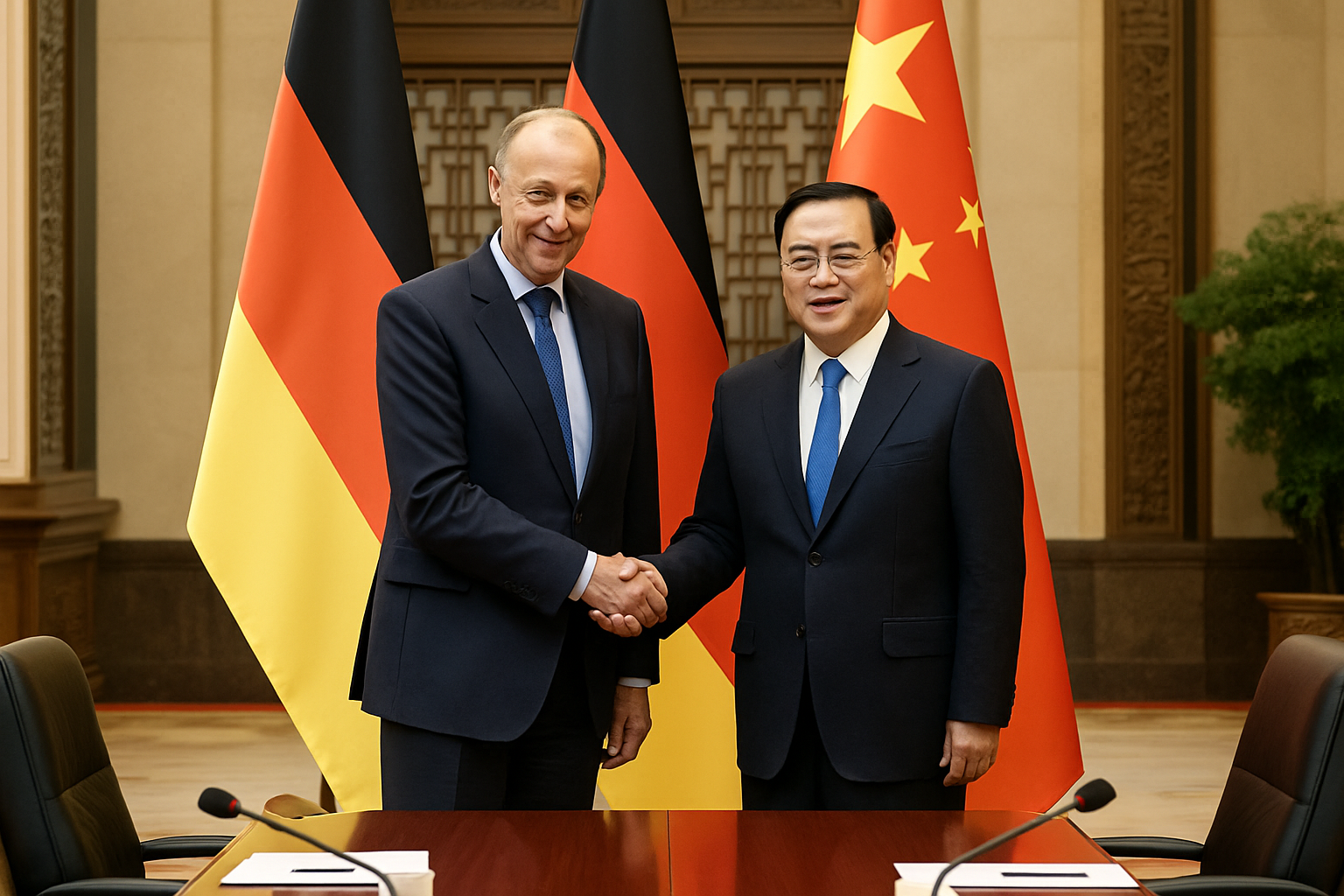
German Chancellor Friedrich Merz concluded a pivotal two-day visit to Beijing, securing a significant order for 120 Airbus aircraft from Chinese airlines while both nations seek to recalibrate their economic relationship amid mounting global trade tensions and technological competition.
The visit, Merz's first to China as Chancellor, demonstrated both countries' commitment to maintaining robust economic ties despite increasingly complex geopolitical dynamics. Speaking at the Great Hall of the People alongside Chinese Premier Li Qiang, Merz emphasized the need for "fair" economic competition while acknowledging the "great potential for growth" in bilateral relations.
Historic Airbus Deal Underscores Aviation Partnership
The centerpiece of the visit was China's announcement of purchasing 120 Airbus aircraft, a deal worth billions of euros that underscores the continued importance of China-Germany economic cooperation. The French-built but German-engineered aircraft represent one of Europe's most successful industrial partnerships with China, demonstrating how strategic cooperation can thrive even amid broader geopolitical tensions.
"This substantial aircraft order reflects China's confidence in European aviation technology and our shared commitment to maintaining strong commercial relationships," Merz announced during a joint press conference with Chinese officials.
The timing of the aircraft announcement is particularly significant, coming as global aviation supply chains face disruption and as China seeks to modernize its civilian aviation fleet. The deal also serves as a counterbalance to ongoing trade tensions between China and the United States, offering European manufacturers continued access to the world's second-largest aviation market.
Diplomatic Reset Amid Strategic Competition
Merz's visit represents a deliberate diplomatic recalibration, with Germany seeking to balance economic interests with growing concerns about Chinese technological competition. During meetings with President Xi Jinping and Premier Li Qiang, both sides acknowledged the fundamental transformation in their relationship from what German officials now describe as China's evolution from "lucrative market to competitive threat" in high-technology sectors.
"We seek fair competition, but we also recognize that China often operates by its own rules. We must be realistic about our expectations while pursuing the great potential that exists in our economic relationship."
— Chancellor Friedrich Merz
The meetings, conducted with full military honors, demonstrated China's interest in maintaining strong ties with Germany, Europe's largest economy and a crucial partner for both trade and technology transfer. Chinese officials welcomed Merz's "pragmatic approach" to bilateral relations, contrasting Germany's diplomatic engagement with what Beijing characterizes as more confrontational American policies.
Technology Competition and Market Access
Central to the discussions were questions of market access and technological cooperation in an era of intensifying strategic competition. German businesses have increasingly found themselves competing directly with Chinese companies in sophisticated manufacturing sectors where Germany traditionally held technological advantages.
Chinese firms now compete head-to-head with established European manufacturers in areas ranging from renewable energy technology to advanced manufacturing systems. This shift has forced Germany to reconsider its approach to China from primarily viewing it as an export market to recognizing it as a direct competitor in global markets.
The visit coincided with China's announcement of significant tariff reductions on European Union dairy products, lowering rates from 21.9%-42.7% to 7.4%-11.7% for a five-year period. This sector-specific approach demonstrates China's strategy of pursuing targeted trade cooperation while managing broader geopolitical tensions.
Strategic Context: Trump's Trade Disruptions
Merz's Beijing visit takes place against the backdrop of major disruptions in global trade architecture, particularly following the U.S. Supreme Court's recent ruling striking down President Trump's global tariff program. The constitutional crisis in Washington has created uncertainty about American trade policy, providing both China and Germany opportunities to strengthen bilateral economic cooperation.
Trump's planned visit to Beijing scheduled for March 31-April 2 adds another layer of complexity to international trade relations. German officials are closely monitoring U.S.-China developments while positioning Germany as a stable, predictable partner for Chinese economic cooperation.
The timing also coincides with China's historic announcement of zero-tariff access for 53 African countries beginning May 1, 2026, representing the most comprehensive expansion of China-Africa trade relations in history. This multilateral approach contrasts sharply with the Trump administration's preference for bilateral trade agreements.
Economic Transformation Challenges
Both nations face significant challenges in adapting their economic relationship to new realities. For Germany, the relationship with China has transformed from complementary trade partnership to complex competition across multiple sectors. German automotive manufacturers, machinery producers, and technology companies now find themselves competing with increasingly sophisticated Chinese rivals.
China's domestic challenges include addressing supply chain disruptions affecting key industries. Lenovo, the world's largest PC manufacturer, reported a 21% profit decline due to global memory shortages, which CEO Yang Yuanqing described as a structural issue affecting the entire technology sector.
The Chinese government has responded with comprehensive reforms, including efforts to create a unified national power market to support energy security and achieve the country's 2030 carbon-peak target. These domestic transformations directly affect German companies operating in China and seeking to expand their presence in renewable energy and clean technology sectors.
Looking Forward: Managing Competition and Cooperation
The success of Merz's visit will be measured not by immediate breakthroughs but by the establishment of frameworks for managing economic competition while maintaining beneficial cooperation. Both nations recognize the need for new approaches to their economic relationship that acknowledge direct competition while preserving mutual benefits.
German officials emphasized the importance of creating predictable frameworks for business investment and technology transfer, while Chinese counterparts stressed their commitment to opening markets and maintaining fair competition. The challenge lies in translating these high-level commitments into practical policies that benefit businesses and consumers in both countries.
The visit also highlighted the role of European integration in China policy. Germany's approach must align with broader EU strategies for managing Chinese economic relationships while maintaining sovereignty over key technologies and strategic industries.
As global trade relationships continue evolving in response to technological change and geopolitical tensions, the Germany-China economic partnership serves as a crucial test case for whether major economies can maintain beneficial trade relationships while managing direct competitive challenges. The outcomes of this diplomatic reset will likely influence broader European approaches to China engagement and provide insights into managing economic cooperation in an era of strategic competition.