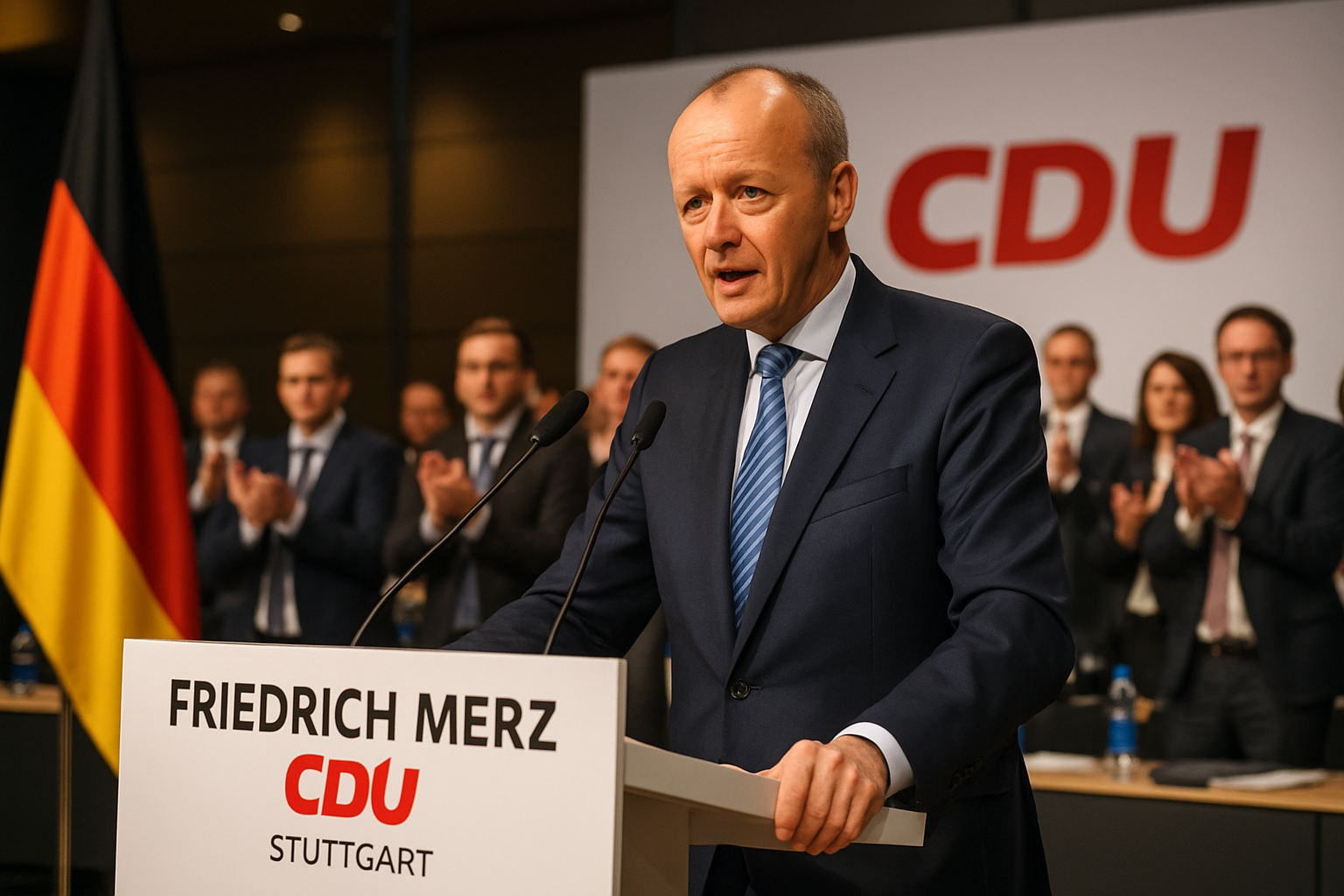
German Chancellor Friedrich Merz has been decisively re-elected as leader of the Christian Democratic Union (CDU), securing 91.2% of delegate votes at the party congress in Stuttgart on February 20, 2026, marking a significant improvement from his 2024 performance and consolidating his leadership during a period of intense European political upheaval.
The overwhelming endorsement from 963 delegates out of 1,001 present demonstrates the party's unified confidence in Merz's leadership as Germany faces mounting domestic challenges and an increasingly complex international landscape. The result represents a notable increase from his previous leadership victory, signaling strengthened internal party unity at a critical juncture for both German and European politics.
Strategic Leadership Amid Crisis
Merz's re-election comes at a pivotal moment for German politics, with the CDU confronting significant challenges including declining polling numbers and the growing influence of the far-right Alternative for Germany (AfD). The party congress in Stuttgart served as a crucial test of Merz's ability to maintain party cohesion while addressing voter concerns about economic uncertainty and security threats.
According to party sources, Merz has demonstrated rare public self-criticism in recent months, acknowledging shortcomings in his performance while vowing that the AfD will not "ruin our country." This combination of humility and determination appears to have resonated with party delegates, who see him as the leader capable of navigating Germany through its current political difficulties.
"The CDU has strengthened Merz's position at a time when strong leadership is essential for Germany and Europe."
— Political analyst from FAZ
The congress also witnessed a notable appearance by former Chancellor Angela Merkel, her first attendance since stepping down in 2021. Merkel's presence and the "storm of applause" she received demonstrated the party's commitment to unity and continuity, bridging different generations of CDU leadership during challenging times.
European Context and International Pressures
Merz's re-election occurs against the backdrop of unprecedented European political developments, including recent discussions about European strategic autonomy and nuclear deterrence cooperation with France. The German Chancellor has been actively engaged in high-level diplomatic initiatives, including participation in the Munich Security Conference and upcoming diplomatic engagements with China, positioning Germany as a stable democratic leader amid global challenges.
The timing of the party congress is particularly significant given the broader European political landscape, where traditional party structures face pressure from populist movements and changing voter preferences. The CDU's show of unity contrasts sharply with political instability witnessed in other European nations, where coalition governments are fracturing and far-right parties are gaining ground.
Recent memory analysis reveals that Merz has been central to major European security discussions, including historic nuclear deterrence talks with French President Emmanuel Macron and involvement in NATO's Arctic Sentry mission planning. These international responsibilities underscore the importance of strong domestic political support for his continued effectiveness on the European stage.
Domestic Challenges and Reform Agenda
The CDU leader faces significant domestic pressures, with the party trailing in polls ahead of crucial 2026 state elections where the AfD aims to achieve its first state election victory. Merz's strategy combines promises of domestic reforms with a strong anti-extremist positioning, attempting to consolidate centrist voters while preventing defection to populist alternatives.
The party congress addressed mounting concerns about Germany's economic competitiveness, with delegates discussing measures to enhance productivity and technological innovation. These discussions reflect broader European Union initiatives to strengthen competitiveness against Chinese economic expansion and American bilateral trade policies that bypass EU frameworks.
Merz has committed to accelerating reforms in key areas including digital sovereignty, energy security, and defense capabilities. The party's support for his leadership provides the political capital necessary to implement potentially controversial changes required to maintain Germany's economic leadership within Europe.
International Diplomatic Initiatives
The CDU leader's international profile has been significantly elevated through his participation in critical European security discussions. Recent diplomatic initiatives include direct negotiations with French President Macron about nuclear cooperation frameworks and involvement in discussions about extending France's nuclear deterrent beyond national scope - representing the first serious European nuclear talks since the Cold War's end.
These discussions reflect deep concerns about US security guarantee reliability under current geopolitical tensions, positioning Merz as a key architect of European strategic autonomy. The CDU's endorsement of his leadership provides crucial domestic political support for these sensitive international negotiations that could reshape European security architecture.
Merz's upcoming visit to China and continued engagement with European partners demonstrates Germany's commitment to maintaining multilateral diplomatic relationships while strengthening European unity. The party's confidence in his leadership enables continued diplomatic innovation during a period when European nations are reassessing their international partnerships.
Implications for European Integration
The strong mandate received by Merz has significant implications for European Union dynamics, particularly given Germany's central role in EU decision-making processes. His re-election provides stability for German participation in crucial European initiatives, including digital sovereignty projects, climate transition policies, and defense cooperation frameworks.
The CDU's united support enables Merz to pursue ambitious European integration projects while maintaining domestic political viability. This balance is crucial as European nations navigate between national sovereignty concerns and the need for collective action on transnational challenges including climate change, technological regulation, and security threats.
Recent European developments have highlighted the importance of strong national leadership for effective multilateral cooperation. Merz's strengthened position allows Germany to continue its role as a bridge between different European approaches to integration, balancing French preferences for deeper integration with concerns from Eastern European nations about national sovereignty.
Looking Forward
The overwhelming endorsement of Merz's leadership positions the CDU to play a central role in shaping Germany's response to current political challenges while maintaining its influence in European affairs. The party's unity provides a foundation for addressing domestic concerns about economic competitiveness and security while pursuing international diplomatic initiatives.
The success of Merz's leadership will be measured by his ability to translate party support into electoral success in upcoming state elections and his effectiveness in international negotiations that could determine Europe's future security architecture. The CDU's confidence in his leadership creates opportunities for significant policy innovations both domestically and internationally.
As Europe faces its most challenging period since World War II, with ongoing conflicts, economic pressures, and institutional strain, the stability provided by strong national leadership becomes increasingly valuable. Merz's re-election demonstrates that democratic institutions can maintain effectiveness even during periods of significant uncertainty and change.