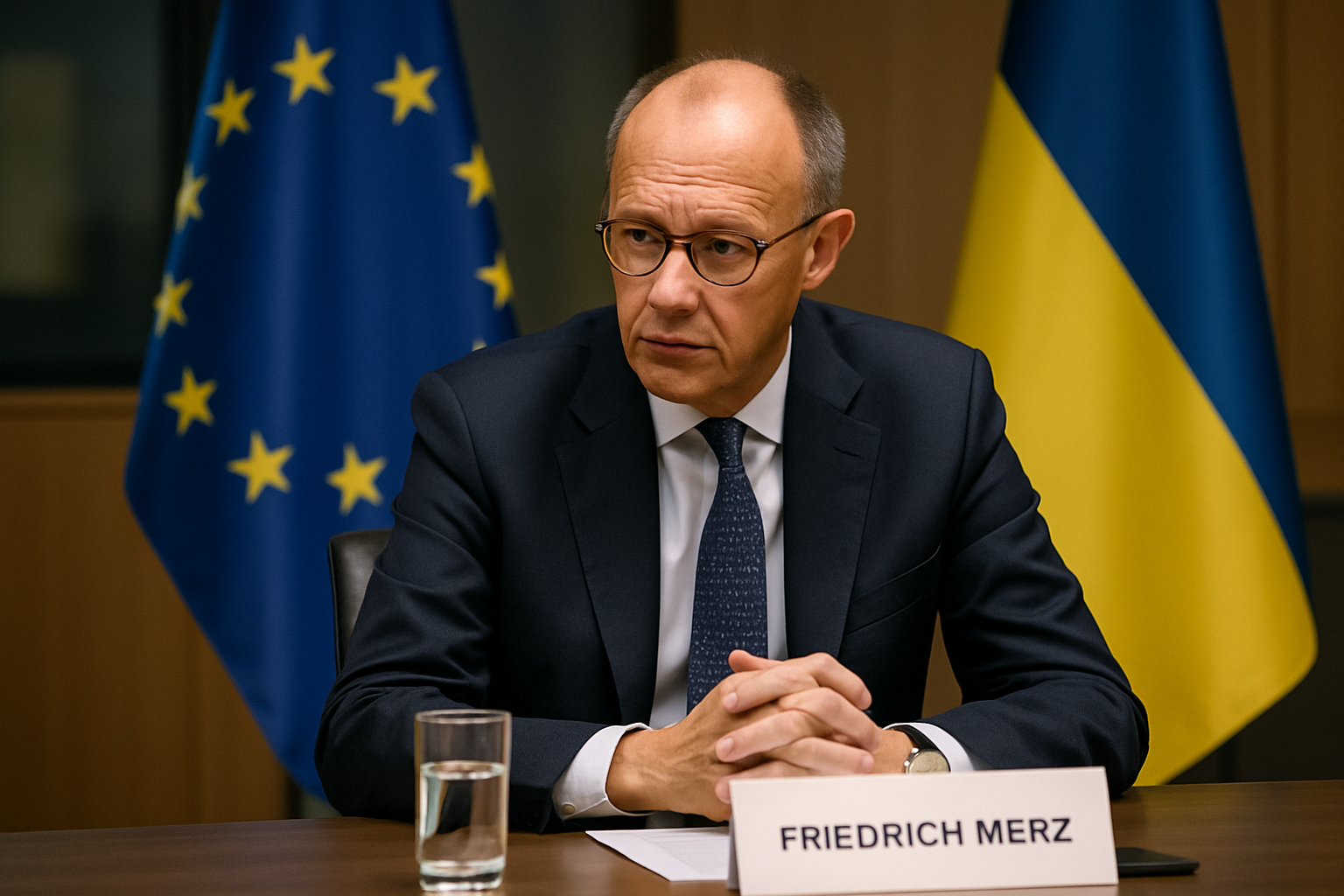
German Chancellor Friedrich Merz has ruled out rapid European Union membership for Ukraine while emphasizing support for deeper cooperation between Brussels and Kyiv, as the bloc grapples with balancing immediate wartime assistance against long-term institutional commitments.
Speaking after an informal EU leaders' meeting in Nicosia, Merz declared that Ukraine's swift accession to the European Union "is not feasible" while stressing the need for enhanced cooperation mechanisms. The German leader's comments come as the EU continues providing unprecedented support to Ukraine through its historic €90 billion loan package, the largest single-nation assistance program in the bloc's history.
Defense Cooperation Takes Priority Over Membership
Merz's position reflects growing European consensus that immediate military and economic support should take precedence over complex institutional enlargement processes. Since his April 2026 Berlin meetings with Ukrainian President Volodymyr Zelensky, Germany has positioned itself as Europe's largest Ukraine aid provider, delivering €55 billion since the invasion began.
The German-Ukrainian partnership has evolved beyond traditional aid relationships toward comprehensive defense cooperation. Their landmark agreements include joint drone production initiatives described as potentially "one of the largest of its kind in Europe," leveraging Ukrainian battlefield expertise with German manufacturing capabilities.
"The Ukrainian defense industry is the most innovative globally through battlefield necessity. We must build on this foundation for European security."
— Friedrich Merz, German Chancellor
Germany currently operates four MRO (Maintenance, Repair, and Operations) facilities in Ukraine servicing Western military equipment, with a fifth facility planned. This represents the first public acknowledgment of extensive military infrastructure on Ukrainian soil, signaling long-term commitment to Ukrainian defensive capabilities.
Estonian Proposal for Russian Goods Taxation
Meanwhile, Estonian Prime Minister Kristen Michal has proposed a novel funding mechanism for Ukraine's post-war reconstruction: levying taxes on Russian imports not subject to existing sanctions. Speaking to POLITICO, Michal argued the European Union should implement this targeted taxation to generate reconstruction funds while maintaining pressure on Moscow.
The Estonian proposal comes as reconstruction cost estimates reach $588 billion according to World Bank assessments, representing one of the largest post-conflict rebuilding challenges since World War II. With systematic infrastructure destruction continuing across Ukraine, innovative funding mechanisms are becoming increasingly critical for long-term recovery planning.
EU Enlargement Challenges and Enhanced Cooperation
Merz's cautious stance on Ukrainian membership reflects broader institutional challenges facing the EU. Traditional enlargement procedures require extensive democratic, judicial, and economic reforms that typically span years or decades. Ukraine's ongoing conflict situation creates unprecedented complexities for standard accession processes.
However, the bloc has shown flexibility through enhanced cooperation mechanisms, allowing willing member states to proceed with deeper integration without requiring unanimous consent. This approach has proven crucial for maintaining Ukrainian support despite opposition from Hungary, Slovakia, and the Czech Republic to certain assistance packages.
European leaders have been exploring "reverse enlargement" models that could provide Ukraine with partial institutional participation before completing traditional reforms, effectively locking Kyiv into European structures during the ongoing conflict.
Strategic Partnership Evolution
Germany's approach reflects lessons learned from previous enlargement experiences while adapting to wartime realities. The formal strategic partnership framework announced during Zelensky's Berlin visit encompasses security, defense, and economic recovery beyond immediate military aid, providing sustainable revenue streams and reducing dependence on non-European defense suppliers.
Joint production of advanced defense systems serves broader European markets while addressing Ukrainian financing gaps through German technological and financial backing. This model could template similar partnerships across Europe, strengthening the continent's defense industrial base.
Nuclear Governance and Security Context
The defense cooperation gains particular significance amid an unprecedented nuclear crisis. The New START Treaty's expiration in February 2026 marked the first time in over 50 years without US-Russian nuclear constraints, with both superpowers controlling 80% of global nuclear weapons.
European conventional defense cooperation becomes increasingly critical as diplomatic channels remain limited and nuclear risks reach their highest levels in decades according to UN Secretary-General António Guterres. The Ukraine-Germany partnership provides a template for European strategic autonomy development amid uncertain alliance relationships.
Implementation Challenges and Opportunities
Successful implementation of deeper EU-Ukraine cooperation faces substantial challenges requiring significant investment, regulatory approvals, and coordination within NATO and EU frameworks. However, success could position the Ukraine-Germany partnership as a leading European defense technology hub, particularly in unmanned systems where Ukrainian battlefield experience provides competitive advantages.
Economic benefits include employment generation and export potential for both nations. The infrastructure investment suggests confidence in Ukrainian long-term defensive capabilities and territorial integrity, providing alternatives to traditional military assistance during stalled peace negotiations.
Broader European Security Architecture
The agreements represent fundamental shifts in European defense relationships toward long-term capability development beyond immediate crisis response. Joint production initiatives could influence broader European defense industrial policy while building strategic autonomy independent of uncertain American guarantees.
As Munich Security Conference assessments declared the "post-war order no longer exists," these bilateral partnerships provide templates for enhanced cooperation when multilateral processes face obstacles. The model offers alternative pathways for capability development that transcend immediate conflicts while contributing to European strategic autonomy in an increasingly complex security environment.
With peace talks suspended indefinitely due to the Iran crisis and territorial disputes remaining unresolved, practical defense cooperation provides Ukraine with tangible security improvements while strengthening European defense capabilities for long-term continental security challenges.