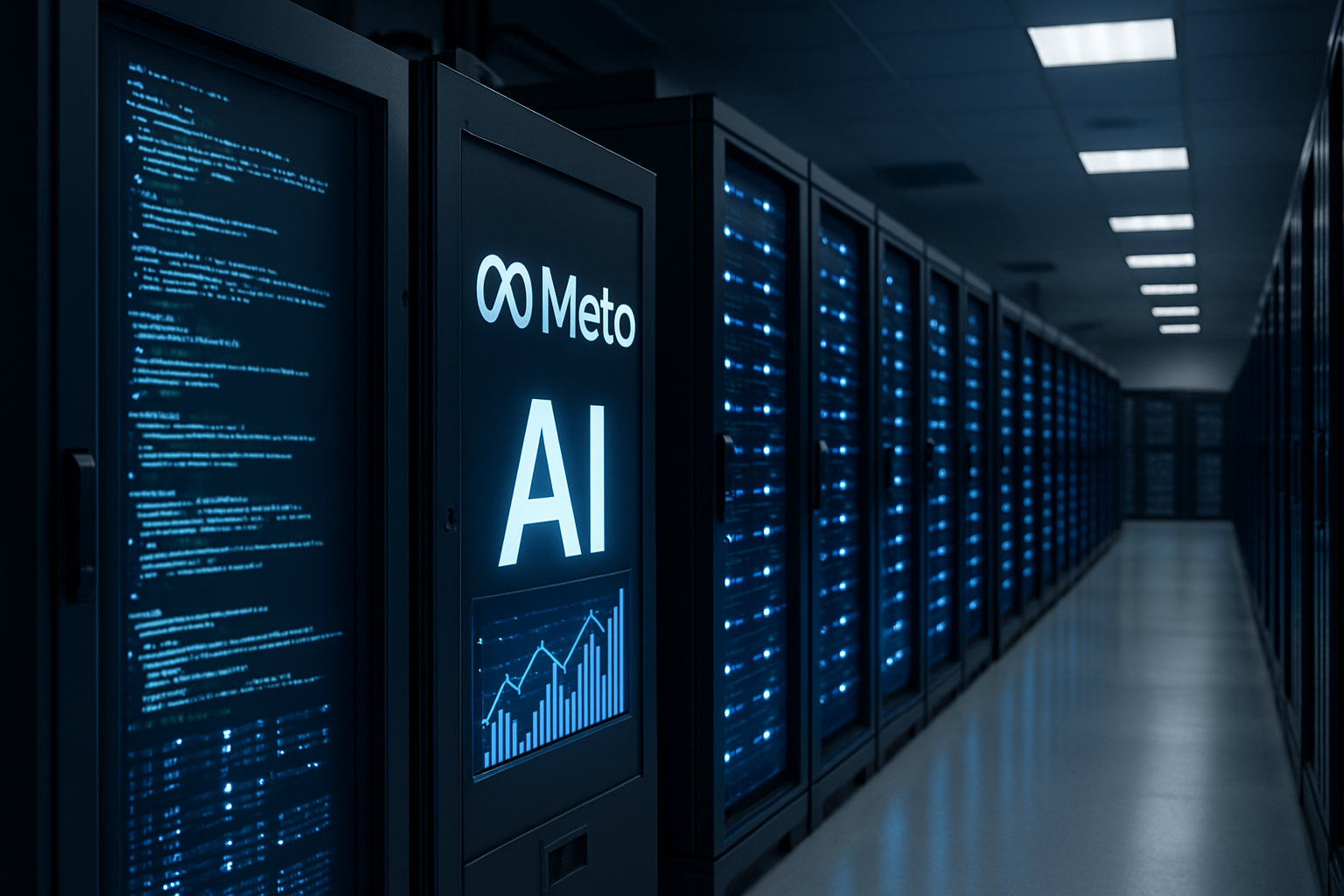
A global surge in artificial intelligence investments reached new heights this week as Meta unveiled its ambitious 'Muse AI' model, Digital Realty announced a massive $5.49 billion expansion in Singapore, and premium smartphone manufacturers doubled down on AI integration as their primary competitive advantage.
The convergence of these developments marks what industry experts are calling a critical "inflection point" in AI technology, where experimental applications transition to essential business infrastructure across multiple sectors simultaneously.
Meta's Strategic AI Breakthrough
Meta launched its groundbreaking artificial intelligence model 'Muse AI' on Wednesday, representing the culmination of the company's multi-billion dollar AI investment strategy. The launch follows months of strategic positioning as the social media giant attempts to compete with OpenAI's ChatGPT and other leading AI platforms.
According to Danish media reports, the Muse AI system demonstrates significant capabilities across multiple domains, positioning Meta as a serious contender in the rapidly evolving AI landscape. The company's investment in AI infrastructure has been substantial, with industry analysts estimating expenditures in the billions to develop and deploy the new system.
This launch occurs during what analysts have termed the "March 2026 Critical Inflection Point," where AI systems transition from experimental features to essential business infrastructure across global technology companies.
Singapore Emerges as Asia-Pacific AI Hub
U.S. data center company Digital Realty announced plans to invest nearly 7 billion Singapore dollars (approximately $5.49 billion USD) in Singapore, highlighting the city-state's growing importance as a hub for artificial intelligence infrastructure in the Asia-Pacific region.
The massive investment underscores Singapore's strategic positioning in the global AI economy, offering companies access to advanced infrastructure, favorable regulatory frameworks, and proximity to key Asian markets. Singapore's government has actively courted AI companies through supportive policies and infrastructure investments.
Digital Realty's commitment represents one of the largest single foreign technology investments in Singapore's history, signaling confidence in the region's long-term potential as an AI development center. The expansion will provide critical infrastructure for companies requiring high-performance computing capabilities for AI training and deployment.
"Singapore's strategic location and supportive environment make it ideal for AI infrastructure deployment across the Asia-Pacific region."
— Digital Realty Representative
Premium Smartphone AI Integration Revolution
The global premium smartphone market has confirmed its decisive shift toward artificial intelligence integration, with AI capabilities becoming the central selling point for major manufacturers in 2026. Apple, Samsung, and Google are engaged in intense competition to capture demanding consumers through AI innovations.
The iPhone 17 Pro Max distinguishes itself through high performance and optimized battery life, consolidating Apple's position in the premium segment. Samsung's Galaxy S26 Ultra has established itself as a photography reference point, while Google continues pushing AI-first features across its Pixel lineup.
This transformation represents a fundamental market shift where AI capabilities determine consumer purchasing decisions more than traditional specifications like processor speed or storage capacity. Premium smartphone manufacturers are treating AI as essential infrastructure rather than optional features.
Global Infrastructure and Investment Context
These developments occur amid ongoing global semiconductor challenges, with memory chip prices experiencing significant increases affecting major manufacturers including Samsung, SK Hynix, and Micron. Despite supply constraints, technology companies continue making unprecedented investments in AI infrastructure.
Major corporations including Alphabet and Amazon have committed hundreds of billions toward AI development, demonstrating industry confidence in the technology's essential role in future business operations. The World Bank projects AI-related energy demand will require 4.2-6.6 billion cubic meters of water annually by 2027 for data center cooling operations.
Industry analysts characterize the current period as a "civilizational choice point" where decisions made in 2026 will determine human-AI relationship patterns for decades. Success requires unprecedented coordination between governments, technology companies, and civil society to balance innovation acceleration with responsible governance frameworks.
Regulatory Landscape and International Cooperation
The rapid AI advancement occurs alongside intensifying global regulatory oversight. Spain has implemented the world's first criminal executive liability framework for technology platforms, while France has conducted cybercrime raids on AI companies. The United Nations has established an Independent Scientific Panel with 40 global experts for comprehensive AI assessment.
This regulatory intensification represents the most sophisticated global technology governance effort since internet commercialization, aimed at preventing regulatory arbitrage while ensuring uniform jurisdiction standards across different markets.
Economic Transformation and Employment Impact
The AI surge is driving what economists call the "SaaSpocalypse" - the elimination of hundreds of billions in traditional software market capitalization as AI systems demonstrate direct replacement capabilities for conventional solutions. However, successful implementations focus on human-AI collaboration rather than wholesale job replacement.
Regional variations in approach are emerging, with Western companies pursuing traditional restructuring strategies while Asian corporations implement comprehensive worker transition programs emphasizing reskilling over displacement. Canadian universities' AI teaching assistants and Malaysia's AI-integrated educational programs demonstrate successful human-centered approaches.
Future Implications
The convergence of Meta's Muse AI launch, Singapore's infrastructure expansion, and smartphone AI integration represents a decisive moment in global technology evolution. These developments suggest AI technology is moving beyond experimental applications to become essential infrastructure across all business sectors.
Success in navigating this transformation requires treating AI as sophisticated amplification tools for human capabilities rather than replacement mechanisms. The most promising path involves preserving creativity, cultural understanding, and ethical reasoning while leveraging computational advantages for enhanced productivity and innovation.
As the window for coordinated international action narrows, decisions made in 2026 will determine whether AI serves humanity's highest aspirations through democratic governance frameworks or creates new forms of inequality and social disruption. The technology industry faces the challenge of ensuring revolutionary advances serve human flourishing while maintaining the distinctly human qualities that artificial intelligence cannot replicate.