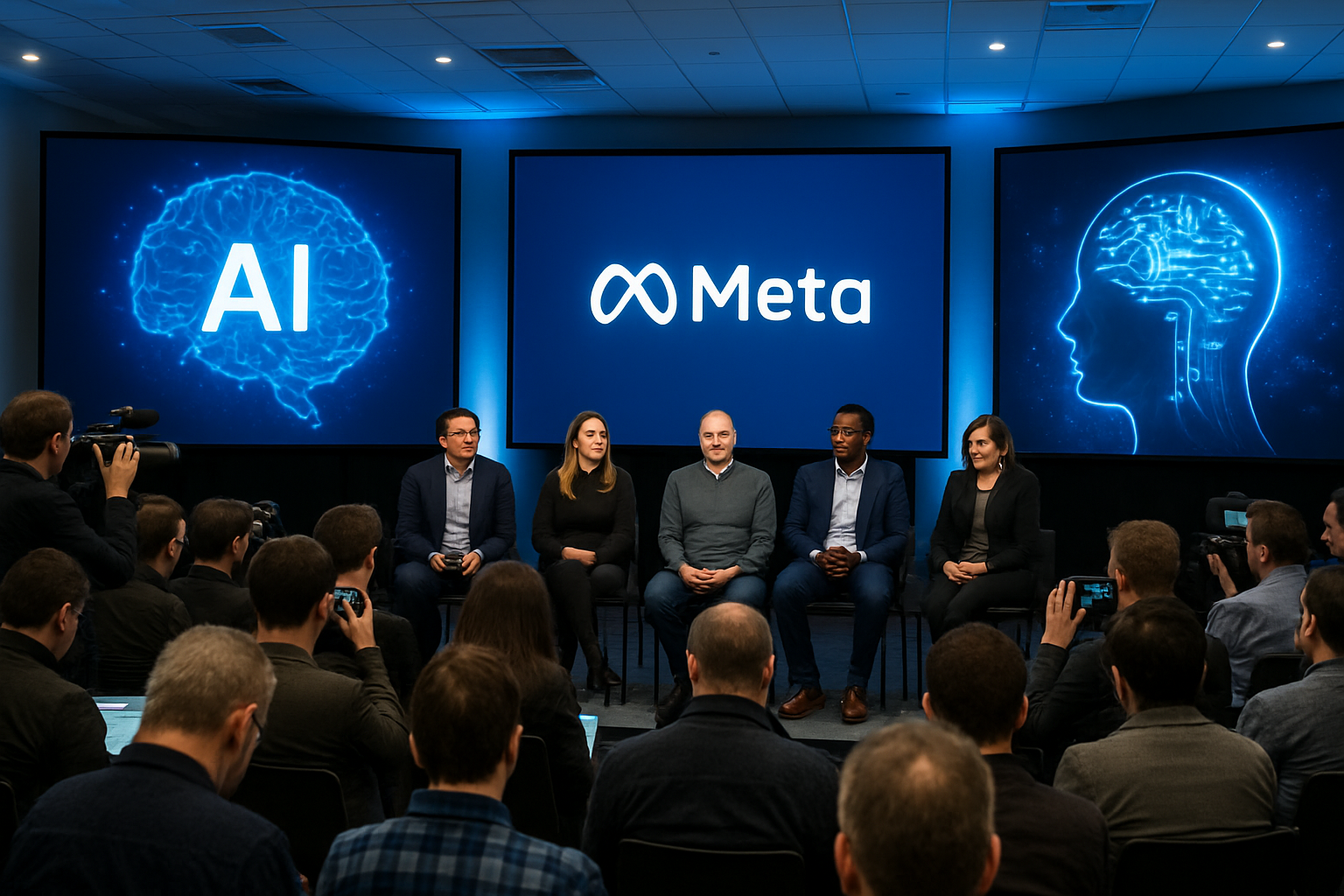
Meta Platforms has officially launched its highly anticipated artificial intelligence model "Spark," representing the culmination of months of multimillion-dollar investments in AI development and positioning the company at the forefront of what industry experts call the "2026 AI inflection point."
CEO Mark Zuckerberg characterized Spark as "particularly strong in areas related to personal superintelligence, visual understanding, health, social content, shopping, gaming and more" during the announcement, highlighting the model's versatility across Meta's diverse platform ecosystem.
Strategic Context and Investment Scale
The Spark launch comes as Meta navigates an intensely competitive AI landscape, with technology giants making unprecedented investments despite global infrastructure constraints. Alphabet has committed $185 billion to AI infrastructure in 2026 alone—the largest single-year corporate tech investment in history—while Amazon has unveiled plans for over $1 trillion in AI development over the coming decade.
Meta's launch occurs during what analysts term the "March 2026 Critical Inflection Point," when artificial intelligence transitions from experimental technology to essential business infrastructure. This shift has triggered the "SaaSpocalypse," eliminating hundreds of billions in traditional software market capitalization as AI systems demonstrate direct replacement capabilities for conventional solutions.
"We're witnessing the most significant transformation in computing since the internet's commercialization. Spark represents Meta's determination to lead this transition rather than follow it."
— Industry Analyst, Technology Research Institute
Technical Capabilities and Applications
Spark's architecture emphasizes practical applications across Meta's platform family, including Facebook, Instagram, WhatsApp, and the company's metaverse initiatives. The model's "personal superintelligence" capabilities suggest sophisticated user behavior analysis and personalized content generation, while its visual understanding components could revolutionize how users interact with multimedia content.
The health applications component positions Meta to compete in the emerging AI healthcare market, where systems are increasingly demonstrating capabilities that match or exceed traditional diagnostic methods. However, the company faces the same challenges documented globally—ensuring AI enhances rather than replaces human medical judgment while maintaining patient safety standards.
Infrastructure Challenges and Innovation
Meta's launch occurs amid a global semiconductor crisis that has driven memory chip prices to surge sixfold, affecting Samsung, SK Hynix, and Micron operations. Supply shortages are expected to persist until 2027 when new fabrication facilities come online. Paradoxically, these constraints have spurred innovation in memory-efficient algorithms and sustainable deployment strategies.
The World Bank projects that AI systems will demand 4.2-6.6 billion cubic meters of water annually by 2027 for data center cooling—equivalent to four to six times Denmark's total water consumption. This has forced companies like Meta to develop more efficient cooling technologies and sustainable infrastructure approaches.
Regulatory Landscape and Governance
Spark's deployment occurs during an unprecedented period of AI regulatory intensification. Spain has implemented the world's first criminal executive liability framework for tech platforms, creating personal legal risks for executives. France has conducted AI cybercrime raids, and the UN has established an Independent Scientific Panel of 40 global experts—the first fully independent international AI assessment body.
Meta faces particular scrutiny following its $375 million penalty in New Mexico for "unconscionable" trade practices that exposed children to sexual exploitation on Facebook and Instagram. Internal documents from 2014-2015 revealed explicit engagement time goals despite knowledge of psychological harm, with whistleblower Arturo Béjar warning that algorithms help predators locate children.
Employment and Workforce Implications
The Spark launch comes as Meta prepares for sweeping layoffs affecting potentially 20% or more of its workforce—tens of thousands of positions—as mounting AI infrastructure costs strain budgets. This follows a pattern across the tech industry, with Block Inc. eliminating 4,000 positions (40% of its workforce) in February 2026, explicitly attributing the cuts to AI advancement rather than financial pressures.
Microsoft's Mustafa Suleyman predicts that AI will replace the majority of office workers within two years, with lawyers and auditors facing replacement within 18 months. However, successful human-AI collaboration models are emerging globally, including Canadian AI teaching assistants that maintain critical thinking standards and Malaysia's world-first AI-integrated Islamic school.
Global Competition and Multipolar AI Development
Meta's Spark launch occurs within an increasingly multipolar AI landscape. Chinese companies have achieved breakthrough capabilities, with DeepSeek's recent service outage affecting hundreds of millions of users worldwide, demonstrating the global dependency on diverse AI infrastructure providers.
European initiatives include Mistral AI's $830 million debt financing for Paris data center expansion and Germany's strategy to double data center facilities by 2030. This distributed development prevents single-entity dominance while enabling culturally sensitive AI approaches that respect local values and regulatory frameworks.
Future Implications and Civilizational Choices
Industry experts characterize April 2026 as a "civilizational choice point" determining whether AI serves human flourishing or becomes an exploitation tool beyond democratic accountability. Meta's Spark model will serve as a critical test case for responsible AI development that enhances human capabilities while preserving creativity, cultural understanding, and ethical reasoning.
The success of Spark and similar AI systems will depend on unprecedented coordination between governments, technology companies, educational institutions, and civil society. The challenge lies in balancing innovation acceleration with safety governance, commercial interests with human welfare, and competitiveness with international cooperation.
Looking Forward
Meta's Spark represents more than a technological advancement—it embodies the company's vision for human-AI collaboration that amplifies human potential rather than replacing it. As the AI revolution accelerates, the decisions made by companies like Meta in 2026 will establish decades-long patterns for human-AI relationships.
The window for proactive adaptation is narrowing rapidly, requiring immediate coordinated responses to ensure AI serves humanity's highest aspirations through democratic governance and human-centered values. Spark's success will ultimately be measured not just by its technical capabilities, but by its contribution to a future where artificial intelligence enhances rather than diminishes human potential.