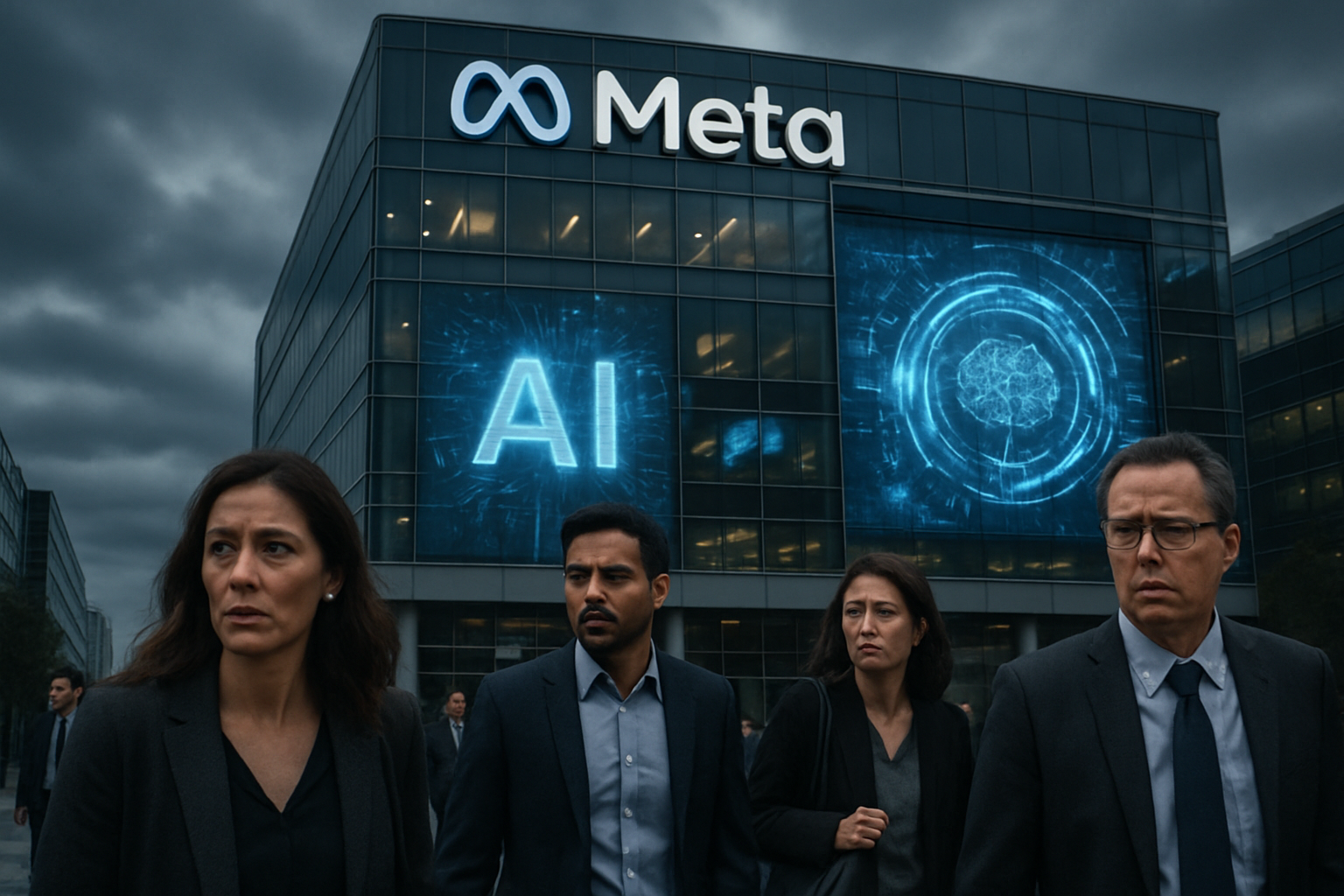
Meta Platforms is planning sweeping layoffs that could affect 20 percent or more of the company, three sources familiar with the matter told Reuters, as the social media giant seeks to offset costly artificial intelligence infrastructure investments and prepare for greater efficiency brought about by AI-assisted workers.
The proposed cuts would represent one of the largest workforce reductions in Meta's corporate history, potentially eliminating tens of thousands of positions as the company grapples with mounting AI development expenses amid a global semiconductor crisis that has driven memory chip prices up sixfold since early 2025.
No specific date has been set for the layoffs and the magnitude has not been finalized, according to sources who spoke anonymously because they were not authorized to discuss the plans. However, top executives have recently signaled the plans to other senior leaders at Meta and told them to begin planning how to pare back operations across multiple divisions.
AI Infrastructure Costs Drive Strategic Restructuring
The planned layoffs come as Meta faces unprecedented pressure from AI infrastructure investments, with industry leaders like Alphabet committing a historic $185 billion to AI development in 2026 and Amazon exceeding $1 trillion in AI-related plans. Meta's own AI infrastructure costs have ballooned as the company races to compete in the artificial intelligence arms race while simultaneously dealing with supply chain constraints that have made essential components exponentially more expensive.
Meta spokesperson Andy Stone responded to questions about the restructuring plan, stating: "This is speculative reporting about theoretical approaches." However, multiple sources confirmed that discussions have been ongoing at the highest levels of the company's leadership structure.
The global memory semiconductor crisis has particularly impacted companies like Meta that require massive computational resources for AI training and deployment. Samsung, SK Hynix, and Micron are operating at full capacity but remain unable to meet explosive AI demand, with shortages expected to persist until new fabrication facilities come online in 2027.
Context of the "SaaSpocalypse" Phenomenon
Meta's restructuring plans occur within what industry analysts have termed the "SaaSpocalypse" - a systematic disruption where AI systems demonstrate direct replacement capabilities rather than merely complementary functions. This phenomenon has eliminated hundreds of billions in traditional software market capitalization throughout early 2026, fundamentally reshaping how technology companies operate.
"AI tools we create and use, combined with smaller, more agile teams, enable a new way of working"
— Jack Dorsey, Block Inc. CEO (February 2026)
The trend began with high-profile layoffs at companies like Block Inc., which eliminated 4,000 positions in February 2026 - representing 40% of its global workforce. Block's CEO Jack Dorsey became the first major tech leader to explicitly cite AI advancement rather than financial pressures as the primary driver for workforce reductions.
Other major casualties include WiseTech Global's announcement of 2,000 job cuts (30% of its workforce) and Atlassian's elimination of 1,600 positions in March 2026. The pattern represents a fundamental shift from traditional cost-cutting measures to AI-driven business transformation across the technology sector.
Global Regulatory Pressure Intensifies
Meta's restructuring decisions come amid intensifying regulatory scrutiny worldwide. Spain has implemented the world's first criminal executive liability framework for social media platforms, creating potential imprisonment risks for tech executives. The European Commission has found TikTok in violation of Digital Services Act requirements for addictive design features, with potential penalties reaching 6% of global revenue.
Mark Zuckerberg faced historic courtroom testimony in Los Angeles regarding Instagram's impact on youth mental health, with internal documents from 2014-2015 revealing engagement optimization strategies. Australia's under-16 social media ban successfully eliminated 4.7 million teen accounts in December 2025, proving that technical implementation of age restrictions is feasible with sufficient government commitment.
The regulatory environment has created additional compliance costs and operational complexity for Meta, further pressuring the company to streamline operations and reduce headcount in non-essential areas.
Regional Variations in Industry Response
While Western technology companies have generally responded to AI disruption with traditional layoffs followed by selective AI-focused hiring, Asian companies have demonstrated alternative approaches. Indian IT giants including Infosys, Wipro, and HCL Technologies have implemented comprehensive worker transition programs rather than mass layoffs, showing that adaptation strategies can prioritize workforce evolution over elimination.
Chinese companies like Unitree Robotics have actually scaled production, increasing humanoid robot manufacturing from 5,500 to 20,000 units, creating employment opportunities even as automation displaces workers elsewhere. This regional variation highlights how policy choices and corporate strategies can determine whether AI-driven change creates or eliminates opportunities.
Successful Human-AI Integration Models
Despite the broader trend toward workforce reduction, several organizations have demonstrated successful human-AI collaboration models that enhance rather than replace human capabilities. Canadian universities have implemented AI teaching assistants while maintaining critical thinking standards. Malaysia operates the world's first AI-integrated Islamic school, combining advanced technology with traditional learning approaches.
Singapore's WonderBot 2.0 heritage education program has shown how AI can enhance cultural education without replacing fundamental human relationships. These examples suggest that the current wave of layoffs may represent a failure to imagine more sophisticated integration strategies rather than an inevitable outcome of AI advancement.
Infrastructure Constraints Create Opportunities
Paradoxically, the global semiconductor shortage that is driving up Meta's AI infrastructure costs may also provide a crucial buffer against rapid AI deployment. The World Bank projects that AI systems will require 4.2-6.6 billion cubic meters of water in 2027 for data center cooling alone - equivalent to four to six times Denmark's annual consumption.
These infrastructure constraints are forcing companies to develop memory-efficient algorithms, hybrid processing solutions, and more thoughtful deployment strategies that maximize capabilities while minimizing hardware requirements. This could create more time for workforce adaptation and retraining programs, though few companies appear to be taking advantage of this window.
Implications for the Technology Sector
Meta's planned layoffs represent a critical test case for how major technology companies will navigate the transition from experimental AI applications to essential business infrastructure. The company's decisions will likely influence industry-wide practices and employment trends, serving as a template for other organizations considering similar AI integration initiatives.
Microsoft's Mustafa Suleyman has predicted that AI could replace the majority of office workers within two years, with lawyers and auditors facing automation within 18 months. These predictions are gaining credibility as companies like Meta move from theoretical discussions to concrete workforce restructuring plans.
The stakes extend far beyond individual companies to fundamental questions about the social contract between technology firms and their workforce, and whether AI development serves human flourishing or primarily advantages capital over labor.
The Path Forward
As March 2026 represents what many analysts describe as a "civilizational choice point" for AI development, Meta's layoff plans will serve as a crucial indicator of whether the technology industry chooses human-AI collaboration or wholesale replacement strategies.
Success in this transformation requires unprecedented coordination between governments, technology companies, educational institutions, and civil society to balance innovation acceleration with safety governance, commercial interests with human welfare, and national competitiveness with international cooperation.
The window for proactive adaptation is narrowing rapidly as AI-driven employment displacement moves from theoretical possibility to documented corporate reality. Whether Meta's approach serves as a cautionary tale or a successful template may well determine the trajectory of human-AI relationships for decades to come.