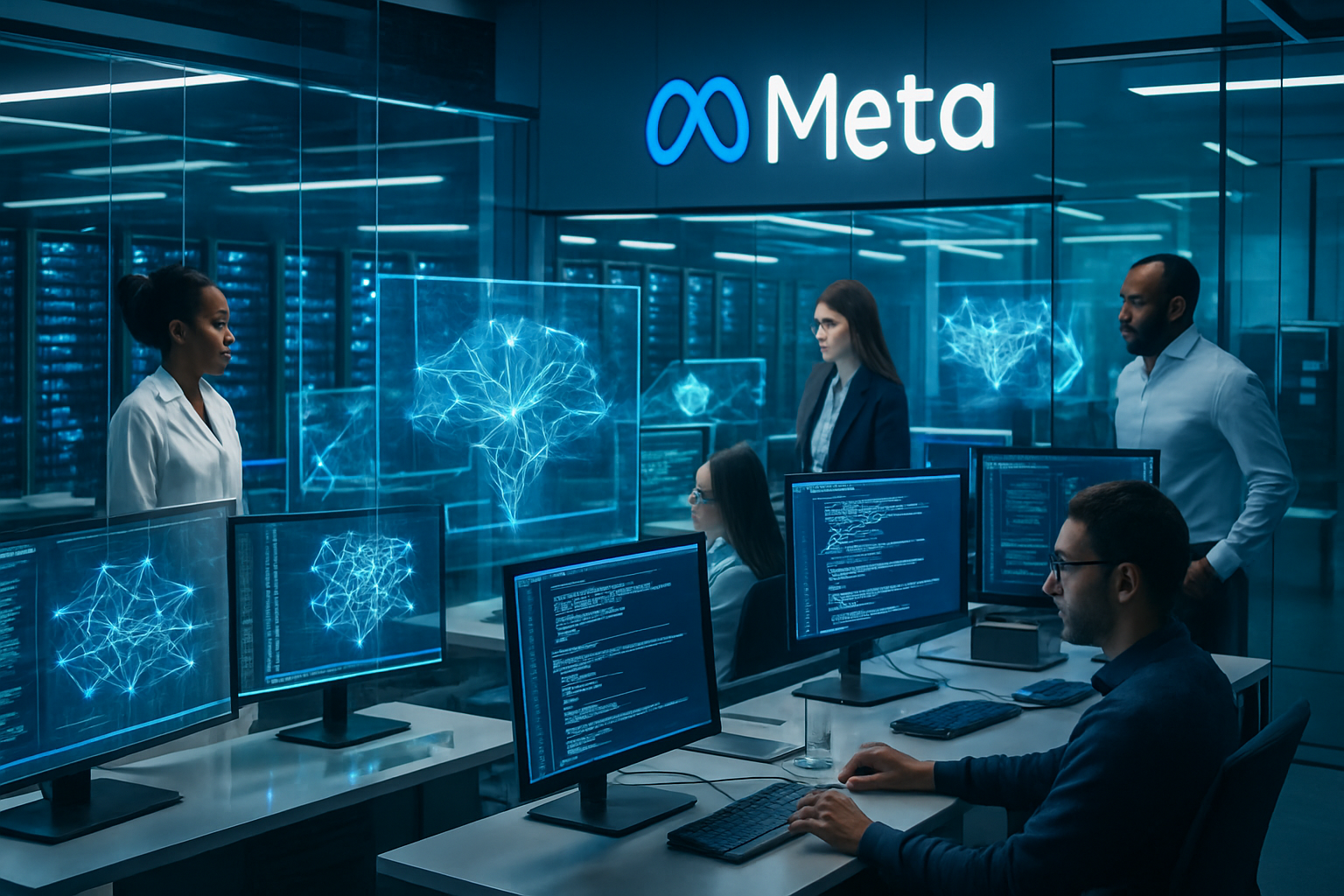
Meta Platforms has released its most advanced artificial intelligence model to date, Muse Spark, positioning the company at the forefront of the global AI arms race as the technology transitions from experimental curiosity to essential business infrastructure in what experts are calling the "2026 AI inflection point."
The release represents Meta's first major AI breakthrough since the company dramatically restructured its Superintelligence Labs division, investing billions in what CEO Mark Zuckerberg has described as the company's most critical strategic pivot. The Muse Spark model is being touted as significantly "smarter and faster" than previous iterations, capable of advanced reasoning across multiple domains including visual understanding, health applications, and social content optimization.
Strategic Positioning Amid Industry Upheaval
The launch comes at a pivotal moment for Meta, which has been navigating unprecedented challenges including potential workforce reductions affecting up to 20% of staff due to mounting AI infrastructure costs. The company faces increasing pressure from global semiconductor shortages that have driven memory chip prices up sixfold, affecting major suppliers Samsung, SK Hynix, and Micron until new fabrication facilities come online in 2027.
According to sources familiar with the development, Meta has invested heavily in computational resources despite these constraints, following industry leaders like Alphabet's record $185 billion AI infrastructure commitment and Amazon's trillion-dollar development plans. The World Bank projects that AI systems will require 4.2-6.6 billion cubic meters of water by 2027 for data center cooling alone—equivalent to four to six times Denmark's annual water consumption.
Competitive Landscape and Global AI Race
Meta's Muse Spark release occurs amid what industry analysts have termed the "SaaSpocalypse"—the systematic elimination of hundreds of billions in traditional software market capitalization as AI systems demonstrate direct replacement capabilities. Chinese competitor DeepSeek has emerged as a formidable challenger to US-dominated AI services, achieving breakthrough capabilities that have triggered massive market disruptions.
"Meta spent billions rebuilding its AI program and finally has something to show for it. Anthropic, meanwhile, has something it's not sure anyone should see."
— Sydney Morning Herald Analysis
The competitive pressure has intensified following several high-profile setbacks for Western AI companies. DeepSeek's recent 12-hour service outage in March demonstrated the global dependency on Chinese AI infrastructure, affecting hundreds of millions of users worldwide and highlighting the multipolar nature of the current AI landscape.
Regulatory Challenges and Governance Concerns
Meta's AI advancement comes amid unprecedented regulatory scrutiny. The company faces potential criminal executive liability under Spain's world-first framework that creates imprisonment risks for tech executives. The European Union has established billion-dollar penalty structures under the Digital Services Act, while France has conducted AI cybercrime raids targeting major technology companies.
The regulatory environment has been further complicated by a controversy involving a Meta employee in the UK who allegedly downloaded approximately 30,000 private Facebook images, currently under investigation by British authorities. This incident has heightened concerns about data security and employee access controls within Meta's vast AI training operations.
The United Nations has established an Independent Scientific Panel of 40 global experts under Secretary-General António Guterres, representing the first fully independent international AI assessment body. This development reflects growing international recognition that AI governance requires unprecedented coordination between governments, technology companies, and civil society.
Technical Capabilities and Innovation
Muse Spark represents a significant leap in Meta's AI capabilities, incorporating what the company describes as "personal superintelligence" features designed to enhance rather than replace human cognitive abilities. The system demonstrates advanced visual understanding capabilities and has been optimized for integration across Meta's platform ecosystem, including Facebook, Instagram, and WhatsApp.
The model's development has benefited from Meta's recent acquisition of AI-focused companies and talent, including the controversial purchase of Moltbook, the world's first AI-only social networking platform. This acquisition has raised questions about AI governance and democratic oversight, as the platform's autonomous AI interactions challenge traditional content moderation approaches.
Global Context and Infrastructure Challenges
The release occurs during what researchers have identified as a critical "civilizational choice point" for artificial intelligence development. Microsoft's Mustafa Suleyman has predicted that AI could replace the majority of office workers within two years, with lawyers and auditors potentially displaced within 18 months.
However, successful integration models have emerged globally, demonstrating human-centered approaches that enhance rather than replace capabilities. Canada has implemented AI teaching assistants in universities while maintaining critical thinking standards, Malaysia operates the world's first AI-integrated Islamic school, and Singapore's WonderBot 2.0 has achieved success in heritage education.
Infrastructure constraints have paradoxically driven innovation toward more memory-efficient algorithms and sustainable deployment strategies, potentially democratizing AI access through constraint-driven development that requires less computational power.
Economic and Strategic Implications
The economic stakes of Meta's AI development extend far beyond the company itself. The current "SaaSpocalypse" has already eliminated hundreds of billions in traditional software market capitalization, with companies like Block Inc. explicitly attributing workforce reductions to AI advancement rather than financial pressures.
Regional variations in response strategies have emerged, with Western companies typically implementing layoffs followed by selective AI hiring, while Asian technology giants have adopted comprehensive worker transition programs. Indian IT companies including Infosys, Wipro, and HCL Technologies have pioneered adaptation strategies that avoid mass displacement.
Looking Forward: The Human-AI Collaboration Model
Meta's Muse Spark represents more than a technological achievement—it embodies a strategic approach to human-AI collaboration that could define the remainder of the decade. The most promising implementations emphasize AI as sophisticated amplification tools that preserve creativity, cultural understanding, and ethical reasoning while leveraging computational advantages.
The success or failure of Meta's approach will likely influence broader industry strategies and regulatory precedents for AI platform governance. As artificial intelligence transitions from experimental to essential infrastructure, the decisions made in 2026 regarding development approaches, workforce management, and international cooperation will establish human-AI relationship patterns that could persist for decades.
The window for effective coordinated action is narrowing rapidly, requiring unprecedented cooperation between governments, technology companies, educational institutions, and civil society to ensure that AI serves human flourishing while preserving the distinctly human qualities—wisdom, empathy, and cultural understanding—that provide meaning to human experience.